Collard-Wrapped Salmon with Winter Roots

I’ve lost track of how much snow has fallen on New York City this winter. This morning’s commute was a sloppy one–and we’re supposed to be getting two more rounds before the week is through. My office has been a comedy of errors since the new year. Today an air conditioning hose burst while workers sanded the outer wall, creating a dusty haze that found me grabbing for my inhaler and sending everyone home early. And so, three hours after arriving at the office, I was slogging back through the slush.

More Snow

I took a different route than usual so that I could swing by Whole Foods to pick up a large can of olive oil. Dreading the wet subway ride home, I roamed the aisles for a bit. The guy behind the fish counter was fervently pushing the wild Alaskan sockeye, which was on sale. My craving was so instantaneous and intense that I have to believe I’m suffering from some sort of deficiency.

I haven’t been eating much fish as of late, in part because last semester’s foray into the world of collapsing fisheries left me a bit freaked. But a quick check of Seafood Watch confirmed that wild sockeye is one of the better choices. I arrived home an hour later, popped the fish into the fridge, changed into pajamas, and spent the afternoon emailing and editing while the snow continued to fall.

By 6:00 I was ready for dinner. I had lots of root vegetables from my CSA share and some collard greens that were already looking a little sad when I bought them a week and half ago. Some of the larger outer leaves seemed salvageable. Wild salmon is much leaner than farmed, containing about half the fat but roughly the same amount of protein. I’ve found that it dries out quickly as a result, so I hatched the notion of wrapping the fish in collards to hold the moisture in during cooking.
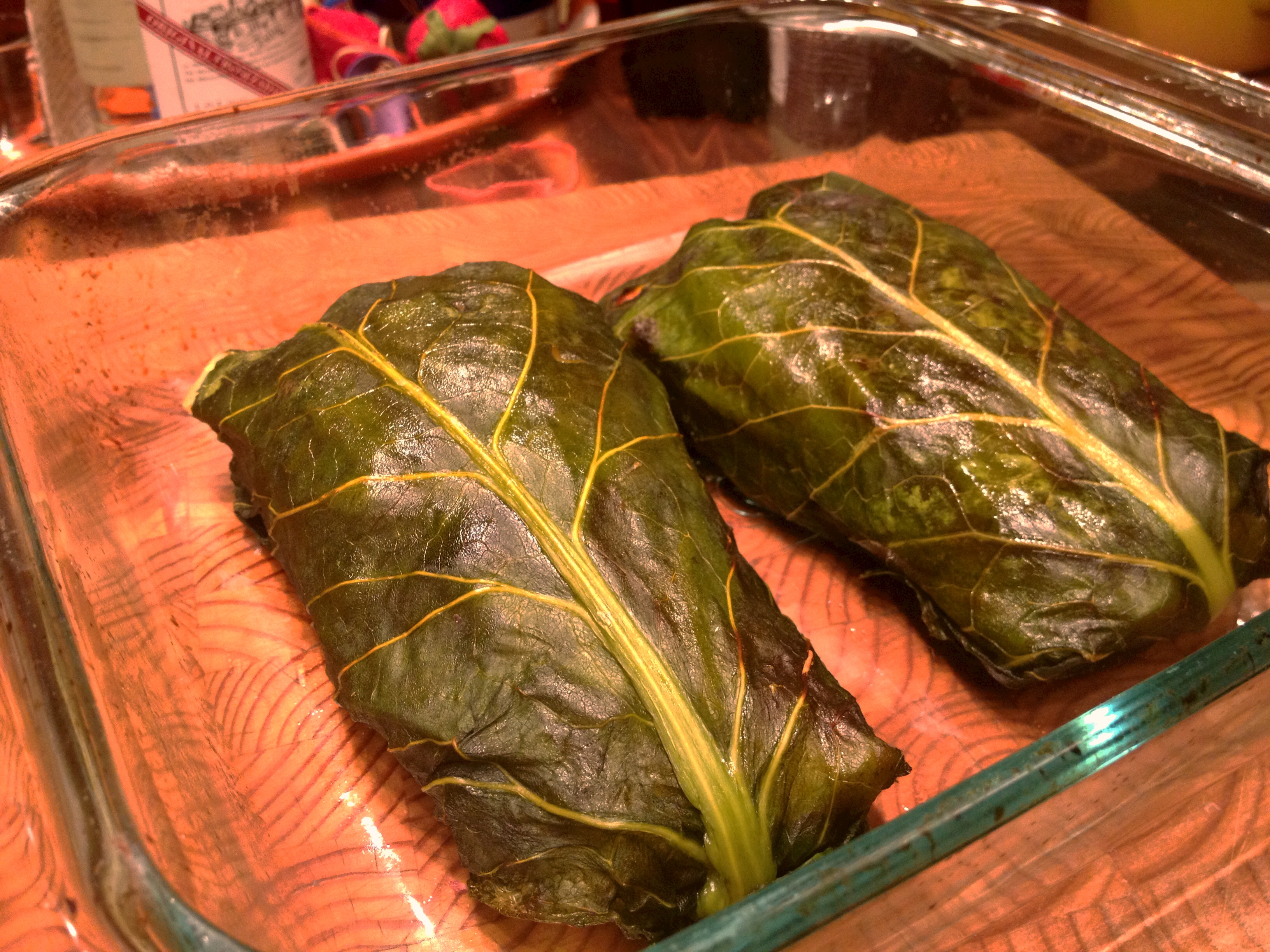
Collard-Wrapped Salmon

Collard-Wrapped Salmon with Winter Roots

  • 2 large collard leaves (or four medium-sized if that’s what you’ve got)
  • 3 tablespoons coconut oil (butter is fine too)
  • 1 medium red onion, sliced pole-to-pole
  • 4 small daikon radishes, cut into large matchsticks
  • 4 small parsnips, cut into large matchsticks
  • 1/2 teaspoon orange zest
  • 2 8-ounce wild sockeye salmon filets
  • salt and pepper (including white pepper if you have it)
  1. Rinse the collards and steam in a lidded pan for 5 minutes or so, adding more water as needed to prevent scorching. You want the leaves to be pliable and dark green. Remove from the pan and spread out to dry.
  2. Rinse out the pan, add 2 tablespoons of coconut oil and bring up to medium-low heat. Add the red onion and sauté until it starts to brown around the edges. Add the parsnips and daikon radishes along with 1/4 cup water and pop the lid back on. When the vegetables have started to soften, remove the lid and cook off the water, allowing things to caramelize. Sprinkle with zest, salt and pepper. (I find that white pepper really complements the sweetness of parsnips, but it’s all good.) Remove to a plate or, if your pan is big enough, just slide them to the side.
  3. Rinse and dry your salmon, sprinkling both sides with salt and pepper (black in this case). If your collard leaves are small, slice each filet in half lengthwise. Add 1 tablespoon of coconut oil to the pan, still over medium-low heat, and cook the salmon for two minutes per side, starting with the skin down if you’ve got it.
  4. Spread the collard greens on your work surface and spoon half of the vegetable mixture into the center. Top with the salmon, skin side up. Fold the sides, top and bottom of the collards over the salmon as you would a burrito. Flip and place gently into a baking dish lightly greased with coconut oil.
  5. Bake in a 350-degree oven for 10 minutes and serve immediately.

Collard-Wrapped Salmon 2

This recipe makes enough for two hungry people, so scale up or down accordingly. You could easily swap in different vegetables–leeks, fennel, potatoes, carrots, etc.–based on what you have on hand.

The Art of Assembly

This time of year one’s cooking skills are a bit of a fifth wheel. The produce is so varied and abundant that the real challenge is narrowing it all down to a single meal. From there, it’s mere assembly.

I’m hosting a fancy fundraiser in the Hamptons next weekend, which necessitated a midweek trip to Sagaponack. Turns out that the drive out isn’t so bad if you hit the road at 10:00pm on a Tuesday. By midnight I was in bed munching the last of my blueberries and perusing a magazine.

The next morning was a flurry of espresso and emails. I knocked off in time to hit the amazing Breadzilla for lunch before my noon meeting. In my experience, the Hamptons is rife with overpriced and lackluster food. But I happily forked over $16.50 for the best lobster roll of my life, which I ate on a bench in the adjacent garden. I also picked up a baguette, assuming it would play a roll in the evening’s dinner.

The afternoon was back-to-back meetings. I selected flatware and linens, discussed the logistics of transporting a baby grand piano, and wandered around Wölffer Estate Vineyard with a tape measure while vacationers enjoyed wine flights. I did manage to squeeze in a stop at a farm stand, picking up Italian eggplant, zucchini, young shallots with the green shoots still attached, basil, and some unimaginably sweet small yellow tomatoes. I was saved from buying even more by their cash-only policy. This is what I could get for the $16.50 in my wallet.

Veggies

I got a bit lost trying to take the back roads home, but was rewarded when I passed a fish shop selling all sorts of local delights. Mercifully, they took credit cards, so I was able to pick up a pound of wild sea scallops, a couple of balls of burrata, and a lemon for good measure. I still didn’t know what I was going to make, but it would be hard to go wrong with these ingredients.

The day was a hot one and my last meeting had been on an unshaded terrace. I got back to the house where I was staying around 5:00 and rewarded myself with a dip in the pool.

Another hour of furious emailing and it was off to collect my dear friend Louis at the train station. On the way home, we picked up the two final ingredients for our evening meal: rosé and rosé. We made short work of the first bottle, a Côtes de Provence, while gabbing poolside as the sun set.

Sunset

Time to uncork the next bottle and start assembling dinner. I cut the shallots in half, leaving the green ends intact, and tossed them with olive oil, salt and pepper. The scallops got the same treatment, minus the slicing. (Had I been able to locate a grater of some sort, they would have gotten some lemon zest too.) I cut the eggplant and zucchini on the diagonal and added fish sauce and tamari to my simple marinade.

While I fired up the grill, Louis got busy halving the tomatoes, chiffonading a bunch of basil, and pouring another round of wine. Once they were ready, I arranged the grilled veggies and scallops in stripes alongside the tomatoes and burrata, which I tore into hunks. The whole platter got a drizzle of olive oil and balsamic vinegar and some fresh cracked pepper.

This being a casual and intimate meal, we dined at the kitchen table, each armed with a soup spoon to ladle things onto our plate, a lemon wedge to dress our meal, and a baguette hunk to sop up the juices.

Summer DinnerThe evening concluded with a midnight swim.

The next morning found us back at the kitchen table, where we worked until lunchtime. Then it was off to Breadzilla, where Louis enjoyed the lobster roll while I moved on to the delightful shrimp salad. In the afternoon, I downed an espresso and swam laps, which was a shockingly pleasing combination. A few more hours of work and it was time to bid the pool adieu and head back to the city. But first, one more farm stand…

Louis Melons

Jasmine Melons

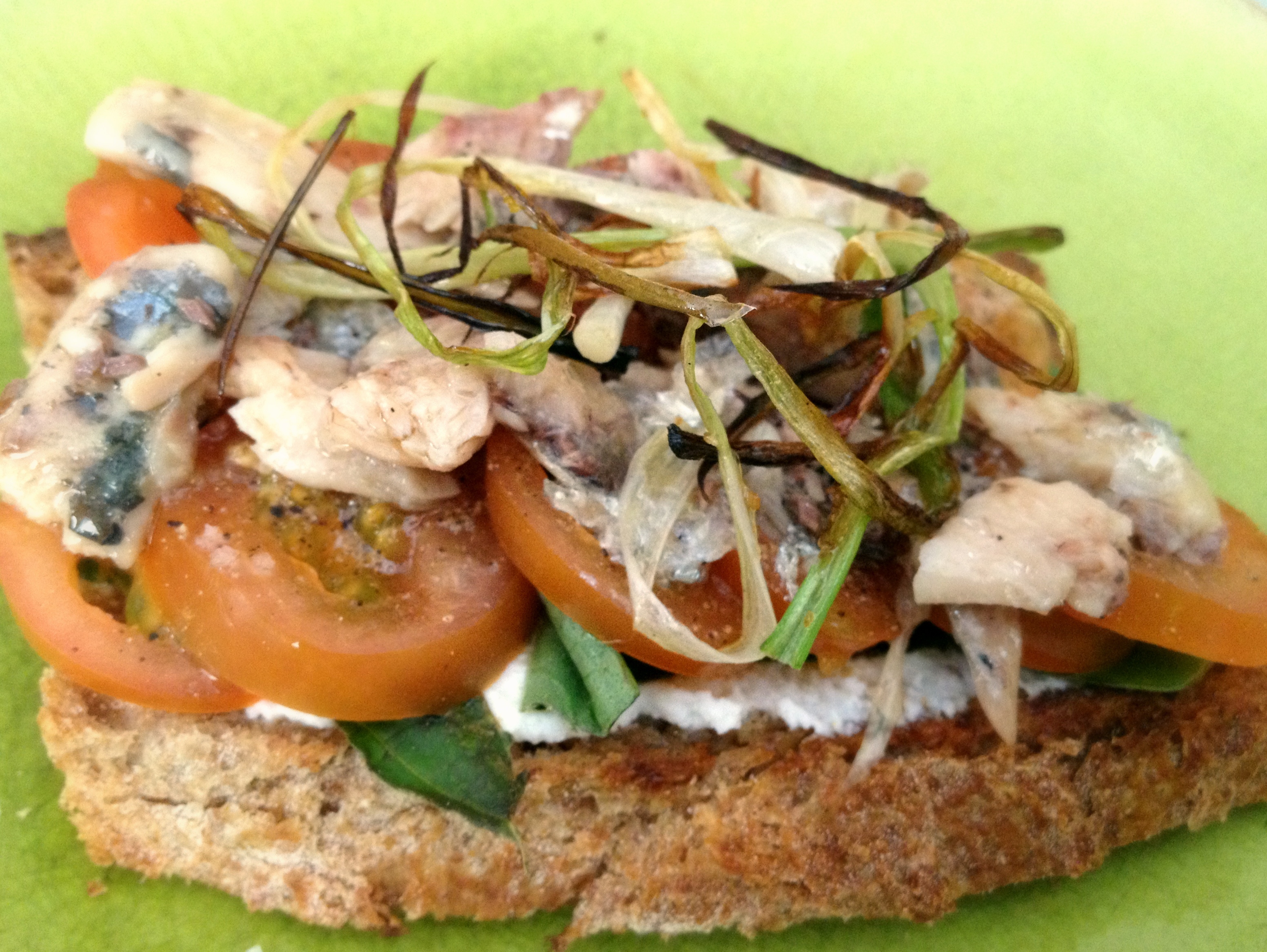
Sardines and Greens

Kindly neighbors collected my CSA share on Tuesday. A bag full of fresh produce on your doorstep is a welcome sight after a 13-hour workday, but it was all I could do to shove the vegetables into the refrigerator alongside the remnants of last week’s haul. Tonight’s meeting was canceled, leaving me with a single, glorious unscheduled evening. I got home from class around 8:00, eager for some home cooking. The broccoli rabe and kale from last week were looking a little worse for the wear but still edible–as were the greens that topped this week’s turnips. Now for some protein. I unearthed a can of Portuguese sardines in olive oil from the cupboard. I could work with this.

Sardines and Greens

  1. Bring a large cast iron skillet up to medium heat. Open a can of sardines and drain the olive oil into your skillet. It will start to sizzle as the water cooks out of the oil.
  2. Once this has subsided, add a few cloves of thinly sliced garlic and a big pinch of red pepper flakes. Cook until the garlic slices turn a nutty brown. Add the sardines, mashing with a wooden spoon until you have a coarse paste.
  3. Rinse and roughly chop a big pile of dark leafy greens. I used the aforementioned kale, broccoli rabe and turnip greens, but pretty much any hefty greens will do. Add these to the pan, stirring between batches to wilt them and make room for more. (If any of the greens have thick stalks, be sure to add these first so that they have a little more time to cook.) Keep stirring.
  4. When the greens looks ready, add salt, pepper, the zest of half a lemon and some chopped parsley if you have it. Pile the greens in a bowl and squeeze fresh lemon juice over the top. 

I bet this would be tasty as a sauce for whole wheat pasta with toasted breadcrumbs sprinkled on top, but I opted for a scattering of ricotta salata, a Brooklyn Lager and an old Law and Order episode. It’s been a long week.

The Kale Caesar Cure

That last margarita was definitely not necessary. I awoke this morning to a trail of clothes leading from the front door to the kitchen, where I had stopped off to grab a glass of water before planting my face in a pillow. Note that I did not actually drink the water, despite the advice of the drag queen in house slippers who read our palms on a dimly lit street corner somewhere in the West Village. But that’s another story.

Something healthy and restorative was in order.

Image

Kale Caesar

  1. Heat a cast iron skillet to medium-low with half a tablespoon of butter and a thinly sliced garlic glove.
  2. Cube a slice or two of stale bread. (I had some sourdough rye on hand.) Add the pieces to the skillet, stirring to coat. Add some salt and pepper, turn the heat down to low and stir occasionally while you continue your preparations. If you have not figured it out yet, the goal here is quick croutons.
  3. Hard boil an egg. Put an egg in a small saucepan, add water to cover and place over high heat. When the water comes to a boil, wait a minute or two, then turn off the heat and let the hot water continue cooking your egg for about ten minutes. Drain the water and cool the egg quickly by adding a couple of rounds of cold water and maybe even some ice. (This helps ward off that greenish gray ring that screams Continental breakfast at a crappy chain hotel the morning after your friends’ wedding.)
  4. Toss the following ingredients into a food processor or mash together with the back of a fork: 3 anchovies (I used sardines because I had an open tin), juice of 1 lemon, 1/2 tablespoon Dijon mustard, 1/2 tablespoon mayonnaise, 1 clove garlic, pinch of cayenne, pinch of sugar, black pepper.
  5. Rinse and finely shred your kale. I went with some young lacinato, which is also known as dinosaur kale, that I got in last week’s CSA share.
  6. Add the kale, dressing, croutons, some grated parmesan or romano cheese, and a pinch of smoked sea salt if you’ve got it. Toss the salad and add your peeled, sliced egg.

This plus an iced coffee and I am feeling a good bit better. Now if I can just figure out how to get the remaining glitter off of my eyelids before this afternoon’s babysitting gig.

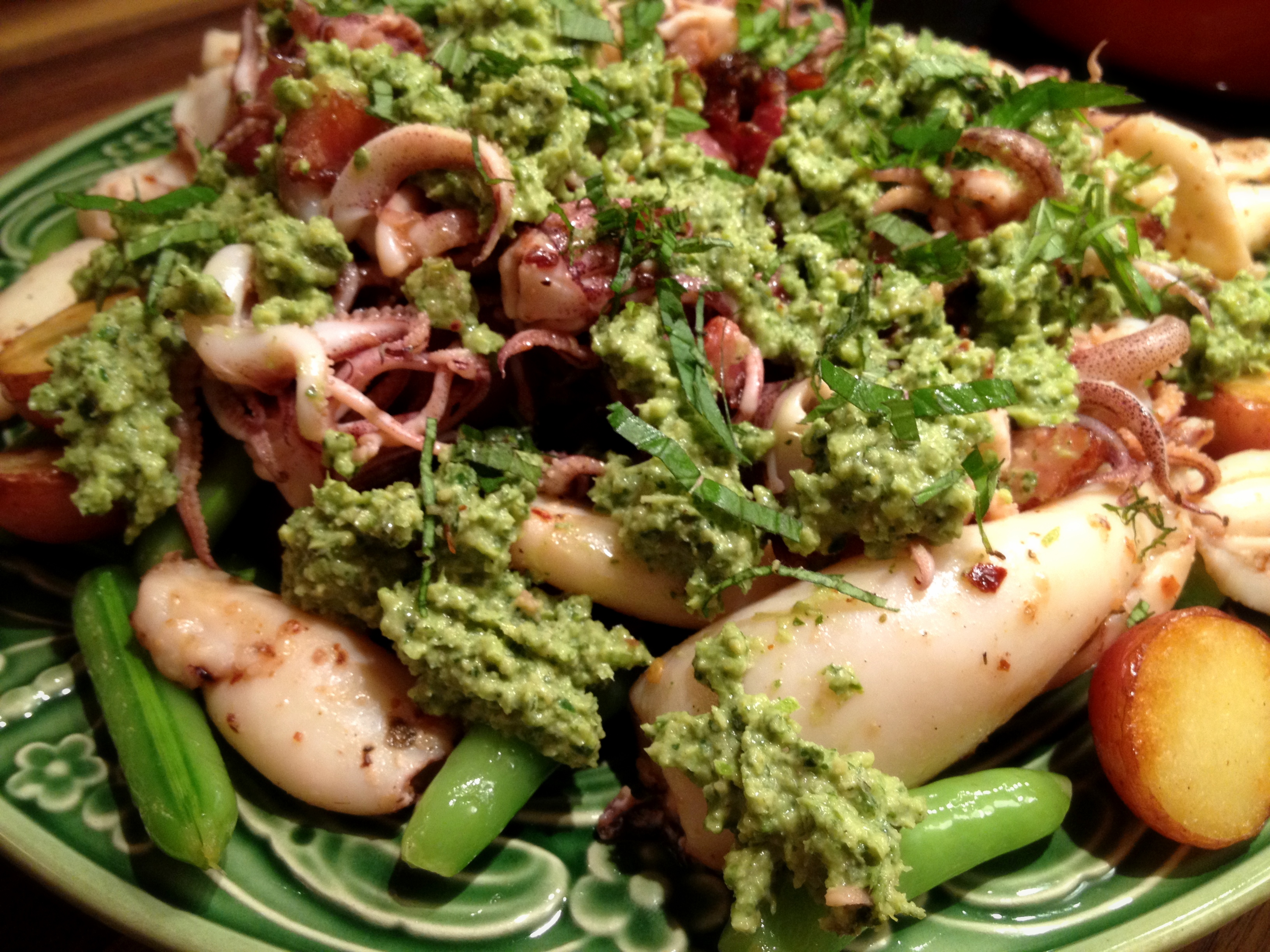
Scapes and Squid

I’ve been traveling a lot, but this weekend was all about Brooklyn. Prospect Heights, Crown Heights, Park Slope, Clinton Hill, Williamsburg, Bushwick, Boerum Hill, Sunset Park and a 24-hour diner in Bay Ridge were all on the agenda. My friend Dana and her girlfriend Kathleen were coming for dinner on Sunday, so I swung by the Grand Army Plaza Greenmarket. It was, indeed, quite green. I came home with three kinds of kale, mint, chives, baby red jacket potatoes, radishes, sugar snap peas, and garlic scapes. (I also bought squid, hot turkey sausage and slab bacon, but had a tough time working them into this composition.)

Image

I was first lured into buying scapes a few years ago; something about their sinuous curves proved irresistible. A scape is a stem that shoots up from the garlic bulb and produces a small flower. Farmers trim them so that their garlic bulbs will continue to grow. They’re similar to garlic in flavor, but not as sharp. Scapes are tasty cooked, but I think they really shine when eaten raw. Here’s just one in an endless number of riffs on scape pesto. (Note that it freezes beautifully.)

Scape Pesto

  • 6 garlic scapes, ends and tips removed
  • 1/3 cup marcona almonds (you could use regular almonds, walnuts, pine nuts, etc., though I would recommend lightly toasting them first)
  • zest and juice of one lemon
  • 3 tablespoons olive oil (good quality, because this isn’t going to be cooked)
  • 30-40 fresh mint leaves (this could be basil, parsley, cilantro, etc.)
  • salt and fresh-ground black pepper (to taste)
  • pinch of sugar (if needed)

Blend the first five ingredients in a food processor, adding water a little at a time  to loosen the mixture enough that it becomes a rough paste. (You could also just add more olive oil, but we’ve got bacon and butter coming further down the page.) Add salt, pepper and, if needed, a pinch of sugar to taste.

I’d texted Dana from the greenmarket to confirm that she eats squid. Her reply came just as I walked in the door: “I eat squid, but am not the hugest fan ever.” The pressure was on. I didn’t really have a plan, but had gotten it in my head that I wanted to make a single dish that married the scapes, squid, potatoes and sugar snap peas into a sort of warm composed salad.

Image

A lot of people find the prospect of cooking squid intimidating, but it’s easy. The key is to cook it very quickly (grilled, fried, boiled or sautéed) or to cook it very slowly (in a traditional Italian red sauce or a fisherman’s stew perhaps). Anything in between yields the rubbery texture of late-night diner calamari.

Scapes and Squid

  • 3 cloves pressed garlic
  • 2 tablespoons olive oil
  • 1 tablespoon red wine vinegar
  • pinch each of dried oregano, Aleppo pepper and red pepper flakes
  • smoked sea salt and fresh-ground black pepper
  • 1.5 pounds cleaned squid

Combine all ingredients and let sit for at least one hour and up to six hours.

  • 1 batch scape pesto (see above)
  • 15-20 small red potatoes, cut in half
  • 3 cups sugar snap peas, strings removed
  • 3 ounces slab bacon (or other smoked fatty pork product)
  • 1 preserved lemon (a regular lemon would also work), flesh removed and rind sliced into slivers
  • 1 tablespoon butter
  • 8-12 fresh mint leaves

While the squid marinates, slice the potatoes and parboil them in salted water until they are just fork tender. Removed the strings from the sugar snap peas and blanch them in the salted water for just a couple of minutes, taking care to cool them down quickly so that they stay crisp and bright green.

At this point, you can knock off and enjoy a glass or two of a nice crisp white wine or a rose until just before you’re ready to eat.

Cut the bacon into small pieces (you may recognize these as lardon) and render them in a cast iron skillet over medium heat.

Meanwhile, in a second pan, melt the butter with the preserved lemon rind over medium heat. When it has stopped foaming, add the potatoes, cut side down.

When the bacon is starting to crisp but is still meaty, push the pieces to the edge of the pan and add as many of the squid bodies as will fit in a single layer. Cook until the squid turns an opaque white on the bottom and then flip. When the other side turns white, pile them at the edge of the pan and add another layer, repeating the process until all of the squid is cooked.

When the potatoes have browned, add the sugar snap peas and stir until they are just heated through.

Spoon the potatoes and peas onto a platter and then add the bacon and squid as well as any juices left in the pan. Drizzle the whole thing with scape pesto and top with some thinly sliced mint leaves.

Dana, the squid skeptic, went back for thirds.

Image

Gumbo in 10 (or So) Easy Steps

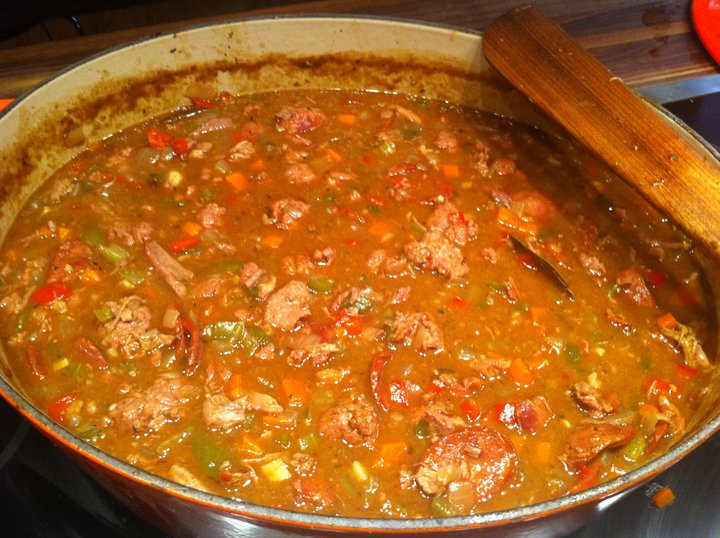
I made gumbo for the third time on Friday and was pleased to see that, once you have the basic concepts down, there are an endless number of ways to riff on this tasty one-pot dish. Pictured here is Friday’s creation, which featured bacon, smoked Louisiana sausage, Maine shrimp tails, okra and mustard greens (these first three ingredients being just a sampling of the proteins lurking in my cramped freezer). Some might consider the mustard greens to be heresy, but I thought that they made for some nice flavor and texture contrast.

What follows is a step-by-step documentation of my very first gumbo. By following these steps, you can make a delicious gumbo using whatever meats, seafood, stock and produce you have on hand. It’s a great way to clean out the freezer.

STEP 1  –  Gather a bunch of meat and brown it in batches in a nice big heavy-bottomed pot. In this case, we have duck breast, andouille sausage, kielbasa and smoked hog jowl.

STEP 2  –  While you’re browning the meat, dice your veggies. Celery, onion and green pepper (“the holy trinity” of Cajun cooking) are traditional. Carrot, red bell pepper and garlic are nice additions. You can also add jalapenos or other hot chile peppers, if you’re into that kind of thing.

STEP 3  –  Transfer browned meat to an even bigger heavy-bottomed pot, add liquid and begin to simmer. An odd beer, some leftover red wine, clam juice and homemade stock from last Thanksgiving’s turkey carcass are just fine. (In the case of the shrimp gumbo pictured above, I used the shrimp shells along with some garlic, celery, carrot, a bay leave and whole black peppercorns to make a quick stock. You could also use a ham hock, which is a great thing to keep stashed in the freezer for soup and stew emergencies.)

STEP 4  –  Now it’s time to make the roux. Add approximately as much flour as you have rendered fat from browning all of that meat and start whisking. If you’re low on fat, you can supplement with whatever hard fat you have on hand – butter, schmaltz, lard, vegetable shortening, etc. A cup of fat and a cup of flour will do you right for one large pot of gumbo.

STEP 5  –  Keep whisking. I recommend NPR podcasts to keep you company.

STEP 6 – Now would be a good time to crack open a beer. But don’t stop whisking. The key is not to let it burn.

STEP 7  –  When you can’t stand to whisk any more, you’ve got your roux. If you taste it, it will not be yummy. Do not be scared.

STEP 8  –  Add your chopped vegetables into the roux and stir frequently until they start to soften. Toss in some herbs. Fresh or dried thyme, oregano and basil are all welcome. Cayenne, paprika and other dried chiles can also be added. Then dump it all, plus some bay leaves into the really big pot with the simmering meat.

STEP 9  –  Let is simmer and simmer and simmer. At some point, you’ll want to pull any large hunks of meat out and shred them. Maybe turn the burner off, lid the pot and take a nice bike ride. While you’re out, pick up some really cheap french bread to serve with the finished product. It’s traditional.

STEP 10  –  Fire the burner back up and keep simmering. Taste and adjust seasoning with salt, pepper, whatever hot sauces you have in the fridge, maybe a little more wine, some vinegar, etc. Make a batch of Sazeracs. Make another batch. Make some long-grain white rice. Add some okra, some chopped up oysters, some parsley and anything else your heart desires. Have some more Sazeracs. Just don’t get so drunk that you forget to take a picture of the finished product. Oops.