(Not So) Fat Tuesday

Today is Mardi Gras. While my heart is in New Orleans, my stomach and my workload call for something a little more austere. I got home around 8:00pm after a long day of work followed by school, By 8:30, I was sitting down to a healthy, tasty meal and a couple of episodes of Treme.

Mardi Gras Mask The Drunken Fig in more celebratory times

Vegan Smothered Cabbage

  1. Crack open a good quality dark beer. Bring 2 tablespoons of olive oil up to medium heat in a large cast iron skillet. Add a medium red onion sliced poll to poll and cook until starting to brown. Add a good pinch of red pepper flakes.
  2. Stir in one thinly-sliced tofurky andouille sausage (or, if you’re looking for something a little more indulgent, go for the pork) and cook until it begins to crisp. Then add half a head of green cabbage, shredded as if you were making a slaw, along with a healthy dose of salt and pepper
  3. When the cabbage is wilted but still a bit crisp, add as much beer as you’re willing to sacrifice to deglaze your pan. Cook for another minute or two and then empty the contents of your pan into a low bowl. Serve with Zatarain’s Creole Mustard. (In a pinch, you could substitute any nice whole grain mustard.)

Vegan Smothered Cabbage

Lowcountry Vegan

I am neither a South Carolinian nor a vegan.

Monday morning I received an email from an acquaintance who had accidentally purchased an eighth of a cow and was looking for people to split it with given her limited freezer space. The cow in question came from Grimaldi Farms, a grass-fed, free-range, organic farm in the Hudson Valley. How could I say no?

Seven hours later, Marissa and I met up for a drink and a cash-for-cow exchange. My $50 bought me a whole lot of meat. Three pounds of ground beef and a giant hunk of bone went into the freezer for a future use. Last night I tried my hand at beef liver–a dish I’d never actually eaten before. I soaked the liver in milk and pan-fried it with a light dusting of flour mixed with salt and pepper. Oumar and I ate it with a red onion jam, arugula in a lemon dressing and pillowy egg tagliardi with a pan sauce that included butter, garlic, shiitake mushrooms, parsley and lemon zest.

This was good stuff, to be sure. But a rich, restaurant-style dinner (and, possibly, the after-dinner bourbon) took its toll. I have 24 hours to regain my strength. My cow share also included half of a five-pound top round roast. Rather than divvy it up, we decided to have dinner together. Tomorrow night Maureen, Kevin, Sara and I will be tucking into pot roast.

So tonight it’s a lowcountry vegan meal for me.

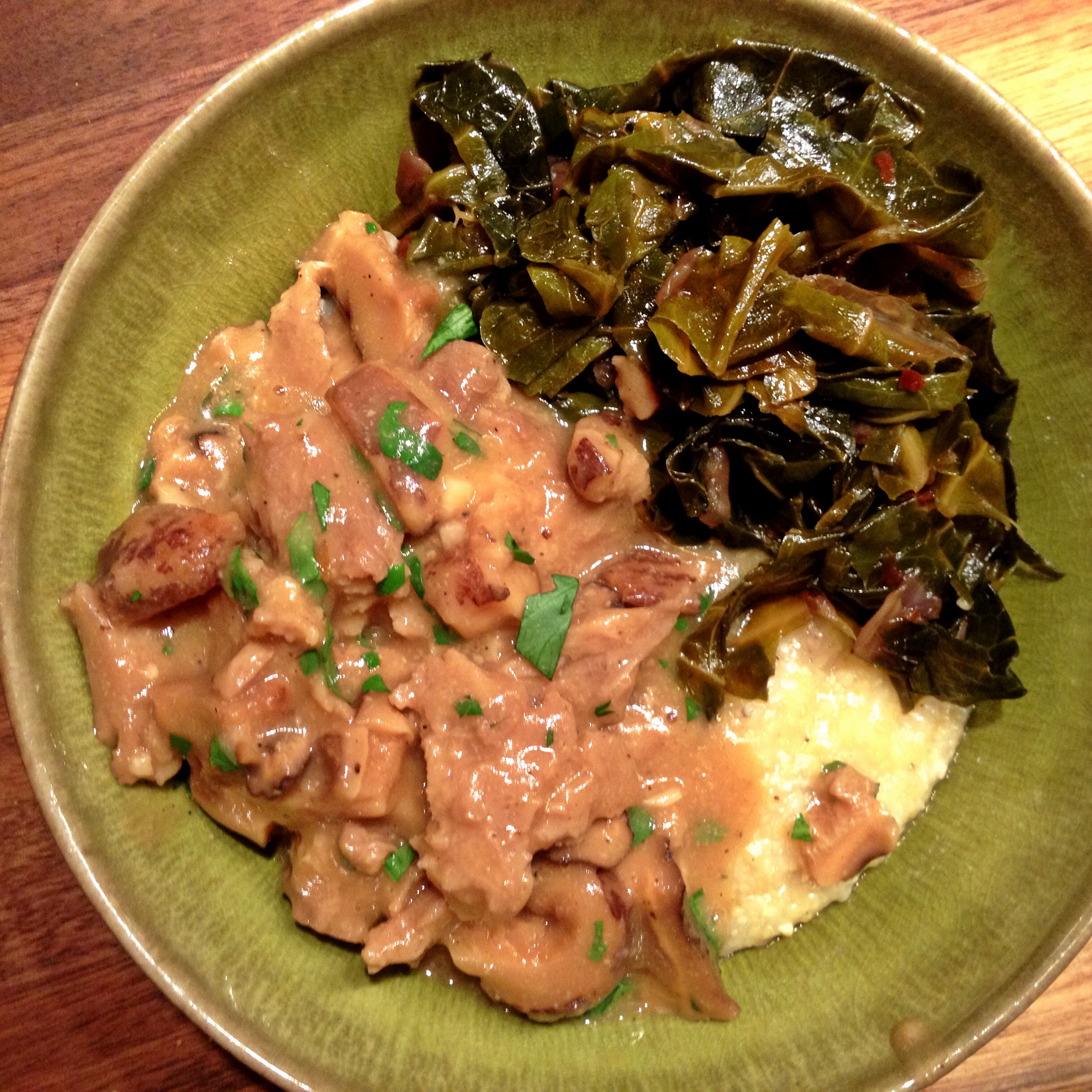
Grits with Shiitake-Seitan Gravy and Braised Collards

  • 1/2 cup grits
  • 1 tablespoon olive oil
  • 1/2 red onion, thinly sliced
  • 3 cloves garlic, 2 thinly sliced and 1 minced
  • 1 pinch red pepper flakes
  • 1 bunch collard greens, stems removed and leaves sliced
  • smoked salt
  • 4 dried shiitake mushrooms
  • 1 tablespoon coconut oil
  • 1 tablespoon flour
  • hot sauce
  • 1 tablespoon nutritional yeast (While not necessary, this will really boost the flavor. And it makes a great popcorn topping.)
  • 1 package (8 ounces) seitan, torn into small pieces
  • 2 tablespoons minced flat leaf parsley
  • salt and pepper
  1. Bring 2 1/2 cups of water to boil in a small pot, lower the temperature to medium, and add the grits. Whisk constantly for a few minutes until the mixtures starts to thicken. Lower the temperature until you achieve a very slow simmer. Whisk occasionally for the next 45 minutes or so. When the grits are done, season with salt and pepper.
  2. Add olive oil to a large pot over medium-low heat. Saute onions until they are soft and beginning to brown. Add red pepper flakes and the sliced garlic and cook stirring constantly for one minute. Stir in the collards, some pepper, a good pinch of smoked salt, and 1/2 cup water. Let simmer with the lid slightly ajar for 30 minutes or so, stirring occasionally and adding water if it starts to dry out.
  3. Bring two cups of water to a boil and pour over the dried mushrooms in a small bowl. When they have softened, remove the mushrooms and chop them, being sure to retain the mushroom broth.
  4. Add the coconut oil to a small saucepan over medium-low heat. Add the minced garlic. After 30 seconds, add the flour and whisk constantly for two or three minutes until the mixture takes on a pale blonde color. (Look, you made a roux!) Add the liquid from the mushrooms and whisk constantly. After a few minutes, your gravy should thicken. (Ah, the wonders of a roux.) Stir in the mushrooms and nutritional yeast. From here, you can add water as needed to keep the gravy from getting too thick. Add salt, pepper and the hot sauce(s) of your choice. I used Frank’s, Tabasco and Matouk’s Calypso Hot Sauce, which has been one of my obsessions since I discovered it while vacationing in the Bahamas a couple of years ago. Cook for a few more minutes and your sauce should start to darken. Stir the seitan (which is fully cooked) in for the last minute or so. Add the parsley off the heat.

Grits with Shiitake Seitan Gravy and Braised Collards

This recipe makes enough for two people. I just polished off half of it to steel myself for tonight’s birthday party. Given that the festivities are at a dive bar walking distance from my house, I imagine the second half will make an excellent breakfast.

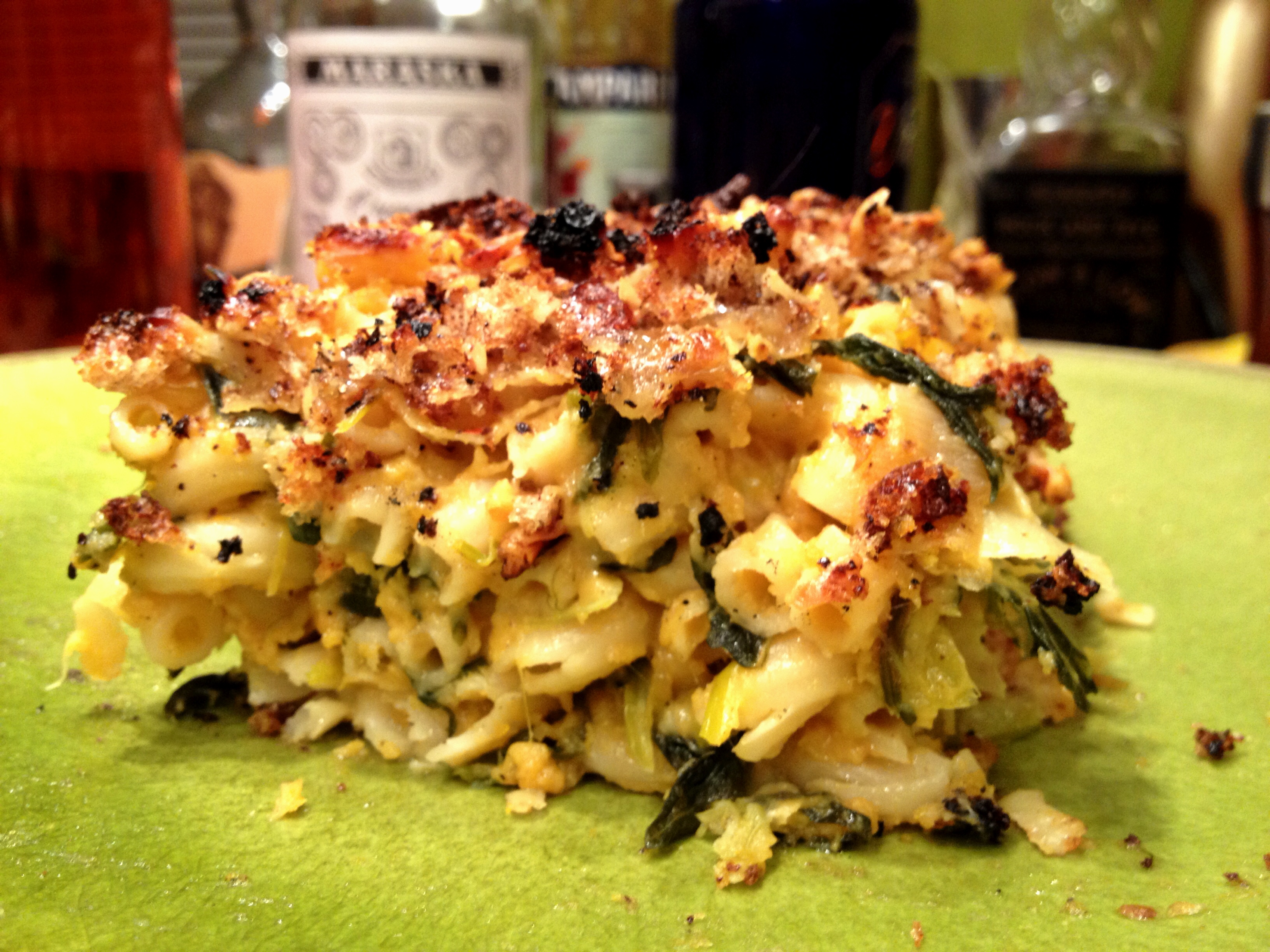
Butternut Mac and Cheese with Winter Greens

I’m headed out of town for a mid-Atlantic tour visiting friends and family. Between finishing up the semester, spearheading the year-end fundraising push at my job, and planning and attending various holiday events, my apartment has become something of a way station. Snow boots and shoes litter the floor. Root vegetables, fondue forks and half-unpacked boxes are stacked on the dining table. The bench in my bedroom is piled high with clothing of indeterminate cleanliness. But it’s the refrigerator that calls out for my attention.

As thanks for his services, I’ve invited my cat sitter over for dinner along with a few friends. (Dinner parties are way more fun than packing.) I will be gone for nine days and there are lots of odds and ends to use up before then. For breakfast, I had a fried egg atop pan-fried butternut squash, onions and fennel. But that still left a couple of pounds of cheese lifted from my office holiday party, two giant leeks left over from last weekend’s oyster extravaganza, an assortment of winter greens from my CSA share, dairy products of assorted “sell by” dates and more butternut squash.

A few months ago, I took my mom to Marcus Samuelsson’s Red Rooster, where we had his sinfully tasty Mac & Greens. A childhood friend has long touted the delight of macaroni and cheese with butternut squash. And so this dish was born.

Butternut Mac and Cheese with Winter Greens

  • 1 large butternut squash, peeled and cubed
  • 4 tablespoons olive oil
  • 2 large leeks, whites and greens slice and rinsed thoroughly
  • 6-8 cups chopped winter greens (kale, collards, spinach, chard, mustard greens, etc.)
  • pinch red pepper flakes
  • 1.5 pounds elbow noodles (You could use shells but, for macaroni and cheese, I am uncharacteristically a traditionalist.)
  • 4 tablespoons butter
  • 1 large shallot, minced
  • 4 cloves garlic, minced
  • 4 tablespoons flour
  • 1.5 cups whole milk and/or heavy cream
  • 2 teaspoons nutmeg
  • 3 tablespoons mustard powder
  • 2 tablespoons Dijon mustard
  • 1/2 teaspoon cayenne pepper
  • 1.5 pounds assorted cheese, shredded (Judging from my taste tests, I’m pretty sure I used white cheddar, gouda and Gruyère. But just about any cheese that melts well will work here.)
  • 1 cup bread crumbs (I used some I’d made from the remnants of a whole wheat sourdough loaf and then frozen a while back, but store bought are cool too.)
  • salt and pepper
  1. Toss the butternut squash with 2 tablespoons of olive oil and cook in a 425-degree oven until tender and just starting to brown. Puree in the food processor, adding a small amount of water if needed. Set aside.
  2. Bring the rest of the oil to medium-low heat in a large heavy-bottomed pot. Add the leeks and cook stirring frequently until they are soft. Stir in the red pepper flakes and chopped greens. Place a lid on and let cook for 10 minutes. Remove the lid, turn up to medium-high heat and cook stirring frequently until all liquid is gone. Set aside in separate bowl.
  3. Give your pot a quick rinse, fill with cold water, add some salt, and bring to a boil. Add the pasta and cook about halfway. Strain and set aside.
  4. Give your pot another quick rinse, add the butter and bring up to medium-low heat. Add the shallot, cook for a few minutes and then add the garlic. Cook for another couple of minutes before whisking in the flour. Your mixture should turn gummy and blonde. Whisk in the milk and/or cream plus the nutmeg, cayenne, mustard, mustard powder, a good pinch of salt and lots of pepper. When the mixture starts to thicken, whisk in the cheese in batches, reserving a cup or two for your topping. Once the cheese has melted, stir in the pureed squash, taste your mixture and add additional seasoning if needed.
  5. Stir the pasta and greens into your cheese mixture and then pour into a greased baking dish. Mix the reserved cheese with the breadcrumbs, salt and pepper. Sprinkle the mixture over the top, set aside and go about your business.
  6. About an hour before you are ready to eat, preheat the oven to 375. Bake for 30-40 minutes until your casserole is bubbling and your one-bedroom apartment is engulfed in the heady smell of melted cheese. If you want to get fancy, run it under the broiler for a couple of minutes to brown your crust. Let stand for 5-10 minutes before serving.

Butternut Mac and Cheese with Winter Greens

This paired nicely with a spinach and red onion salad with a Dijon and red wine vinaigrette. The recipe makes enough that five grown people can go back for seconds–and you’ll still have enough leftovers for your cat sitter to enjoy a home cooked lunch for another four or five days. As if hanging out with this adorableness wasn’t reward enough.

Oona

Pickled ‘n Deviled

Saturday night Sarah hosted the third annual Holiday Oyster Extravaganza, in which we prepare and consume 100 oysters (along with a liberal dose of booze). Shucking 100 oysters is no easy feat, but Mark once again rose to the occasion. As usual, I was in charge of the oyster accoutrement. This year’s raw oysters got a toasted fennel mignonette and a beet and horseradish relish.

Raw Oysters with Fixin's

The roasted version featured a fennel-saffron cream.Roasted Oysters with Fennel-Saffron Cream

The Blue Points were delicious, but I’m here to talk eggs. Much as I love eggs in all their forms, I’ve had trouble keeping up with the share I get from my CSA, so I had resolved to prepare deviled eggs for Saturday’s party.

On Thursday night I wrapped up my third semester in NYU’s Food Studies program and went out with friends to toast a month of pleasure reading. I got home late and tipsy, but determined to get a head start on prepping for the party. Rooting through the fridge for a snack while my eggs cooked, I stumbled on some beets that were looking a little worse for the wear. This got me thinking.

A few years back a friend and I spent a weekend checking out Pennsylvania’s Amish Country. We had occasion to dine at a smorgasbord, where I stumbled on the delight that is a beet-pickled boiled egg. As previously confessed, I am a sucker for a hard-boiled egg. Throw in tangy flavor and an outlandish pink hue and I am putty in your hands.

Beet-Pickled Deviled Eggs 

  • 2 large beets
  • 1 tablespoon olive oil
  • 1 dozen eggs
  • 2 cups apple cider vinegar (Bragg if you can get it)
  • 3-4 tablespoons assorted pickling spices (I used black and red peppercorns, coriander, fennel, allspice, torn bay leaves, and probably something else I’m not thinking of at the moment.)
  • 1 teaspoon salt
  • 1/4 cup sugar
  • 1/2 cup mayonnaise
  • 1 tablespoon Dijon mustard
  • 1 tablespoon dried mustard powder
  • salt, pepper and whatever your taste buds tell you to add
  • 2 scallions, greens thinly sliced and white portion reserved for another use
  1. Pre-heat the oven to 400. Rinse the beets, toss them with the olive oil in a small pan and stick in the oven. Cook until tender (about 45 minutes).
  2. Boil the eggs using your own technique or according to my interpretation of Betty Crocker’s failsafe recipe.
  3. Once the beets are cool enough to handle, peel and slice them. Add these to a large jar or a bowl along with the vinegar, salt, sugar and spices.
  4. Peel the eggs and add them to your brine, taking care not to splash the fuchsia liquid all over your white tank top.Eggs Pickling
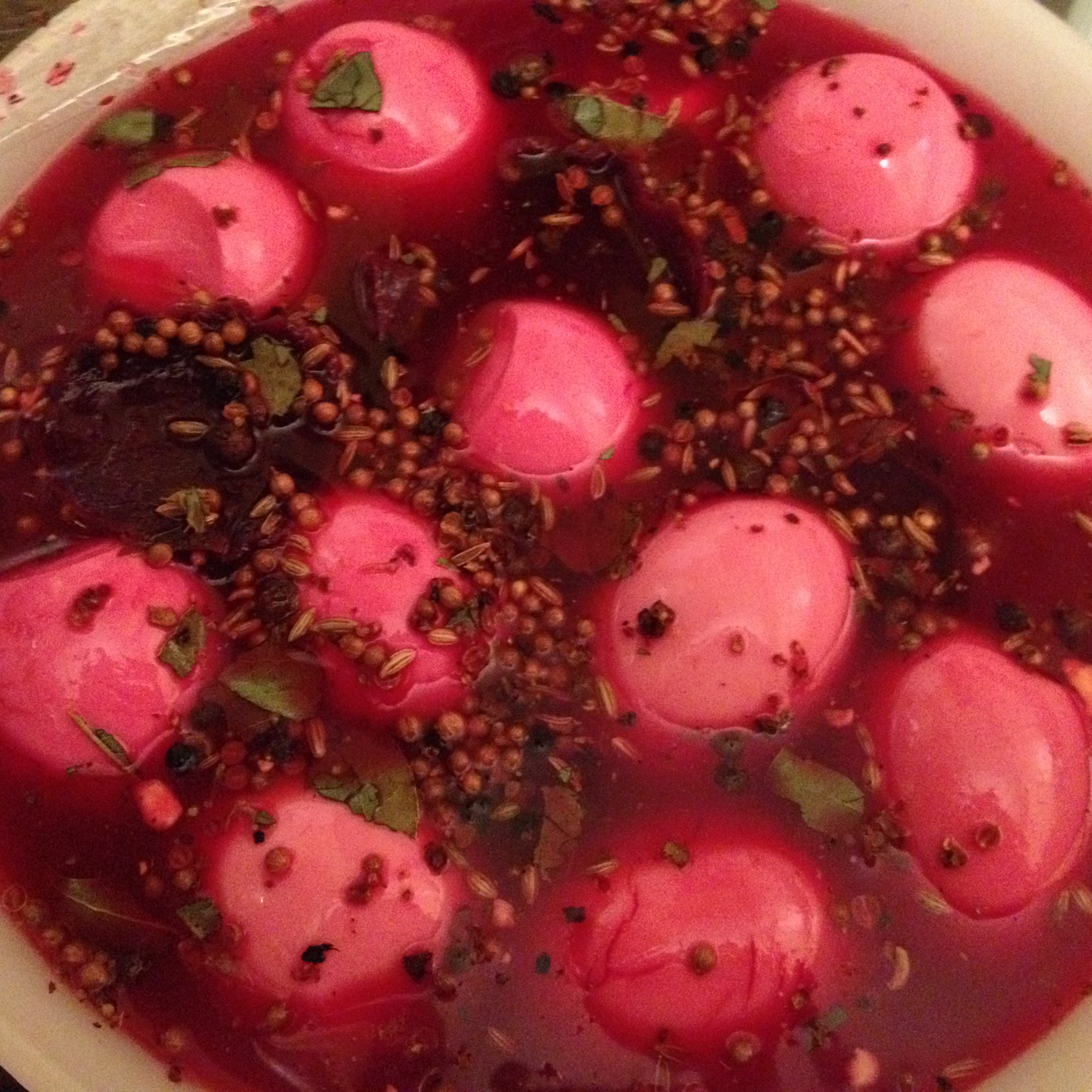
  5. Place a lid or some plastic wrap over the top and pop it in the refrigerator. Let these sit for 12 to 24 hours, stirring at least once to make sure they take the color evenly. I left mine in the brine until I got home from my office holiday party the following night and this is what they looked like.Pickled Eggs
  6. Fish the eggs out, pop them in the fridge to dry, and snack on the pickled beets. Still not a good time for a white tank top.
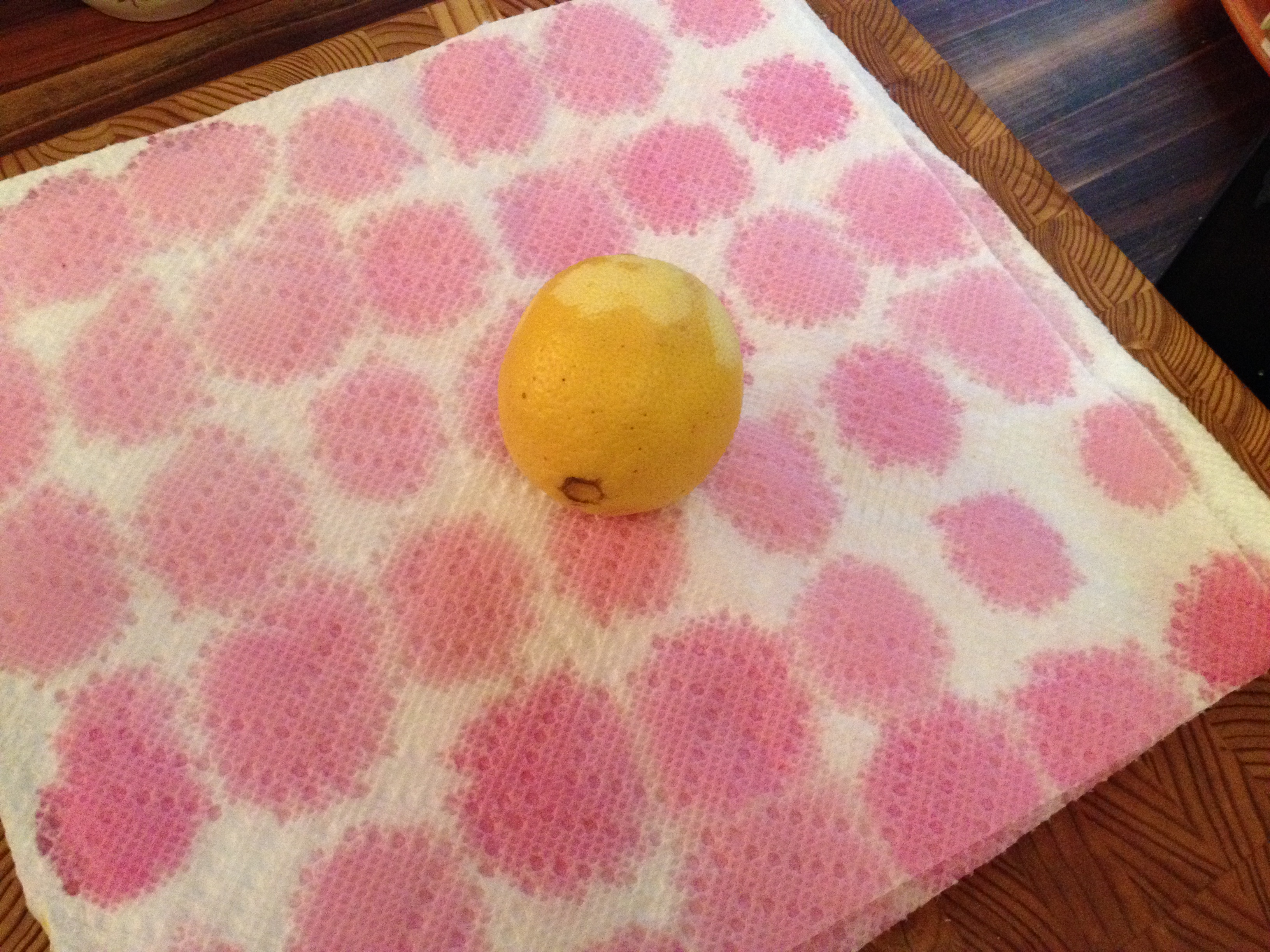
  7. Carefully slice your eggs in half lengthwise and pop the yolks into a bowl. If you’ve left them in for the full 24 hours, the yolks will be quite a sight, as will the paper towel where you set the halved eggs.Sunset Egg YolksBeet Stains and a Lemon
  8. Using a fork, mash the yolks roughly with the mayonnaise, mustard, mustard powder, salt, plenty of freshly-ground pepper and anything else that strikes your fancy. Press the mixture through a sieve for a refined, creamy filling. Or don’t. Taste the mixture and tweak as you see fit. I added a pinch of sugar and probably some other stuff I can’t recall.
  9. Let the filling chill until just before you are ready to serve. Spoon it into a freezer-worthy plastic bag, snip the corner and pipe the filling directly into the egg (not so) whites. Or just glob it in with a spoon.
  10. Garnish with the scallion greens because none of the crappy stores you went to had chives and a little green makes the eggs look more like food and less like some sort of alien life form.

Beet-Pickled Deviled EggsThe eggs were a smashing success, as was the party. The guests laughed. The Christmas tree twinkled. The yule log crackled on the flat-screen television. At some point in the night, Prosecco and oysters gave way to rum and hunks of leftover cheese. Eventually, I was forced to brave the elements. A daylong snowfall had turned into freezing rain. The streets were slushy and abandoned.

Mouse HatMy newly acquired hat and I got home a little before 3:00am. I had a devilishly good time at this year’s Oyster Holiday Party, but will confess to feeling a bit pickled come Sunday morning.

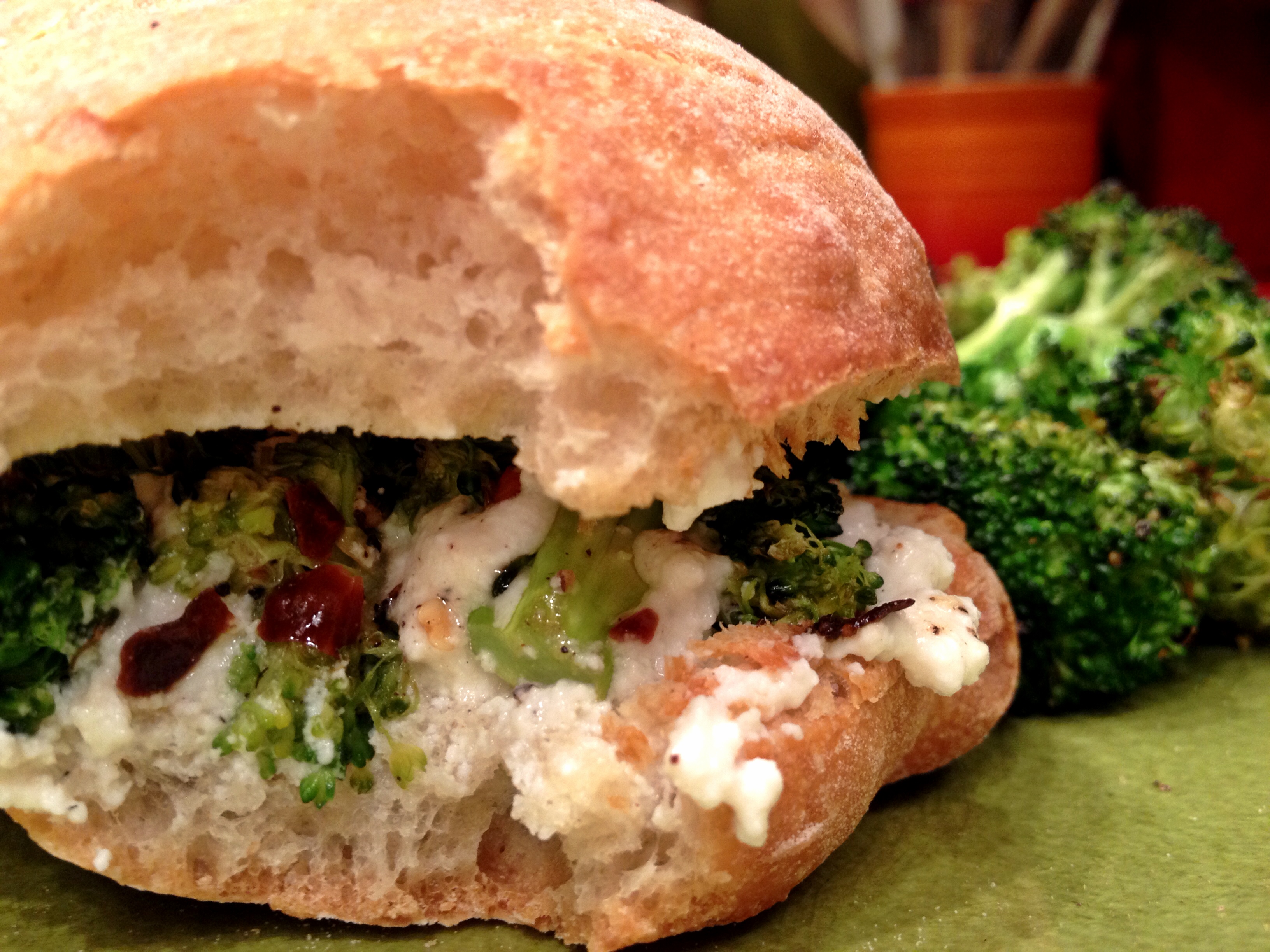
EAT THIS: Roasted Broccoli and Ricotta Panino

Roasted Broccoli and Ricotta Panino

You know those broccoli florets you lifted from last night’s office holiday party? Roast them with olive oil, salt and red pepper flakes then layer them onto toasted ciabatta along with ricotta cheese sprinkled with nutmeg and a little more olive oil, and you just may recover in time for tonight’s party. ‘Tis the season.

A Recipe for Recovery

I just got back from South Florida where I spent Thanksgiving with my family. I tacked a couple of days in Miami Beach on to the end of my trip. I was looking forward to checking out the Miami dining and cocktailing scene–as well as the swanky pool at my hotel. Instead, I contracted food poisoning and spent the next 36 hours checking out the pay-per-view selection and the marble-tiled bathroom floor. (While there a few suspects, my money is on the peel-and-eat shrimp.) When I did manage to drag myself to the balcony, this is what I gazed upon.

Fontainebleau View

I made it through last night’s plane and taxi rides without incident, but still felt the need to sleep with a bucket next to the bed. I’m in that awkward stage of recovery when the thought of food nauseates me but so does an empty churning stomach. White toast, white rice, white pasta or Saltines would probably be advisable, but these are not things I keep around and going to the store seems unthinkable at the moment.

As luck would have it, I did have the ingredients below–all of which are easily digestible and/or possess restorative properties. The inspiration came from Blue Hill Yogurt, which is very popular with a certain one-year-old friend of mine.

Tahini-Squash Yogurt (aka Sophisticated Baby Food)

  • 1 small delicata squash (I imagine butternut or any number of other winter squashes would work nicely.)
  • 2 tablespoons tahini
  • 2 tablespoons maple syrup
  • 1 cup plain yogurt (I used goat, but any kind would do, so long as it has the good bacteria.)
  • 1 teaspoon ground ginger
  • 1/2 teaspoon nutmeg
  • pinch of salt
  1. Core, peel and slice the squash. Steam until tender.
  2. Puree the squash plus the rest of the ingredients in a food processor. You could get fancy and run this through a chinoise to remove any fibrous squash matter. It was all I could do to pour it into a bowl.

Delicata Squash-Tahini YogurtThis was tasty and seems to have kept my blood sugar up until well into the afternoon. I do not hold it responsible for the stabbing pain just under my left lower ribs.

Sweet & Sour Curried Chickpeas with Spinach

Sometimes just making it to Friday night seems like a Herculean feat. I came home bruised, battered, and hungry. While I had just about made my way through the Homemade Hummus from last weekend’s chickpea extravaganza, I still had a pint and a half of whole chickpeas left to consume. Today was bitterly cold and I found myself craving something warm and spicy.

Sweet & Sour Curried Chickpeas with Spinach

  • 1 tablespoon cumin seeds
  • 1 tablespoon whole coriander
  • 1/2 tablespoon black peppercorns
  • 1/2 tablespoon whole fenugreek
  • 1 tablespoon coconut oil (Ghee or some sort of vegetable oil would be fine.)
  • 1 medium onion, finely chopped
  • 1 knob (large gumball sized) ginger, minced 
  • 1 jalapeño pepper, minced
  • 4 cloves garlic, minced
  • 1 tablespoon turmeric
  • 1/2 tablespoon garam masala
  • 1/2 pound dried chickpeas, cooked, with liquid (You could use a couple of cans in a pinch, but the texture will suffer.)
  • 2 tablespoons dried tamarind (If my crappy grocery store has it, yours will too.)
  • 1 tablespoon sugar
  • salt
  • 2 bunches fresh spinach, roughly chopped
  1. Bring the oil up to medium heat in a medium-sized heavy-bottom pot. Add the onion and sauté stirring frequently. After a few minutes, add the ginger and jalapeño. 
  2. Meanwhile, toast the cumin, coriander, fenugreek and peppercorns in a dry cast iron skillet, shaking frequently, until they begin to pop and release their smell. Grind these using a mortar and pestle or an electric grinder.
  3. Add the garlic to your onion mixture. Stir constantly for about one minute. Then add your ground toasted spices plus the turmeric and garam masala and continue stirring for one minute, allowing the spices to hydrate in the oil. 
  4. Add the chickpeas with their liquid, the tamarind, the sugar and a nice pinch of salt. (There is probably some dentist-approved way to handle the tamarind, but I just tore it into small pieces with my hands and then fished out whatever seeds I could spot as the fruit disintegrated into the sauce. I recommend doing a better job than I did, though I managed to avert a trip to Dr. Czarnik.) Bring to a boil and then reduce the heat and let simmer for a while, adding water as needed.
  5. This is a good time to put some rice on. (While basmati would be traditional, I used some brown Jasmine rice, because that’s what I had, and added turmeric and salt.) When your rice is just about done, taste your chickpeas and adjust the seasoning with salt and sugar as needed. Then add the spinach in batches, stirring to speed the wilting process, and cook until the leaves are just tender.

The resulting meal was a delightful mashup of my favorite Indian takeout dishes. But, with no dairy and just a tablespoon of oil for about four servings, it was much lighter–which is a good thing when you need to buckle down and write a paper at the end of a very long week.

Sweet and Sour Curried Chickpeas with Spinach

Homemade Hummus

As previously reported, I spent six months studying in Jerusalem while in college. This was back in my vegetarian days, and Israel is a great place to be a vegetarian. While the majority of the Jewish population is secular, kosher tradition holds, meaning that most restaurants are either meat or dairy. On top of that, Middle Eastern food embraces legumes and vegetables.

Being the child of hippies, I’d already consumed a lifetime worth of chickpeas. But the hummus in Israel was a revelation–creamy, rich and flavorful–and I indulged with abandon. This came with a price; back in the States, I couldn’t bring myself to eat the lazily mashed canned chickpeas that my college cafeteria tried to pass off as hummus. Even in New York City, where I eventually settled, truly delicious hummus proved elusive.

At some point, hummus started popping up in Korean delis and the fancier cheese sections of grocery stores. I tested them all. Some were as bad as the salad bar glop of my coed days. Some were serviceable. But none were inspirational and, after a tub or two, I always reverted to making my own.

About ten years ago, by sheer accident, I found it: hummus like I remembered. It was a tiny shop just south of Washington Square Park and up half a flight of stairs. A couple of weeks later, over drinks, I announced to my buddy Alex that I had discovered Jerusalem-quality hummus right in the middle of Greenwich Village. Alex interrupted me to announce that he had, in fact, recently found the best hummus in New York City in the East Village. Already a couple of drinks into the evening, we proceeded to argue for the superiority of our individual hummus spots for what must have seemed an eternity to the people seated around us.

It turns out that we were arguing over the same hummus. Ori Apple, an Israeli who bemoaned the lack of good hummus in New York City, had opened the first two locations of Hummus Place just months apart. I am happy to report that, since then, a number of good hummus restaurants have opened around the city.

But I still enjoy making my own. While I don’t really have a fixed recipe, I have learned a few things over the past 20 years. First, and this is truly important, don’t use canned chickpeas. The texture and flavor will be off. Trust. Second, use good quality tahini. (I suspect that this may be the secret to Hummus Place’s magical concoction.) Third, use plenty of liquid. Finally, let the food processor run for longer than you think reasonable.

Here’s what I whipped up this afternoon, but feel free to make it your own. So long as you cook the chickpeas enough, it’s honestly hard to screw up hummus. Just keep tasting and tweaking.
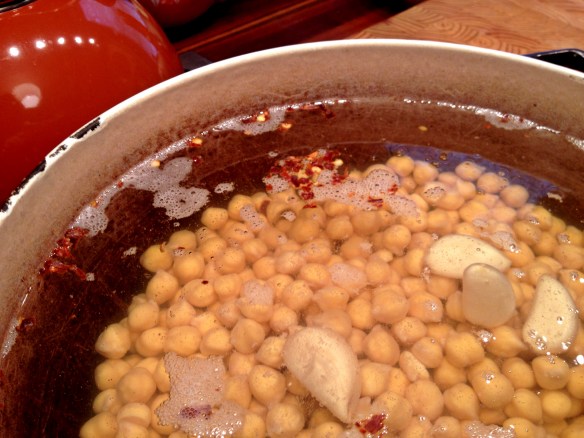
Chickpeas

Jasmine’s Hummus

  • 1 pound dried chickpeas (or, if you are a sensible person, half that)
  • 6 cloves garlic
  • 3/4 cup tahini
  • pinch red pepper flakes
  • 1 bunch curly parsley
  • 1 teaspoon sweet paprika
  • 1 teaspoon hot paprika
  • juice of 1 lemon (or a tablespoon or so of white wine vinegar in a pinch)
  • salt and black pepper
  • 1 tablespoon sumac (optional)
  1. Before going to bed, dump the chickpeas into a bowl and add enough water to come at least a few inches above the beans. (You could look them over for rocks or odd-looking beans, but it’s late. You’re sure to spot anything amiss tomorrow when you are better rested.)
  2. In the morning–or whenever you are good and ready for a little procrastination–drain and rinse the beans. Add them to a large pot, top with plenty of water, toss in the peeled garlic and the red pepper flakes. Bring to a boil and then reduce to a simmer. Let this go for an hour or so while you get back to whatever duties you have been shirking.
  3. Test the chickpeas. If they are tender, add a tablespoon or so of salt and then let them simmer for another 15 minutes. The water should taste fairly salty.
  4. Realize that you are in danger of making a truly obscene amount of hummus. Scoop half of the chickpeas and some of the liquid out. Refrigerate or freeze for future use (in a soup, stir-fry, curry, etc.).
  5. Dump the cooked garlic and the remaining chickpeas into your food processor, making sure to reserve the cooking liquid. Add the tahini, sweet and hot paprika, lemon juice, sumac (if you have some), plenty of black pepper, and whatever else your heart desires. Pour about half a cup of the cooking liquid in and process away. Let it run for five minutes or so, adding more liquid as needed to achieve a loose but not soupy consistency. Taste and adjust seasoning as desired.

I ate this for dinner tonight, topped with a tangle of roasted broccoli rabe. Good stuff.

Hummus and Broccoli Rabe