Salmon, Asparagus, Fennel & Ramps En Papillote

While en papilotte sounds fancy, it’s actually a great trick for crafting a quick and delicious meal for one (or more) with minimal mess. All you need is some parchment paper or, in a pinch, aluminum foil. Not being much of a baker, I’ve had the same box of parchment sitting in a kitchen drawer for years, ready for deployment on nights like tonight.

I spent the first half of my Monday frantically pulling together materials in preparation for an evening board meeting that was ultimately canceled. And so I find myself with an unexpectedly free night and a serious desire for solitude. On the way home I picked up a piece of salmon and some asparagus (hallelujah for green vegetables) to go with the ramps and fennel waiting in my refrigerator.

Salmon, Asparagus, Fennel & Ramps En Papillote

  • 1/2 fennel bulb
  • 8-10 asparagus stalks
  • 3 ramps (or some thinly sliced shallots)
  • 6-ounce salmon filet
  • 2 tablespoons plain yogurt (ideally whole milk)
  • splash of white wine
  • zest of 1/2 lemon
  • salt and pepper
  1. Pop a large cast iron skillet (or a baking sheet or dish of some sort) into the oven and set it to 400. Turn on the radio, strip off your work drag, pop open that bottle of Orvieto left by a dinner guest with excellent taste and pour yourself a glass.
  2. Lay a large piece of parchment on the kitchen counter. Rinse the fennel and then remove the stalks, reserving and finely chopping the fronds. Halve the bulb, core one half and then slice it as thinly as possible. Toss the sliced fennel onto one half of your parchment and pop the unsliced half into the fridge for a future use. Snap the woody ends off of the asparagus and layer the stalks on top of the fennel. Rinse the ramps, trim off the very tip, slice them in half lengthwise and lay them on top of the asparagus. Sprinkle with salt, pepper and lemon zest. While pouring yourself a second glass of wine, give the vegetables a little splash.
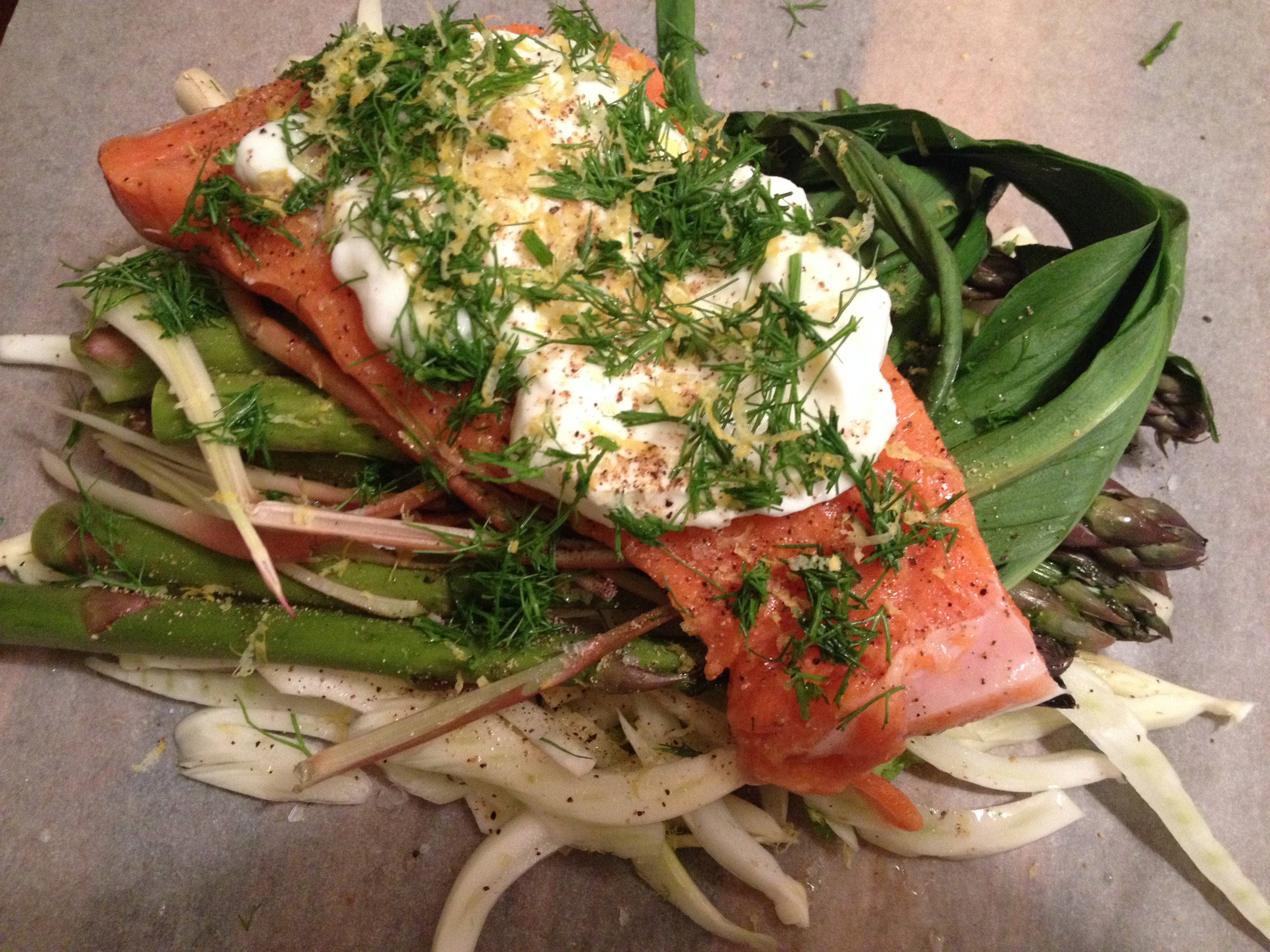
  3. Rinse the salmon, feeling for and removing any remaining bones, and pat dry. Place the fish on top of the vegetables and add more salt, pepper and lemon zest. Spoon the yogurt on top and garnish with the fennel fronds and more lemon zest.Salmon en Papillote Pre-Bake
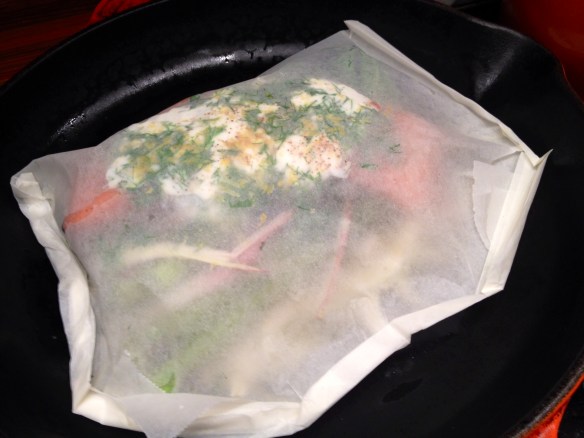
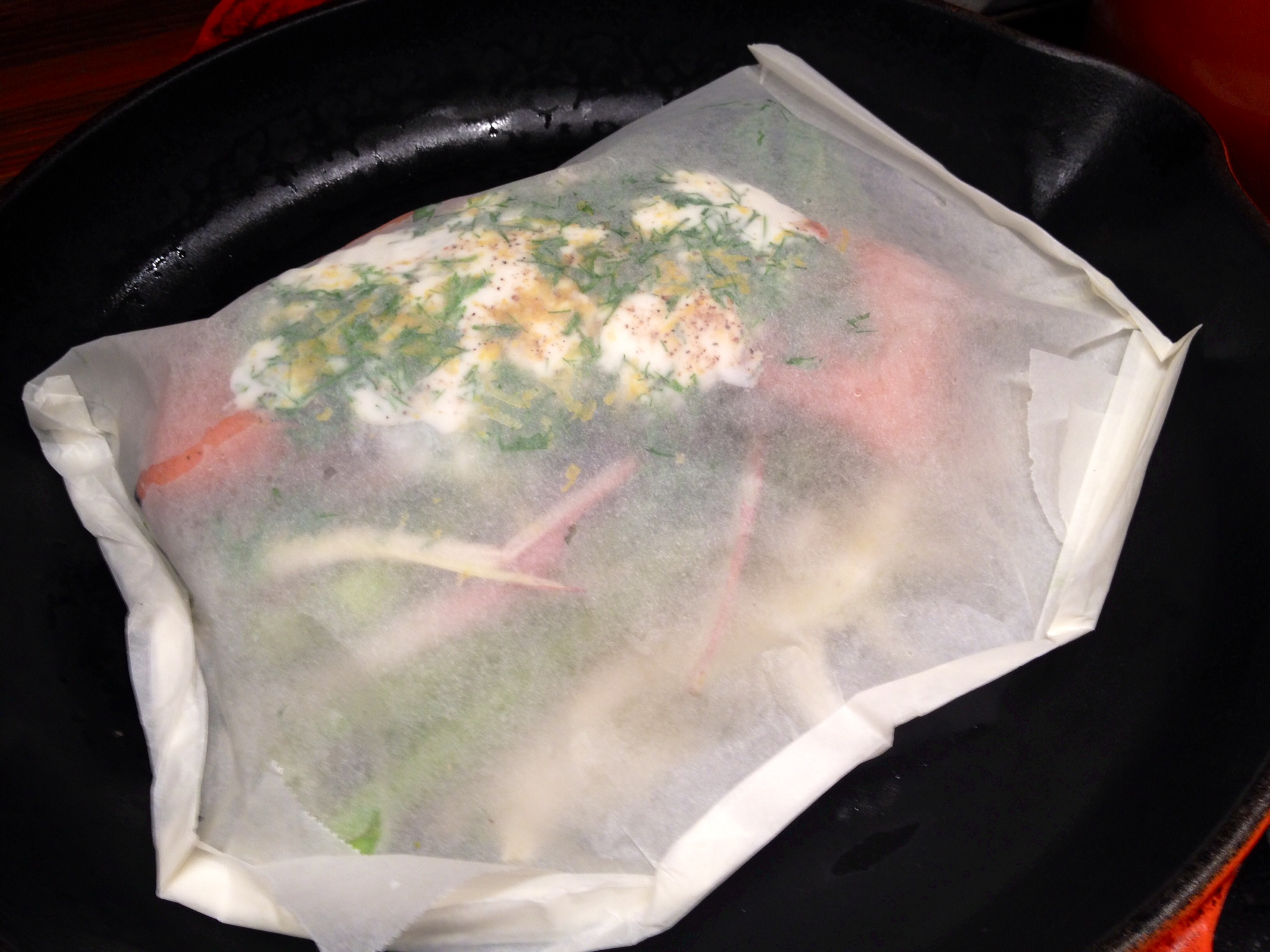
  4. Fold the parchment in half and begin folding the two halves together, making tight creases with your thumbnail as you would origami, until you are satisfied that it is reasonably airtight. Set this in the oven in your preheated pan and go about your business.Salmon Origami
  5. After 17 minutes, pull the pan out of the oven. If you did a good job of folding, the paper will have puffed up. Tear this open like you would a present at your fifth birthday party and behold your dinner, swathed in headily scented steam.
Salmon Fennel Aspargus and Ramps en Papillote

This is a comically simple but deeply satisfying dish. At the end of it all, you are left with a cutting board to wipe down; a chef’s knife, microplane, dinner plate, knife, fork and spoon to wash; and another glass of wine to pour. Can somebody please remind me of this the next time I decide to host a dinner party for eight?

Steamed Clams & Broccoli Rabe

Well that was a long week. I saw visiting family off on Monday, delivered a performance/presentation in class on Tuesday, had major dental work on Wednesday, and turned in my final paper of the semester on Thursday–all while holding down my full-time job. I had high hopes of attending an event tonight, but exhaustion and misanthropy got the better of me. I did manage to swing by the Union Square Greenmarket on the way home. Agricultural reality continues to lag behind our culinary aspirations, but I was able to pick up more ramps and broccoli rabe, along with a couple of Bread Alone’s multigrain panini. I got off the mercifully uncrowded Q train at 7th Avenue and swung by Mermaid’s Garden, the newish fish shop in my neighborhood I’d been meaning to check out for months. I picked up a dozen littleneck clams, which I somehow thought would pair well with broccoli rabe, and a couple of pounds of Georgia shrimp, which went into the freezer for some future delight.

Littleneck Clams

Steamed Clams & Broccoli Rabe

  • 1 dozen littleneck clams
  • 1 bunch broccoli rabe
  • 1 ounce diced bacon ends (or 1 slice bacon or 1 tablespoon olive oil)
  • 3 ramps and those 3 scallions that seem to have wilted in your veggie bin (Shallots, garlic and/or plain old yellow onion would also be fine.)
  • 1 pinch red pepper flakes
  • 1 cup white wine
  • zest of 1/2 lemon
  • salt and pepper
  1. Drop the clams into a small bowl, top with water, and fix yourself a cocktail.
  2. Once you have finished your cocktail, fill a medium pot halfway with water, add a healthy pinch of salt, pop a lid on, and set it over high heat. While the water comes to a boil, fix yourself another cocktail. Roughly chop the broccoli rabe, toss it into the pot, and boil for two minutes or so until just softened but still toothsome. Strain into a colander and run some cold water over the top to stop the cooking process.
  3. Place the pot back on the burner, lower the heat to medium-low and toss in the bacon. Cook, stirring frequently, until the bacon has rendered. Chop the ramps and the green portion of the scallions and add these plus the red pepper flakes to your bacon. Cook for a few minutes.
  4. Crank the heat up to high and add some of that white wine that was questionably drinkable when you first opened it and is most definitely not drinkable after a month in the fridge. Fish the clams out of the water and drop them into the pot. Let boil, stirring a bit, until the clams start popping open (approximately five minutes). As they open, pull them to the top so as not to overcook.
  5. Thinly slice the whites of the scallions. When the clams have all opened, turn off the heat and stir in the blanched broccoli rabe along with the lemon zest and salt and pepper to taste.

Clams and Broccoli Rabe

Dump this into a bowl and serve with some good quality bread to soak up the juices. A spoon might be helpful. But, if you happen to be dining alone, just lift the bowl up to your face. The cat will not be offended.

Asparagus & Ramp Remoulade

Spring is finally here in New York City. The birds are chirping. The trees are in bloom. My toenails are painted (and, more importantly, trimmed). And ramps have returned to the farmers market.

I’ve previously reported on the ramp craze. While some might argue that we have reached the tipping point, after a long winter of turnips, potatoes and more turnips, the sight of anything green is cause for celebration. Plus, ramps are damn tasty.

Asparagus & Ramp Remoulade

  • 3 pounds asparagus
  • 4 good quality eggs
  • 1 large bunch ramps
  • 1 1/2 tablespoons olive oil
  • 3/4 cup mayonnaise
  • 2 tablespoons Creole or other whole-grained mustard
  • 1/2 tablespoon tomato paste
  • 1 celery stalk, finely minced
  • 1/4 cup thinly sliced scallion greens
  • 2 tablespoons finely minced parsley
  • 1 tablespoon prepared horseradish
  • 1 tablespoon white wine vinegar
  • 1 small clove garlic, finely minced
  • juice of 1/2 lemon
  • 2 teaspoons sweet paprika
  • 1 teaspoon hot paprika (or to taste)
  • salt, pepper and (if you think it needs it) a pinch of sugar
  1. Blanch your asparagus in batches in a pot of boiling water. When the stalks are just tender but still al dente, plunge them into a large bowl of very cold ice water. (Do not skimp on the ice–even if it means that you will likely come up a bit short when it’s time to whip up a round of Sazeracs for the evening’s festivities.) Spread the asparagus on dish towels to dry. Then roll bunches in paper towels and stick in the refrigerator until just before serving.
  2. Boil the eggs. If you don’t have your own method, check out the technique I’ve been using since I was seven years old. It has yet to fail me.
  3. Now it’s time to prep the ramps. Rinse them thoroughly, giving them a soak if you see dirt in the folds, and trim the very tip. Bring the oil up to medium low heat in a cast iron skillet. Working in a couple of batches, place the ramps in the skillet so that the white parts are in the oil and the leaves are draped over the edge of the skillet. When one side has browned nicely, use the leaves as a handle to flip. When they’re nice and brown all over, shove them all the way in and allow the green portion to wilt and crisp up a bit. Sprinkle these with salt and set aside.
  4. Combine the rest of the ingredients and let chill for at least an hour.
  5. Just before serving, peel and roughly chop the eggs. Lay the asparagus onto a large serving platter and strew with the ramps. Spoon the remoulade over the top and then sprinkle on the chopped egg. 

This dish made for a lovely presentation as a first course at last night’s dinner party for eight people. While I failed to get a picture of the beautifully arranged platter, I did manage to capture a shot of the leftovers right before I devoured them with my fingers while taking a break from doing the dishes.

Asparagus and Ramp Remoulade

The Morning After Savory Bread Pudding

Last night I hosted seven strangers for dinner in my home as part of a project for the Food and Performance class I am taking this semester. The menu had a distinct New Orleans flavor:

Sazeracs

Creole Fromage Fort, Mushroom Pâté, Olives & Cornichons

Asparagus & Ramp Remoulade

Duck, Oyster & Andouille Gumbo over Rice

 Vanilla Gelato Topped with Goat Milk Cajeta & Spicy Pralined Pecans

While it is going to take me a while to piece the evening together, I’m willing to call A Strange Dinner Party a success. The conversation flowed. Food and drink were consumed. Connections were discovered and forged. The highlight may have been after dessert when everyone pitched in to change a lightbulb–a task I don’t do when alone because it requires standing literally on top of the sticker on the ladder that says “Do Not Stand at or above this level. The Sazeracs and stimulating conversation left me so amped up that I managed to plow through nearly all of the dishes before collapsing into bed.

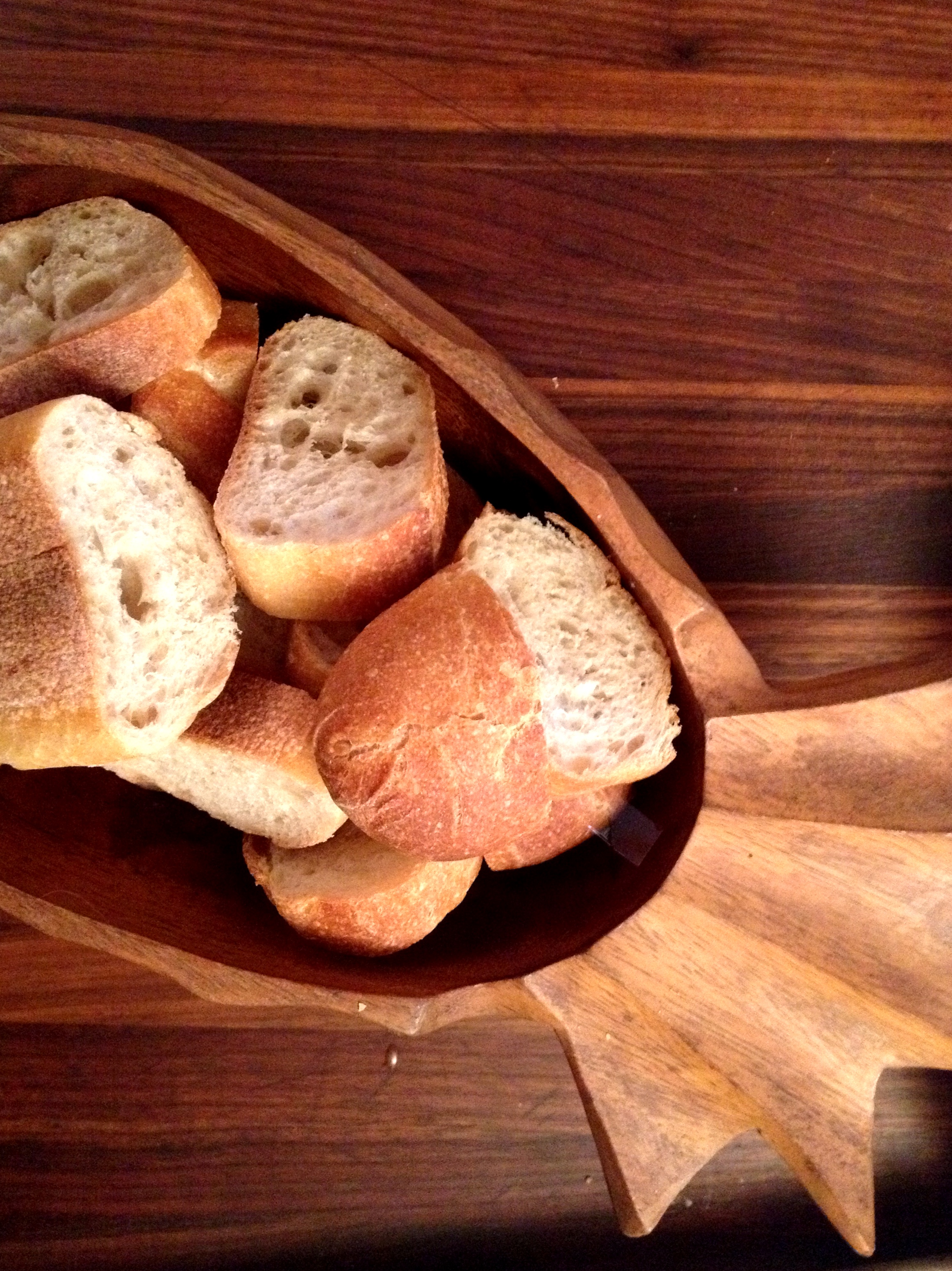
I woke up inexplicably early, having slept a sum total of 10 hours over the past two nights. Sleep deprivation and weekend cocktailing had me feeling a little worse for the wear. I needed a hearty breakfast to fortify me for this afternoon’s New York Abortion Access Fund Bowl-a-Thon. My bleary eyes scanned the kitchen and alit on the now stale bread that my guests had apparently refrained from using to soak up their gumbo.

Stale Bread

The Morning After Savory Bread Pudding

  1. Pour yourself a big glass of water and set the oven to 350.
  2. Grab those stale baguette slices and roughly cut them into 1″ chunks. Spread them on a baking sheet and pop them in the oven to toast until just turning golden.
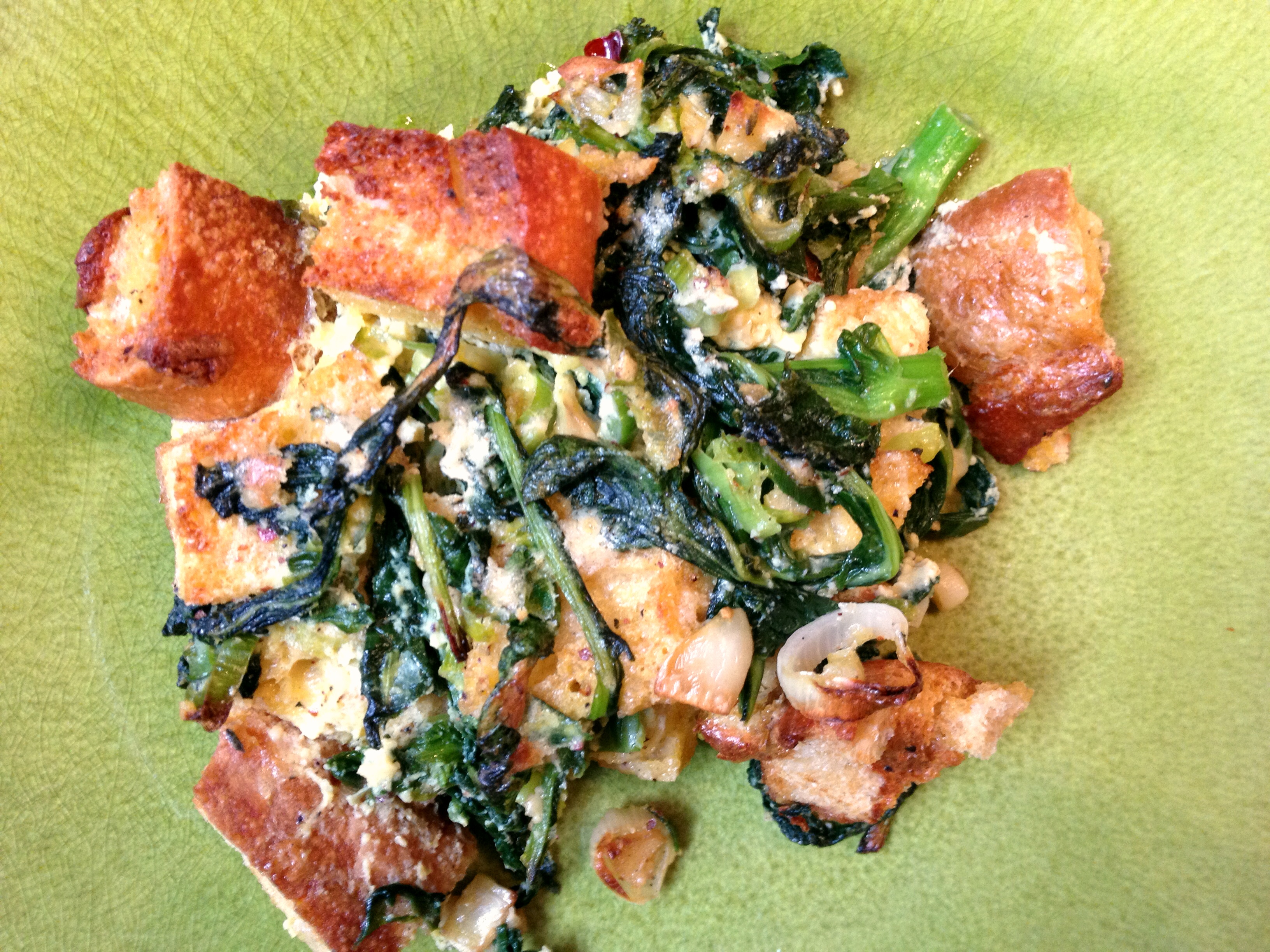
  3. If you’ve got some leftover cooked veggies on hand, you’re almost home free. If, on the other hand, you polished off the last of the asparagus while doing the dishes last night, heat a cast iron skillet up to medium-low with a little olive oil. Add some sliced garlic (or onions or whatever) and a nice pinch of red pepper flakes. When the garlic starts to turn golden, add a big pile of broccoli rabe (or mushrooms or spinach or whatever vegetable(s) you have on hand). Season with salt and pepper and sauté until cooked through. If you happen to have a bunch of scallions you forgot to serve with last night’s gumbo, throw these in toward the end.
  4. Crack four eggs into a medium mixing bowl. Add a cup or so of milk or cream, salt, pepper and a pinch of two of nutmeg. Now stir in that cheese that you hastily packed up at the end of the night. This is a particularly nice way to recycle your already recycled fromage fort.
  5. Mix your toasted bread cubes in with the sautéed veggies and scoop this into a small baking dish. Pour the egg mixture over the top and pop your bread pudding in the oven.
  6. Cook until the eggs are set and the bread on top is nicely toasted–about 25 minutes, which should be ample time to fix yourself a much-needed cup of coffee. 

Savory Bread Pudding

Matzo Brei Duxelles

New York City is a seductive lover who is bound and determined to make sure you don’t get attached.

On Saturday, I left my house at 11:00am and got back twelve hours later. Temperatures soared into the 70s. Outdoor bunch turned into pedicures turned into a trip to the flea market (where, naturally, I found the perfect dress) turned into a bike ride turned into a delicious home cooked meal and a boatload of rosé with good friends.

Three days later, at the end of a long day of work followed by school, I headed home under a steady rain. The cranky passengers disembarking en masse at Astor Place almost obscured the wads of bloody napkins inexplicably strewn about the wet subway platform. But nothing could mask the sound of the man in yellow leggings and large headphones wailing as he took up an entire row of seats on my car. A strange smell (on which I’d prefer not to dwell) hung in the air. Fifteen minutes and two transfers later, without so much as an announcement, my train went express. Having overshot my stop, I trudged back clutching my heavy bags with fingers that longed for a pair of gloves. I made it upstairs and flicked the radio on just in time to hear the WNYC newscaster blithely announce that we’re under a freeze warning, with lows around 28 overnight. It is April 15th.

There are a raft of tasks that I could–in fact, should–be focusing on tonight. Instead, having failed to score a seder invitation for the second night in a row, I set my sights on converting the matzo left over from last night’s salmon into a fancified version of the ultimate Passover comfort food. In keeping with the woe is me theme of this post, the recipe I present is for one. Scale up as you see fit.

Matzo Brei Duxelle

  • 1 tablespoon butter
  • 1 shallot, finely minced
  • 1 garlic clove, finely minced
  • 6 large baby bella mushrooms, diced into very small cubes
  • small pinch red pepper flakes (not traditional, but you’ll thank me)
  • 1/4 teaspoon fresh thyme (also not traditional, but it was in the crisper)
  • 3 tablespoons finely minced parsley (Italian flatleaf would be traditional but, this being Passover, who doesn’t have the curly variety on hand?)
  • 2 sheets matzo
  • 2 large eggs
  • salt and pepper
  1. Melt 1/2 tablespoon of butter in a small nonstick skillet over medium heat. Add the shallot and garlic and sauté for 4 minutes or so until soft. Add the mushrooms, thyme and red pepper flakes along with a pinch of salt. Continue cooking for about ten minutes, during which time the butter will be absorbed by the mushrooms, the mushrooms will release liquid, and the liquid will simmer off. Remove from the heat and stir in the parsley plus a healthy dose of black pepper. Congratulations, you made mushroom duxelles! Now spoon this into a small bowl.
  2. Return the pan to the stove, add 1/4 tablespoon of butter, and reduce the heat to medium-low. Crack the eggs into a small bowl, add some salt and pepper, and blend vigorously with a fork. Break the matzo into pieces approximately 1″ square. Place these in a shallow bowl and run hot water over the top. Stir for 30 seconds or so, scoop them out, and add them to your eggs.
  3. Pour half of your egg and matzo mixture into the pan. Spread your duxelles in a thin even layer and then top with the remaining egg and matzo. Cook until set and browned on the bottom (7 minutes or so). Flip the matzo brei onto a small plate, add your last 1/4 tablespoon of butter to the pan, and then slide the brei back into the pan. Let cook until that side is also golden brown and turn onto a large plate.

Matzo Brei Duxelle

I ate this with a simple salad of arugula dressed with olive oil and lemon juice and topped with a little shaved parmesan. I paired it with a beer, which is decidedly not kosher for Passover, but made me feel better about the sad state of affairs.

Passover Meal for One (or More)

Tonight is the first night of Passover. I had a busy day of work, school, more work, and more school. I wasn’t raised with any religious education and wouldn’t claim to be observant. A dear friend converted to Judaism several years ago. Early in the process, she would call me with questions. I wasn’t much help. I did gift her a copy of Joan Nathan’s The Jewish Holiday Kitchen, which is an excellent resource. The inscription read, “I’ll always eat pork with you.” I get to be a (red-headed, blue-eyed, freckled) Jew (with a Danish last name) because my mom is Jewish.

I told myself that not having a seder to attend was fine. But I have come to realize that I mark the passage of time primarily through food rituals. Somewhere between Bleecker Street in the West Village and Nevins Street in Downtown Brooklyn, I realized that I needed to do something to observe the holiday. As I transferred from the 4 train to the 2 train, I began to catalog the ingredients at the seder table and sort out how I could make them into a quick meal for one. I figured I’d knocked out the lamb last weekend. And my diet includes plenty of eggs. But I did manage to incorporate charoset, matzo, bitter herbs, karpas and wine into my Passover dinner for one.

The resulting dish can be scaled up to feed a crowd but comes together quickly enough that you can justify making it when you still have a few hours of theoretical approaches to cooking shows to read before bed.

Horseradish, Parsley and Matzo-Crusted Salmon

  • 1 six-ounce wild salmon filet
  • 1 sheet matzo, crushed into a mixture of powder and small pieces
  • 2 tablespoons plain yogurt
  • 1 tablespoon prepared horseradish
  • 1 tablespoon dijon mustard
  • 3 tablespoons finely minced curly parsley
  • 1/2 teaspoon lemon zest
  • salt and pepper
  1. Preheat the oven to 400. Combine all ingredients in a small bowl.
  2. Rinse and pat the fish dry. Pour a bit of oil into a glass baking dish, place the salmon skin side down and sprinkle liberally with salt and pepper. Using a spoon, mound the matzo mixture on top of your fish.
  3. Cook the salmon approximately 9 minutes until opaque on the outside but still a little jiggly. 

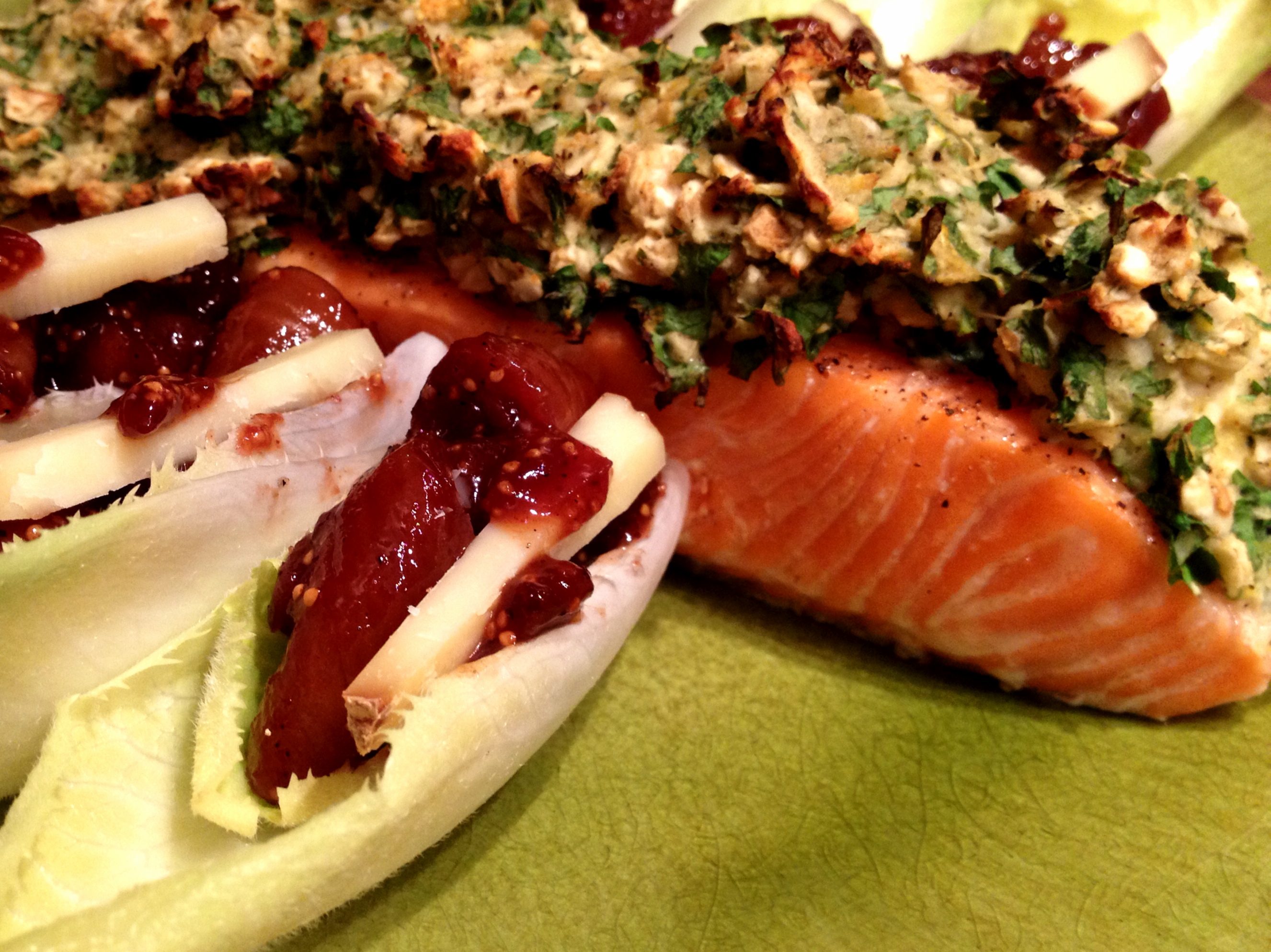
While the oven was preheating, I made a quick version of a Sephardic-style charoset by poaching raisins, dried and quartered figs, and diced red onion in some leftover red wine, honey and lemon juice with a bit of cinnamon, cardamom, ginger, clove and black pepper. I ate this spooned into endive, which made for a great bitter herb, and topped with batons of Adelegger, a very funky raw cow’s milk Alpine cheese (good cheese being my chosen religion).

Horseradish, Parsley and Matzo-Crusted Salmon


Masoor Dal with Kale

Temperatures in New York City soared above 70 today, inducing a collective giddiness. Unfortunately, save for a quick dash outside to pick up lunch and some specialty lightbulbs (good lighting being a bit of an obsession for me), I spent the day at my desk. It is the end of a very long week. By the time 6:00 rolled around, it was all I could do to swing by the health food store for some red lentils and cilantro before heading home. I was craving something spicy that would make use of the kale I picked up last weekend at the Union Square Greenmarket. (It’s tough to use up your vegetables when you get home after 10:00 each night.)

Masoor Dal with Kale

  • 1 cup red lentils
  • 1 knob ginger (about the size of the last joint of your thumb)
  • 1 tablespoon turmeric powder
  • 1 tablespoon ghee (substitute coconut oil if you’re going for a vegan dish)
  • 1/2 tablespoon whole cumin seeds
  • 1/2 tablespoon whole coriander, ground
  • 1/4 teaspoon cayenne (or to taste)
  • 1 medium onion, diced
  • 3 cloves garlic, finely minced
  • 1 bunch kale, roughly chopped
  • zest of 1 small lime
  • 2 tablespoons finely minced cilantro
  • salt
  1. Add your lentils, ginger, turmeric and four cups of water to a medium-sized heavy bottomed pot and bring to a boil. Reduce heat to a very low simmer and place lid on top, leaving open a crack. If you suddenly realize that you need beer, now is the time. Your lentils need to simmer for an hour-plus, so walk those extra five blocks to the good place–and feel free to sample. A growler of Great South Bay Brewery‘s Misfit Toy Black IPA? Don’t mind if I do.
  2. When you get home (about 30 minutes later), give the lentils a stir. (They will have turned to mush; do not be alarmed). By the time you put on some music and pour yourself a beer, it should be time to start the rice. Basmati would be ideal, but I went with Thai Jasmine because that’s what I had on hand. You can follow the instructions on the package, but I’d recommend sautéing the rice in half a tablespoon of ghee or coconut oil for a couple of minutes before adding your water. A good pinch of salt is also key.
  3. Bring a tablespoon of ghee or coconut oil up to medium heat in a small skillet. Add the cumin, coriander and cayenne and cook stirring continuously until the spices are nice and toasty but not burnt (2-3 minutes). Add the onions and the garlic and cook stirring frequently until your onions are crisp and brown at the edges. 
  4. Add the onion and spice mixture to your lentils along with the kale and a couple of healthy pinches of salt and cook for 10 minutes or more, depending on how toothsome your greens are. Taste and adjust your seasoning with additional salt and/or cayenne as needed. Add the lime zest and cilantro off the heat.
  5. Damn, that was easy. But wait, you ask, wouldn’t it be a good idea to remove the giant hunk of ginger before you bite into it? Yes, yes it would.

Masoor Dal with Kale

This dish is best consumed with a second beer, in your underwear, trusty cat by your side, while watching 8 Mile (which you’ve been meaning to see for years).

Mutton Dressed as…Mutton

I was raised a vegetarian. My family introduced meat around the time I started middle school, but it took me a while to truly become a carnivore. Once during my senior year of college my mom brought home fried chicken and had to pick the white meat off of the bone for me.

My budding curiosity was put on hold when I entered college, as cafeteria meat was just too gross to ponder. I started cooking in earnest while studying in Jerusalem during my junior year. Israel was a great place to be a vegetarian. Even on my very limited budget, I was able to eat well and even feed others. For a long time after college I ate (rather pedestrian) meat outside of the house but continued to cook vegetarian dishes at home.

Eventually I became too interested in food not to explore. I found myself frustrated by my own taboos and squeamishness. And so I began to push at my own boundaries. While I might not order it as my entrée, I would taste anything. I moved beyond chicken breasts and ground beef in my own meat cookery. I worked hard at confronting meat that looked like what it was: part of an animal. I delved into braises and barbecuing. I ordered a leg of lamb from an old school pork store and brought it home in the basket of my bike. I bought an untrimmed pork loin and tackled it early one morning in a pre-caffeine haze. The more I worked with meat, the more it became a part of me and my identity.

Today I had the opportunity to attend a daylong intensive workshop on butchering sheep as part of Just Food‘s annual conference. The workshop was led by Adam Danforth, who just published two books on butchering. He talked us through slaughter, animal welfare and what makes meat delicious. After a burrito and margarita break (did I mention how awesome this workshop was?), Adam set to work breaking down a whole sheep and answering our endless questions. A chef was on hand to prepare the various cuts in a simple manner that really highlighted the lamb-y goodness. We rounded out the day with beer, socializing and the chance to pack up a meat cut or two to take home.

Sheep Carcass

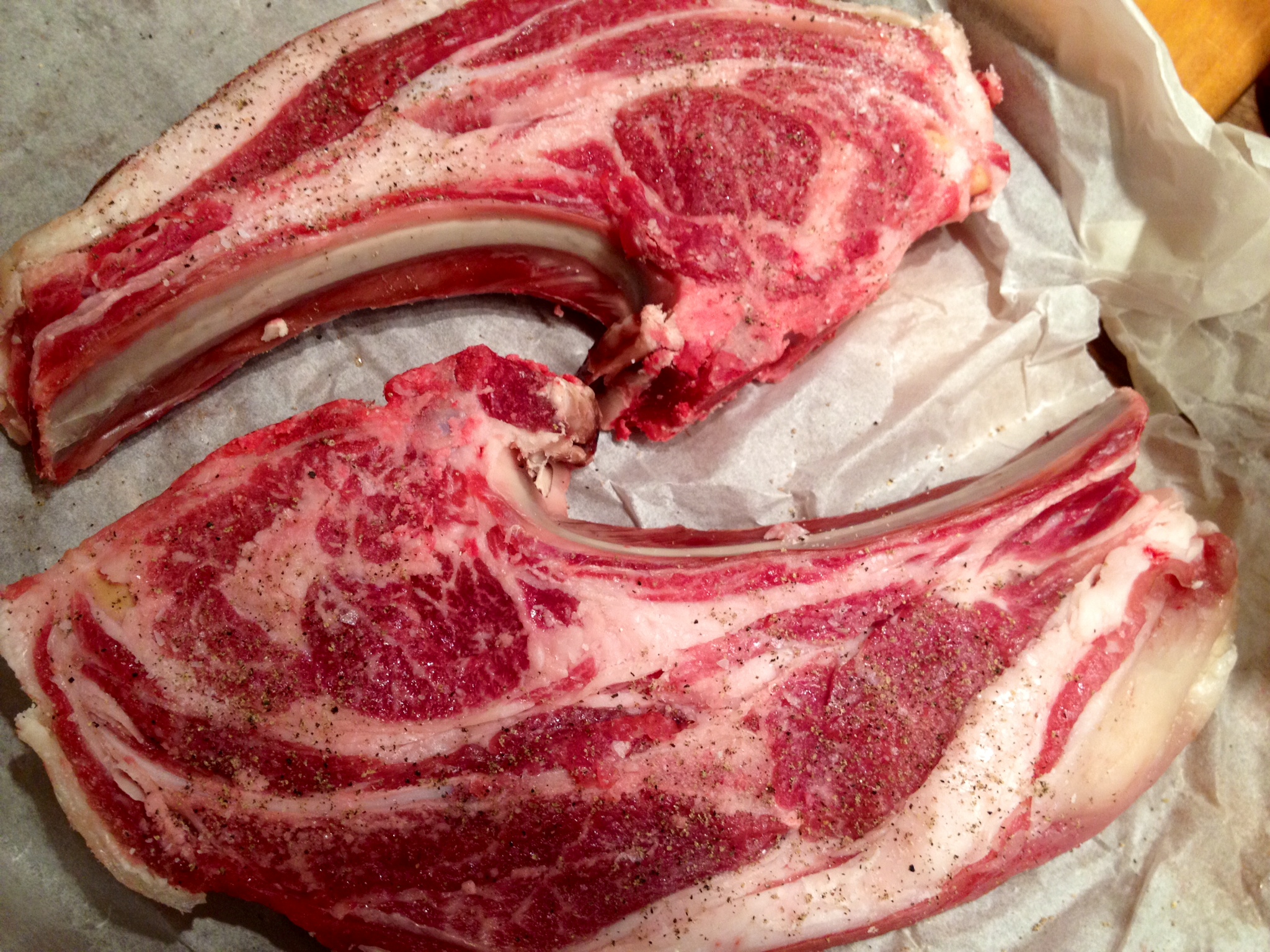
I went for the shoulder chop, which Adam had explained was far more flavorful than the more conventional (and expensive) loin or rib chops. Adam is a big proponent of the complex flavor and marbling that come with a muscle that works hard. He also encourages the consumption of older animals and challenges the commonly held notion that they are tough. It turns out that a sheep is classified as lamb up until it reaches a year old. Between one and two years old, it is a hogget. And, after two years, it becomes mutton. This older meat is darker in color and offers the deeper flavor that lamb aficionados seek.

Mutton Shoulder Chops, Raw

I had plans to go out to dinner. On my way to the train, I dropped my friend a text that there was a change in plan and that he should meet me at my apartment for some serious meat. An hour later Justin arrived bearing the ingredients for Hemingway Daiquiris and I set to work preparing our feast.

Hemingway Daquiris

With the winter CSA season behind us and summer still months off, I find that I have to go to great lengths to get my quota of good quality fresh vegetables. Luckily, I had swung through the Union Square Greenmarket on my way to the workshop (which, incidentally, was in a very cool test kitchen behind an unmarked door).

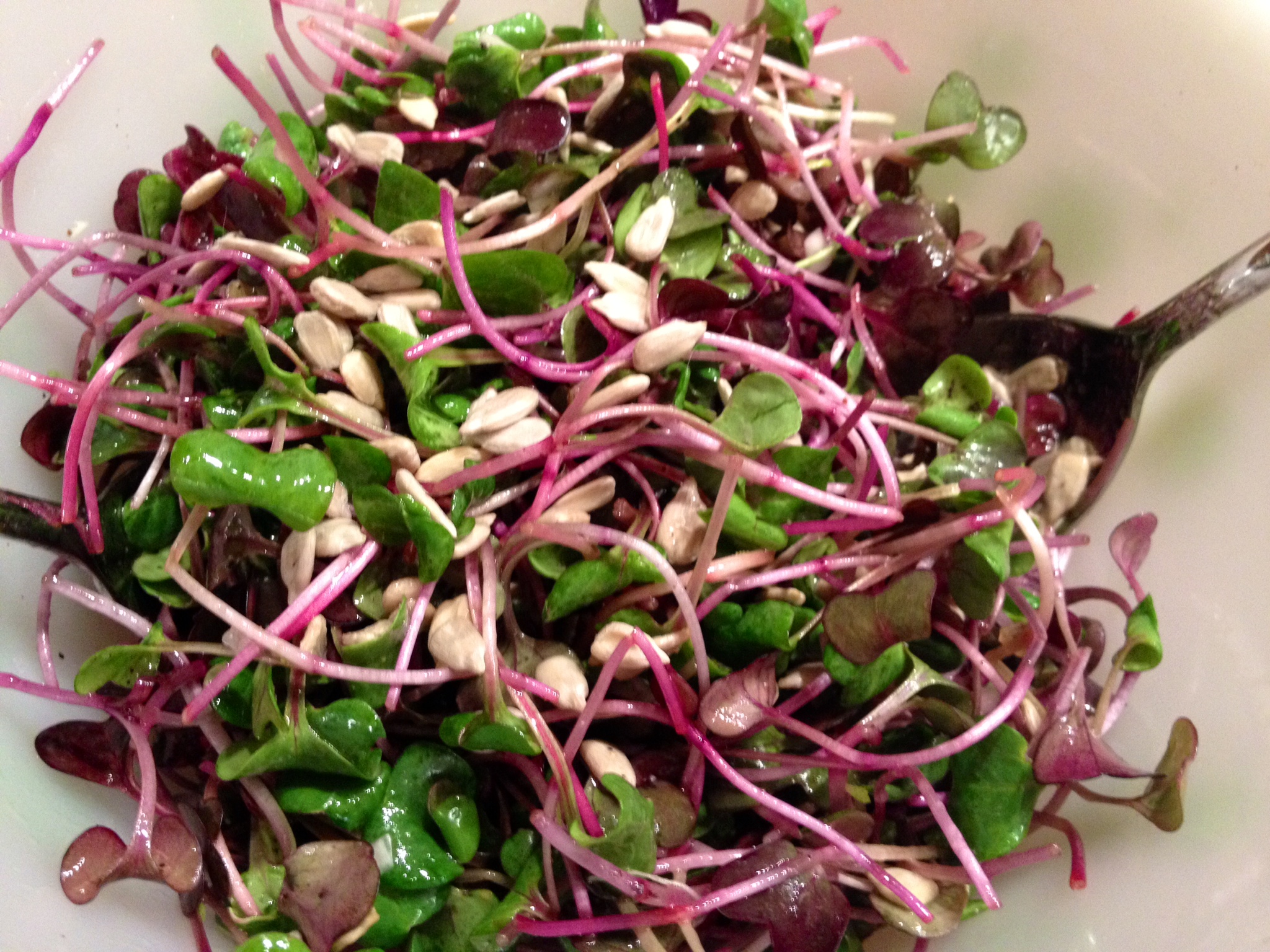
I kept the preparation of the meat and the accompanying dishes simple to highlight the mutton flavor. I stuck a cast iron skillet in the oven while it pre-heated. Meanwhile, I peeled and chopped a celeriac bulb, a couple of parsnips and a large sweet potato. I tossed these root vegetables with some sprigs of fresh thyme, a tablespoon or two of olive oil, and a good dose of salt and pepper directly in the hot skillet and left them to roast, stirring occasionally. I tossed radish sprouts with sunflower seeds and a simple shallot, rice wine and sesame oil vinaigrette.

Radish Sprout Salad

I brought a large skillet up to medium heat with a tablespoon of olive oil and seasoned the room temperature chops liberally with salt and pepper before tossing them into the pan. I seared them for about five minutes per side and then set them aside to rest while I made a quick pan sauce. I poured off all but a tablespoon of the fat, placed the pan back over the heat, and added a couple of tablespoons of finely minced shallots and garlic. After a couple of minutes of constant stirring, I deglazed the pan with the dregs of a bottle of white wine. Off the heat, I stirred in two tablespoons of finely minced parsley and the zest of an old lemon that I unearthed from the crisper bin. I drizzled the sauce over the chops and we sat down to some truly delicious mutton.

Mutton Shoulder Chops, Cooked

Gingered Chicken Soup with Rice

I am suffering from my third stomach ailment this year. After two days of being laid up, my fever had broken and my energy was back. But a ten-hour workday, punctuated by kale salad, farro, beets and Brussels sprouts put me in my place. I woke out of a dead sleep at 4am and went to retrieve the recycling bin that had been my constant companion earlier in the week.

Somehow I managed to dress for work and get as far as my subway stop before giving up and returning home. On the way I stopped off at the grocery store for an array of easily digestible (mainly white) foods. Breakfast was plain white toast. For lunch, I moved on to a small banana and a can of Coke (a concession to my caffeine addiction). By 7:00pm, I was actually experiencing something that resembled hunger, but suspected I still needed to tread lightly.

I’ve made this soup before in various forms. The ginger is great for stomach ailments and clearing the sinuses. It cooks up in under half an hour and, if you’re feeling a little less peaked than I am at the moment, you can doctor it in all kinds of ways. Even the most basic version is a welcome flavor boost after white bread and bananas.

Gingered Chicken Soup with Rice

  • 2 cups low-sodium chicken broth
  • 1 knob ginger about the size of your last thumb joint, peeled and sliced into very thin matchsticks
  • 1 tablespoon tamari or soy sauce
  • freshly ground black and white pepper
  • 1 boneless skinless chicken breast
  • 1/4 cup Jasmine or other long-grain white rice
  • Optional additional ingredients: rice noodles, egg noodles, spinach, egg, scallions, chives, Sriracha, sesame oil, cilantro
  1. Add the first four ingredients to a small pot, bring to a boil and reduce to a very low simmer. Add the chicken and simmer gently until just cooked through (7-10 minutes). Remove chicken.
  2. Add the rice and continue to simmer for 15 minutes or until tender. Meanwhile, shred your chicken using two forks. When the rice is cooked, slide the chicken back in and simmer another minute or two.
  3. The above makes a lovely, restorative soup. If you want to take it a step or two further, at this point you could do any or all of the following 1) swap rice noodles or egg noodles for the rice (and adjust the cooking time accordingly), 2) add spinach leaves and simmer until just wilted, 3) stir in a lightly mixed egg, 4) garnish with thinly sliced scallions or chives, 5) stir in a shot of Sriracha, 6) drizzle with a little toasted sesame oil, 7) sprinkle with cilantro leaves before serving. 

Gingered Chicken Soup with Rice

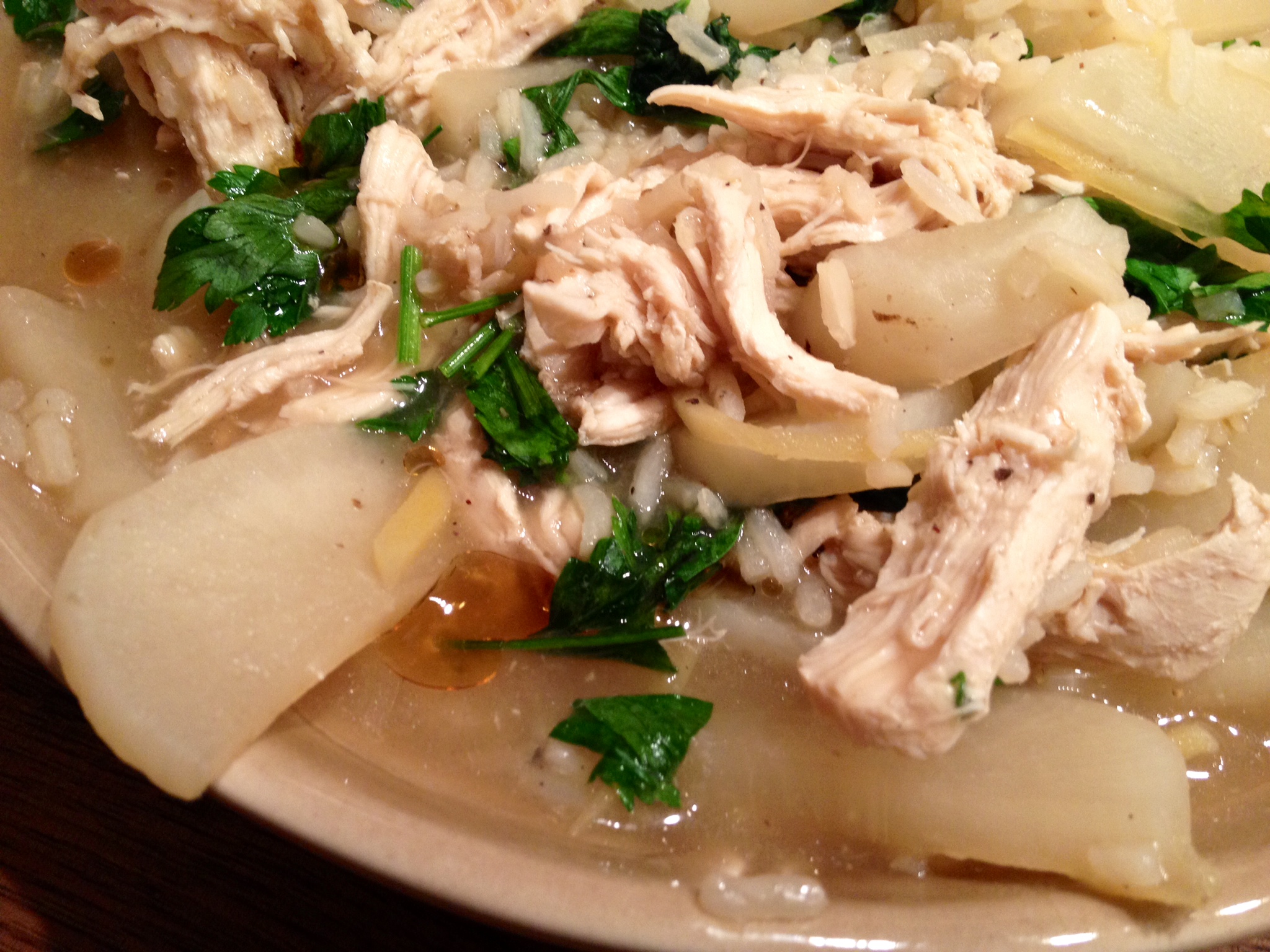
UPDATE: The chicken breasts came three to a pack, so I continued the theme throughout the week. Here’s a version with daikon radish, turnip, parsley and sesame oil that I made the next day, once my stomach had started to recover. The parsley was a sorry substitute for cilantro, but this iteration was otherwise delicious.

Daikon Turnip Chicken Soup

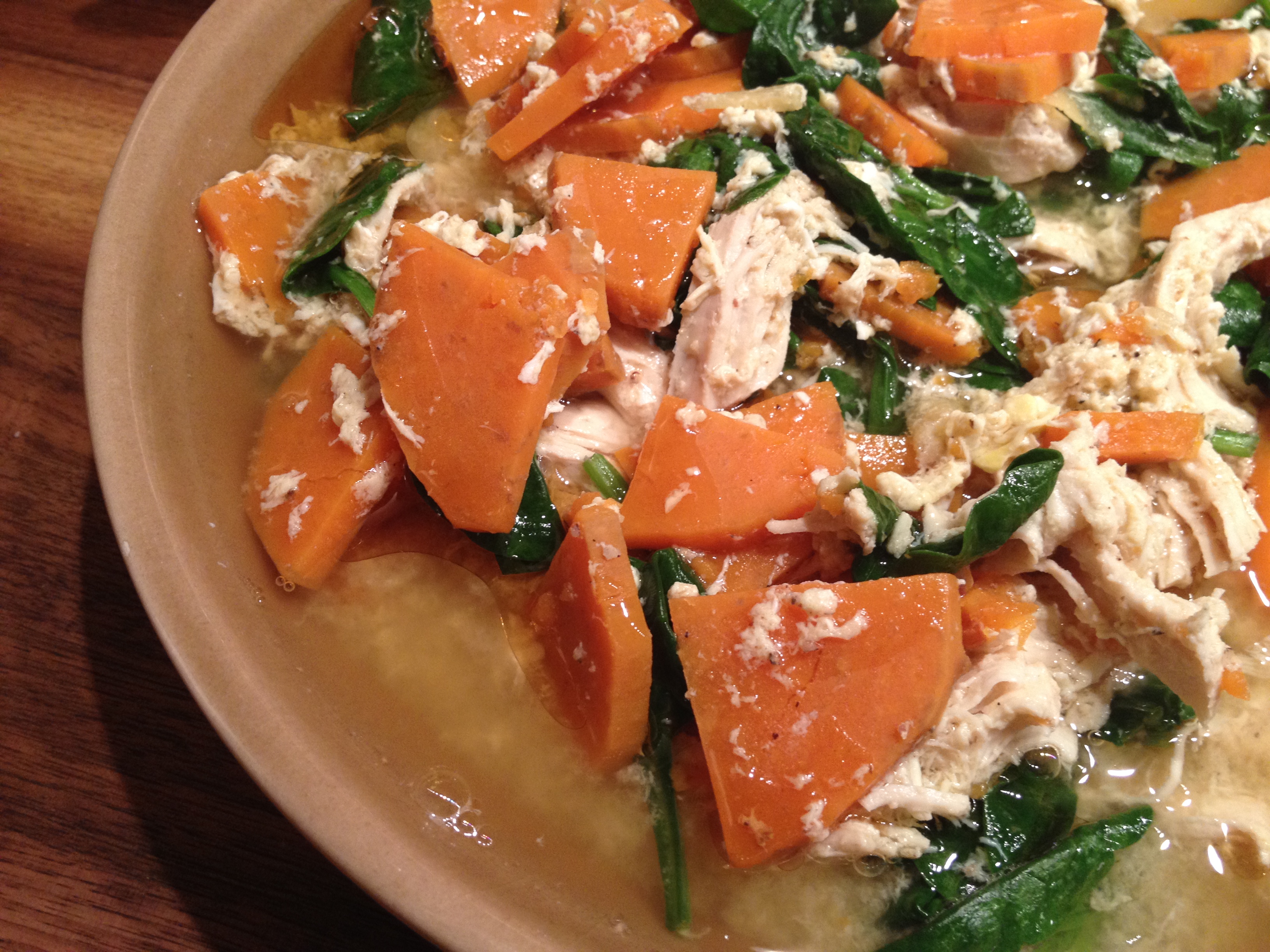
A few days later, when the craving for fiber and complex carbohydrates had kicked in, I swapped the rice for a thinly sliced sweet potato and stirred a bunch of baby spinach and a lightly whisked egg in at the last minute. This was a very nice reentry into my normal food patterns.

Chicken Sweet Potato Spinach Soup

Smoky Creamy Field Peas

I just returned from a truly epic road trip down South. It’s going to take me a minute to put the whole thing down in writing, but suffice it to say that one of the many highlights was consuming five different specimens of pulled/chopped pork in 24 hours. Of all the fine swine that we consumed, the winner by unanimous decision was the unsuspecting plastic-wrapped BBQ sandwich from Cooper’s Country Store in Salter, South Carolina.

Cooper's Country Store

Cooper’s is a classic combination gas station and country store that I suspect hasn’t changed much since it was built at a country crossroads in 1937. Mercifully, they do take credit cards, so we were free to stock up on Blenheim’s ginger ale, locally ground grits, field peas, and all manners of pork. My traveling companions couldn’t resist the lure of the country hams that were curing behind screens. Being a single gal who lives in 600 square feet, I limited myself to several pounds of bacon and smoked ham ends, which would make excellent seasoning meat.

Cooper's Counter

But back to that sandwich. It came on an ordinary enough white hamburger bun. No slaw. No dripping sauce. Just pulled pork meat (whole-hog, as is de rigueur in South Carolina) that was smoky but not overpoweringly so, assertively vinegary, a good bit spicy, and just the tiniest bit sweet. This was the barbecue of our collective dreams.

BBQ Sandwich

Three days later, I found myself back in Brooklyn, catching up on real life. After 36 hours of kale salad, haricot vert and sushi, I was feeling recovered and even a bit nostalgic. The field peas that had made it out of my backpack but not into the cupboard were calling out to me. And, of course, there was that seasoning meat.

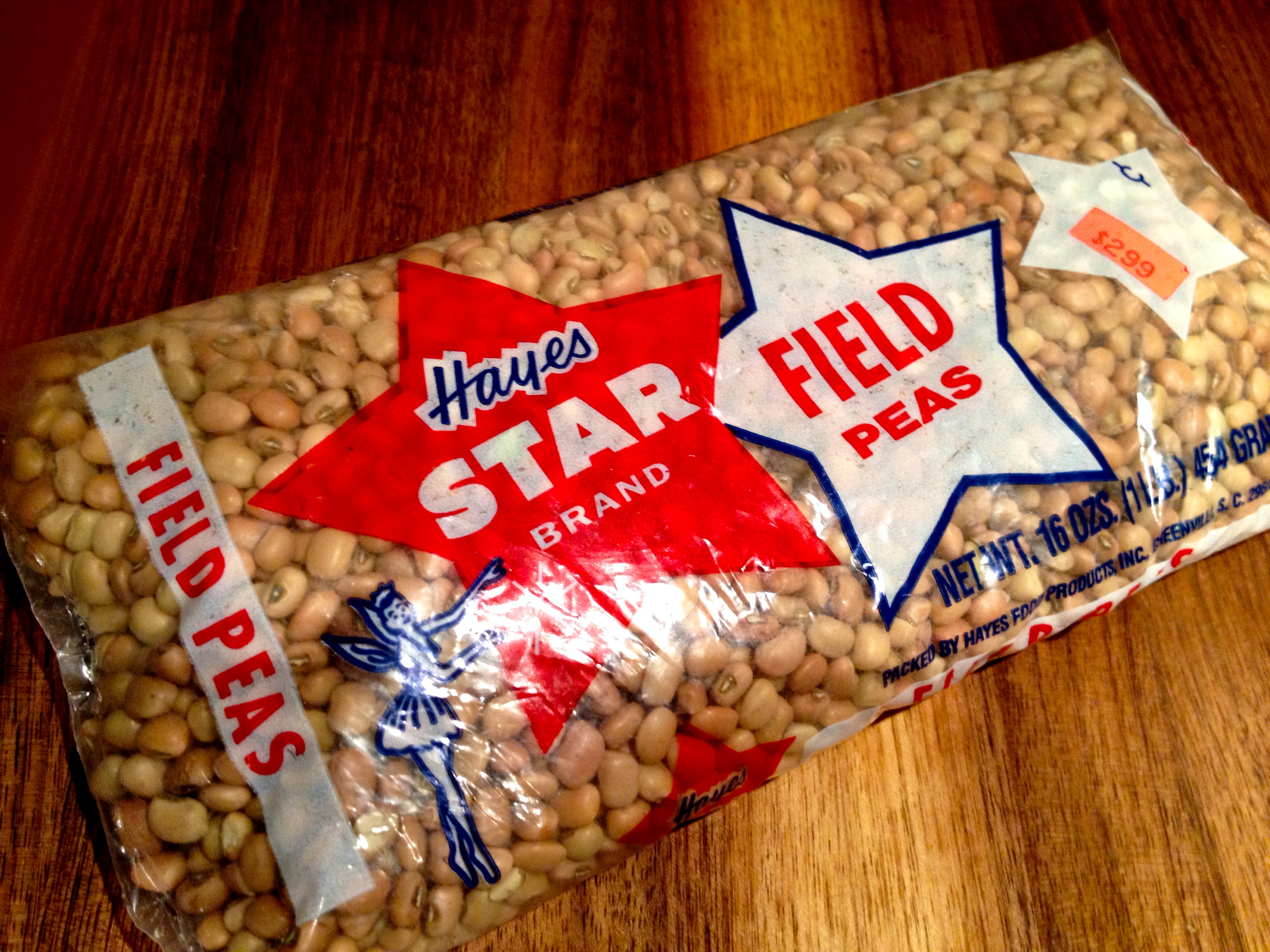
Field Peas

Smoky Creamy Field Peas

  • 1 pound dried field peas, soaked overnight and drained
  • 1 large hunk seasoning meat (approximately the size of a deck of cards), sliced – bacon ends, ham trimmings, salt pork, or what have you
  • 2 medium onions, quartered
  • 2 carrots, cut into large chunks
  • 2 celery stalks, cut into large chunks
  • 3 peeled and halved garlic cloves
  • 1 bay leaf
  • 2 sprigs fresh thyme
  • dried chilis, fresh chilis and/or red pepper flakes
  • 2 or more tablespoons apple cider vinegar
  • 1 tablespoon butter
  • 1 red bell pepper, minced
  • 1/4 cup flat leaf parsley, minced 
  • salt and pepper
  • hot sauce (optional)
  1. Fill a large dutch oven or other heavy-bottomed pot up halfway with water. Add the seasoning meat, onion, carrot, celery, garlic, bay, thyme and chilis. Bring to a boil, reduce heat and let simmer for 15 minutes. Add your peas and let simmer partly covered for approximately 45 minutes or until tender but not falling apart.
  2. Remove and discard the veggies and herbs. Pull out the seasoning meat and dice into small pieces. Unless you are feeding a crowd, remove a pint of the peas and most of the cooking liquid, reserving for future use. (Beans freeze brilliantly.) Scoop another pint into your food processor with a bit of the liquid and let run until they form a paste.
  3. Add 2 tablespoons apple cider vinegar. Taste your beans and adjust seasoning with salt, black pepper, more vinegar, and a little hot sauce of your choice. (If you used country ham ends like I did, you may even be able to forgo any additional salt.) If needed, add back a bit of your cooking liquid.
  4. Add butter to a small skillet over medium heat and sauté the bell pepper until just soft. Stir this into your beans along with the parsley and remove from heat.

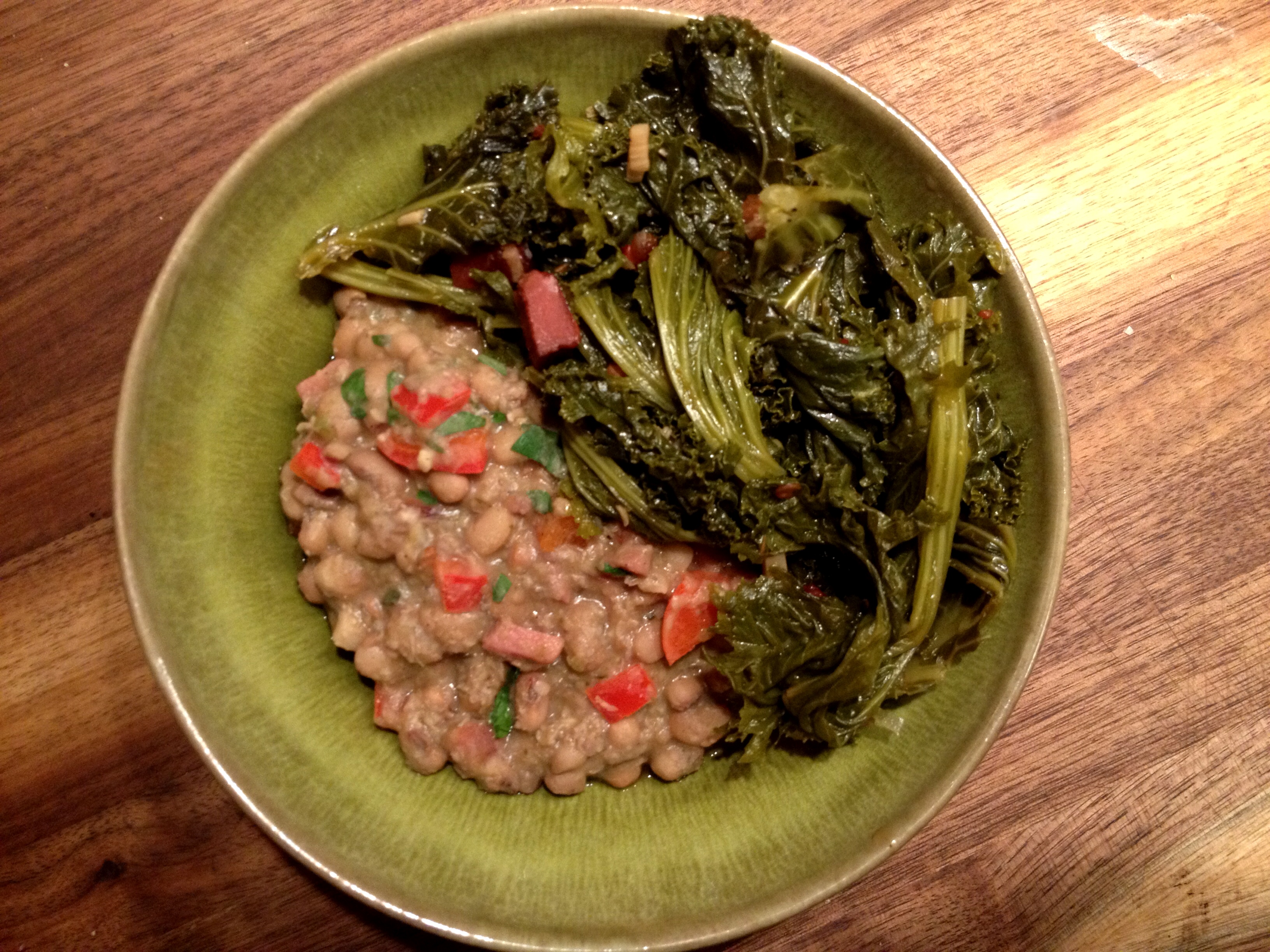
Field peas are traditionally served over long-grain Carolina rice. But, if you happen to have a pot of kale and mustard greens slow cooked with some more of that seasoning meat, that would do fine too.

Field Peas and Greens