- Pick up one quart of strawberries from CSA and take them home.
- Put strawberries in colander and rinse gently.
- Eat strawberries standing at the kitchen counter. Yes, the whole quart. At some point, you may conclude that wasting even a bit of the perfectly ripe flesh around the stem is unacceptable and just pop the strawberries in your mouth whole, leaves and all. This is a reasonable solution.
A Note on Chile Peppers
This week continues to be challenging. I didn’t make it home until around 9:00 last night, by which time I was ravenous. I keep corn tortillas on hand for just such a situation. A few tortillas, half a tablespoon of olive oil, a red onion, a sweet red pepper, a jalapeño, some feta and the less brown half of an abandoned avocado became my dinner in about 15 minutes.
The tacos were tasty but, in my haste, I forgot a few key tips for working with chile peppers.
- Cut off the tip and taste to assess hotness. Each pepper is unique. I’ve had jalapeños as mild as a green bell pepper. I’ve had jalapeños that were scorching. Let’s just say that my lower lip is looking a little bee stung today.
- If the pepper is hot, minimize skin contact. When you cut a pepper, you release capsaicin, the chemical that creates that delicious hot feeling. The more you cut it, the more you release. Some folks recommend wearing plastic gloves. I used to think this was ridiculous–until I met some seriously hot habaneros while making black bean dip. My hands stung for about 24 hours and were tingly for a few days after that. I tried milk. I tried oil. I tried vinegar. I tried harsh detergents. Nothing but time worked. I have yet to buy gloves, but I do make an effort to only touch the outside of the pepper and let my knife do most of the work.
- If your hands do absorb the heat, BE VERY CAREFUL what you touch. You can generally gauge whether one of your fingers is tainted it by sucking on it a bit. You could also gauge this by removing your contacts or by touching some mucus membranes (think soft, fleshy pink parts), but I DO NOT recommend this technique.
- If you want to minimize the heat, remove the ribs (the white part on the inside) and the seeds. If you are in a hurry and do not bother with this, you may end up with some very zesty tacos. Obviously, if you really want to amp your dish up, go for the whole thing.
- Using multiple sources of heat will yield a more complex flavor. In the case of these quick weeknight tacos, I stuck to the jalapeño and some fresh-ground black pepper. But, when I’m making chili or some other slow-cooked dish with layers of flavor, I generally go with a combination of fresh and dried chiles, chile powder, and/or hot sauce.
- Use caution when cooking chile seeds. If you’ve got a soup or a stew or some kind of braise going on, no worries. If you’ve got a hot cast iron pan with minimal oil, you may end up burning the seeds. If you live in a small one-bedroom apartment with no cross ventilation, this could be rather unpleasant. Boys and girls, can you say “pepper spray”?
Quick Roasted Roots
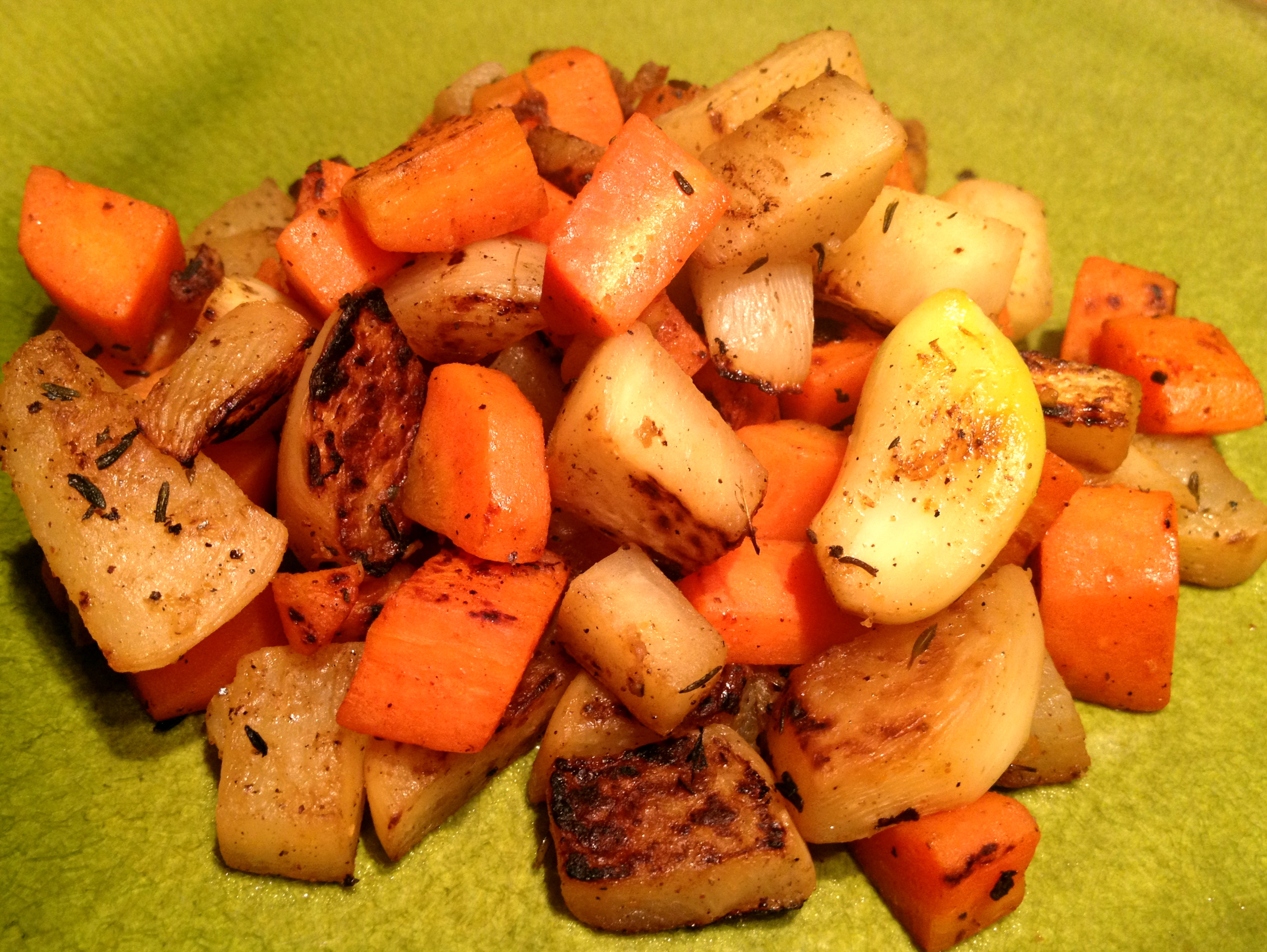
By Monday afternoon it was clear that this was going to be a rough workweek. I made it home by 8:00 the next night, but I still had some urgent work to do. And I was seriously hungry. In the crisper, I found some (slightly moldy) turnips, carrots and a garlic bulb that were left over from a trip to the farmers market a few weeks back. I could work with this.
Most home cooks know how to roast root vegetables in the oven. (Toss the vegetables in olive oil, salt and pepper; spread them in baking pan; and roast at 400-450 until they are cooked.) But sometimes it’s just too hot or you are just in too big a hurry to consider turning on the oven. Here’s a basic technique for roasting root vegetables on the stovetop.
- Bring a cast iron skillet up to medium heat with just a little oil. In this case, I used a tablespoon of olive oil.
- Add your aromatics. I used six whole peeled garlic cloves, which I toasted in the oil until they were fragrant and starting to brown. You could also use onion, shallots, garlic scapes, leeks, etc.
- Dice your roots and add to the pan. I used three medium turnips (with the moldy bits cut off) and seven carrots, which yielded enough food to pack away an extra serving for some future food emergency. You could also use rutabaga, potatoes, beets, parsnips, any hard squash, yams, fennel, and probably a bunch of other things I’m not thinking of.
- Stir occasionally. You want to allow each piece prolonged contact with the cast iron to promote delicious crispy bits. This also allows you time to log into your work email and put out a few fires.
- Add seasoning. I used sea salt, cayenne, black pepper and dried thyme. Fresh herbs would be nice–rosemary, parsley and the like.
- Make it a meal. The cupboard is pretty bare at the moment, so I went with a frozen Boca Burger that had seen better days. A piece of sausage, a turkey burger or a fried egg would work. Just push your vegetables to one side of the pan to make room to cook your protein and you’ve got some seriously easy cleanup!
Thirty minutes after walking in the door, I had finished work for the night and was sitting down to a healthy dinner. And lo, there was a glass worth of Vouvray left in the bottle.
How to Cook Greens
Dark leafy greens are one of my diet mainstays. The darker, the better. They’re packed with nutrients, including vitamins A, C and K. They’re high in fiber. They provide a nice dose of calcium and iron. They keep well in the fridge. They’re delicious. And they can be your dinner in under 20 minutes…
This is a basic technique that I’ve used with collard greens, kale, mustard greens, spinach, dandelion greens, chard, radish greens, turnip greens, broccoli rabe, beet greens, snow pea leaves and arugula. You should riff on it as you see fit based on your tastes and whatever ingredients you have on hand.
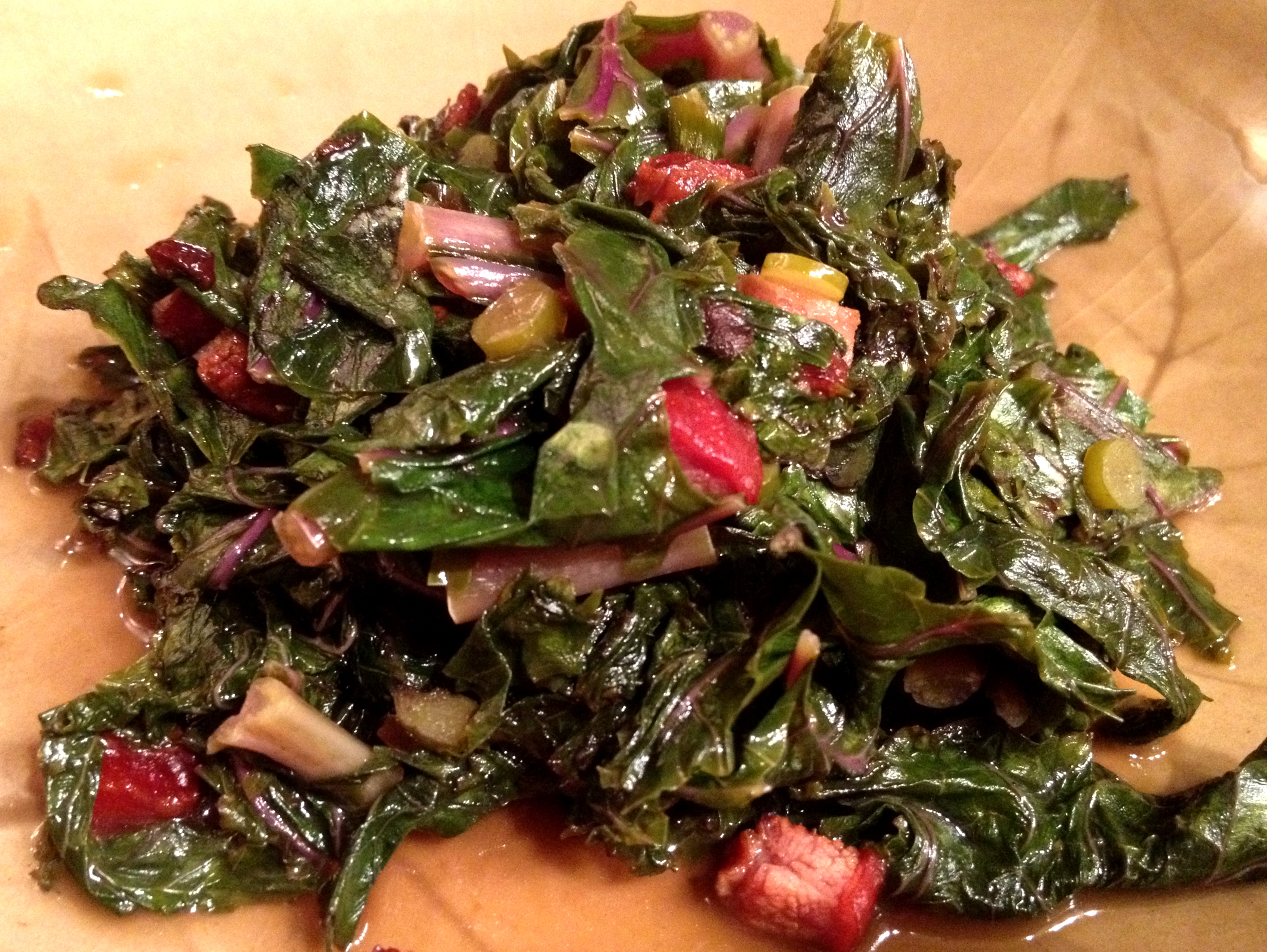
- Heat some fat in a pan. You don’t need much–a tablespoon or so for a whole mess of greens. You can use olive oil, vegetable oil or something from the pork family, preferably smoked. For the greens picture above, I used an ounce of very lean slab bacon, which I rendered with a couple of teaspoons of olive oil.
- Add aromatics. Now you want to flavor your oil with whatever aromatics you have on hand–onions, garlic, ginger, shallots, etc. I am partial to red onion and thinly sliced garlic. Here I used some garlic scapes. I also like to add a little hot dried pepper at this stage.
- Add greens. Make sure to rinse them well, as they tend to be gritty. But don’t bother to dry them; the water left on the leaves will help to steam them in the pan. You may want to slice them. If the stems are particularly tough, remove them or add them to the pan first so that they get a head start on cooking. Greens need more or less time to cook depending on their type, the time of year, how mature they are, how cooked you want them, etc. I am partial to greens that still require some serious chewing. Traditional Southern greens are cooked until they are silky and falling apart. If you want them more cooked, you can always add more liquid (water or chicken broth are nice) and even lid the pan.
- Finish with salt, pepper and a little acid. Lemon juice, tomatoes, apple cider vinegar and red wine vinegar all add a nice counterpoint to the lush mouthfeel of cooked greens. For the kale above, I used white wine vinegar and regular apple cider, which added a little sweetness to what were some very bitter greens. (A pinch of sugar would also do the trick.) You can also add some more heat and complexity at this point by deploying some hot sauce. You can cook for a bit longer to reduce the liquid if you like, but don’t cook it all away. Pot liquor is delicious!
- Make it a meal. Sometimes the greens alone are enough for dinner, particularly if I’ve used andouille or turkey sausage back in Step 1. Sometimes I add a fried egg. Sometimes I serve these up in corn tortillas with feta, salsa and avocado. Sometimes I use the greens as a sauce for whole wheat pasta. I ate this purple kale with some ricotta and a slightly sweet, buttery Vouvray.
Whore’s Radishes
Spending the better part of a day preparing a lavish dinner for friends is a meditative and restorative activity for me. But at 8:30 on a Tuesday night, I just want to get something tasty and nutritious into my stomach as quickly as possible.
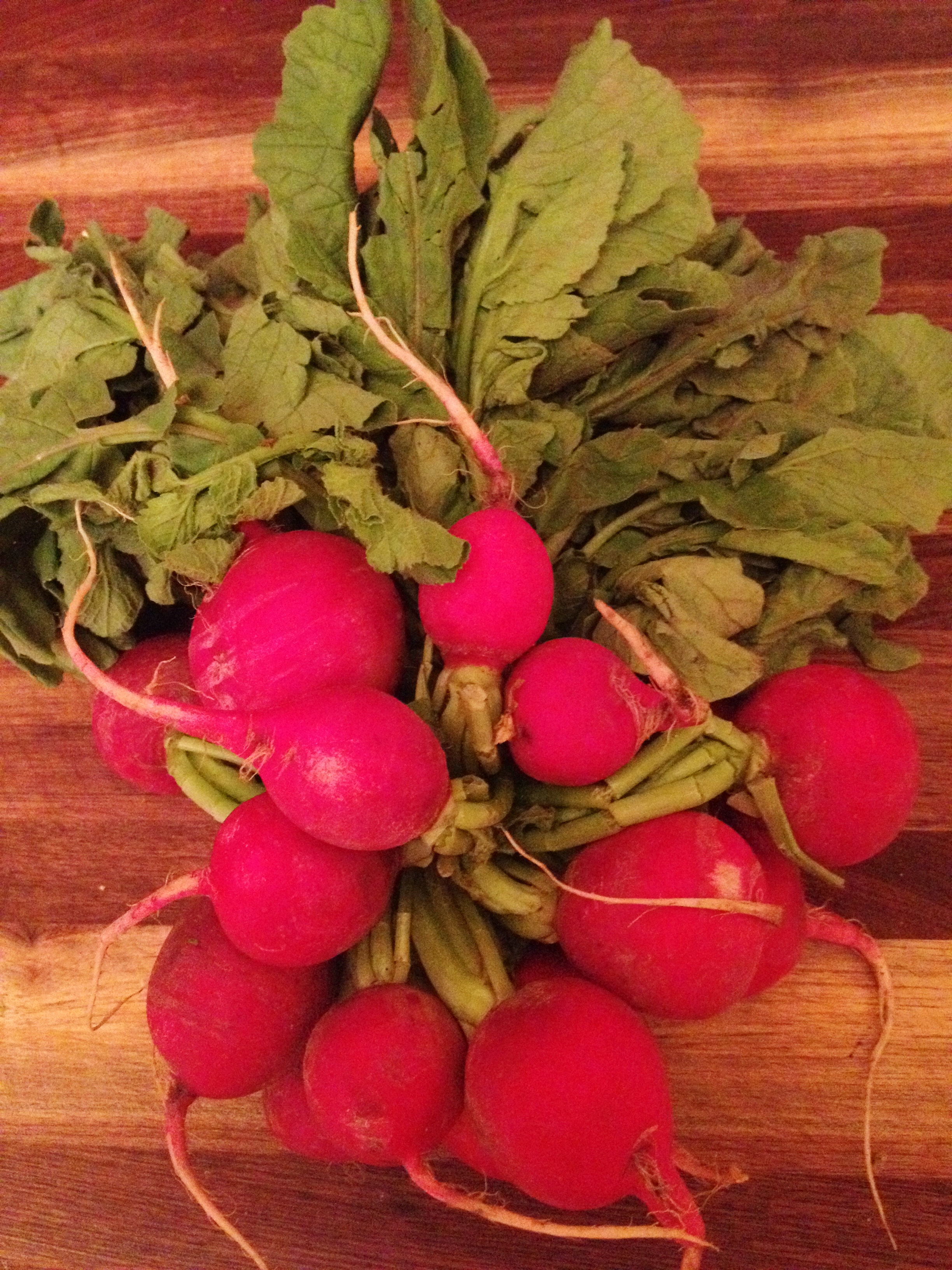
I opened the fridge to discover that the greens atop these radishes were beginning to wilt. If you haven’t caught on by now, I am a bit obsessed with dark leafy greens. Last summer, unable to bear the thought of throwing out such a bounty of greenery (and after having Googled to ensure that they were not poisonous), I decided to try eating the radish greens. They’ve got a slightly rough texture and a bitter, peppery flavor similar to the radish itself, but much more subtle. That is to say, they are delicious.
Tonight I prepared the radishes and radish greens alla puttanesca, which translates as “whore’s style.” There are a number of variations on this, but they all include a variety of savory ingredients–including tomatoes, garlic, onions, chiles, anchovies, capers and olives. Note that these are ingredients that keep well in the pantry or fridge, ready to deliver a burst of flavor whenever you need it.
For this dish, I added a couple of anchovy filets, a tablespoon of olive oil, half a tablespoon of butter (to promote browning), one thinly sliced garlic scape (regular garlic would have been fine, but it’s what I had), and a big pinch of red pepper flakes to a cast iron skillet over medium heat. After a few minutes of stirring, I had a nicely seasoned browned butter. In went the radishes, cut into wedges. I was getting some nice color on them, but they weren’t cooking as quickly as I had hoped, so I added some water to help them along. When the water was nearly gone, I added the radish greens (which you want to wash a little more thoroughly than I did, as they tend toward gritty) and sautéed them. At the last moment, I threw in a tablespoon of capers and 10 or so oil-cured olives that I had chopped and pitted. I finished the dish with some ricotta cheese for a little protein. This would be awesome with some whole wheat pasta.
Scapes and Squid
I’ve been traveling a lot, but this weekend was all about Brooklyn. Prospect Heights, Crown Heights, Park Slope, Clinton Hill, Williamsburg, Bushwick, Boerum Hill, Sunset Park and a 24-hour diner in Bay Ridge were all on the agenda. My friend Dana and her girlfriend Kathleen were coming for dinner on Sunday, so I swung by the Grand Army Plaza Greenmarket. It was, indeed, quite green. I came home with three kinds of kale, mint, chives, baby red jacket potatoes, radishes, sugar snap peas, and garlic scapes. (I also bought squid, hot turkey sausage and slab bacon, but had a tough time working them into this composition.)
I was first lured into buying scapes a few years ago; something about their sinuous curves proved irresistible. A scape is a stem that shoots up from the garlic bulb and produces a small flower. Farmers trim them so that their garlic bulbs will continue to grow. They’re similar to garlic in flavor, but not as sharp. Scapes are tasty cooked, but I think they really shine when eaten raw. Here’s just one in an endless number of riffs on scape pesto. (Note that it freezes beautifully.)
Scape Pesto
- 6 garlic scapes, ends and tips removed
- 1/3 cup marcona almonds (you could use regular almonds, walnuts, pine nuts, etc., though I would recommend lightly toasting them first)
- zest and juice of one lemon
- 3 tablespoons olive oil (good quality, because this isn’t going to be cooked)
- 30-40 fresh mint leaves (this could be basil, parsley, cilantro, etc.)
- salt and fresh-ground black pepper (to taste)
- pinch of sugar (if needed)
Blend the first five ingredients in a food processor, adding water a little at a time to loosen the mixture enough that it becomes a rough paste. (You could also just add more olive oil, but we’ve got bacon and butter coming further down the page.) Add salt, pepper and, if needed, a pinch of sugar to taste.
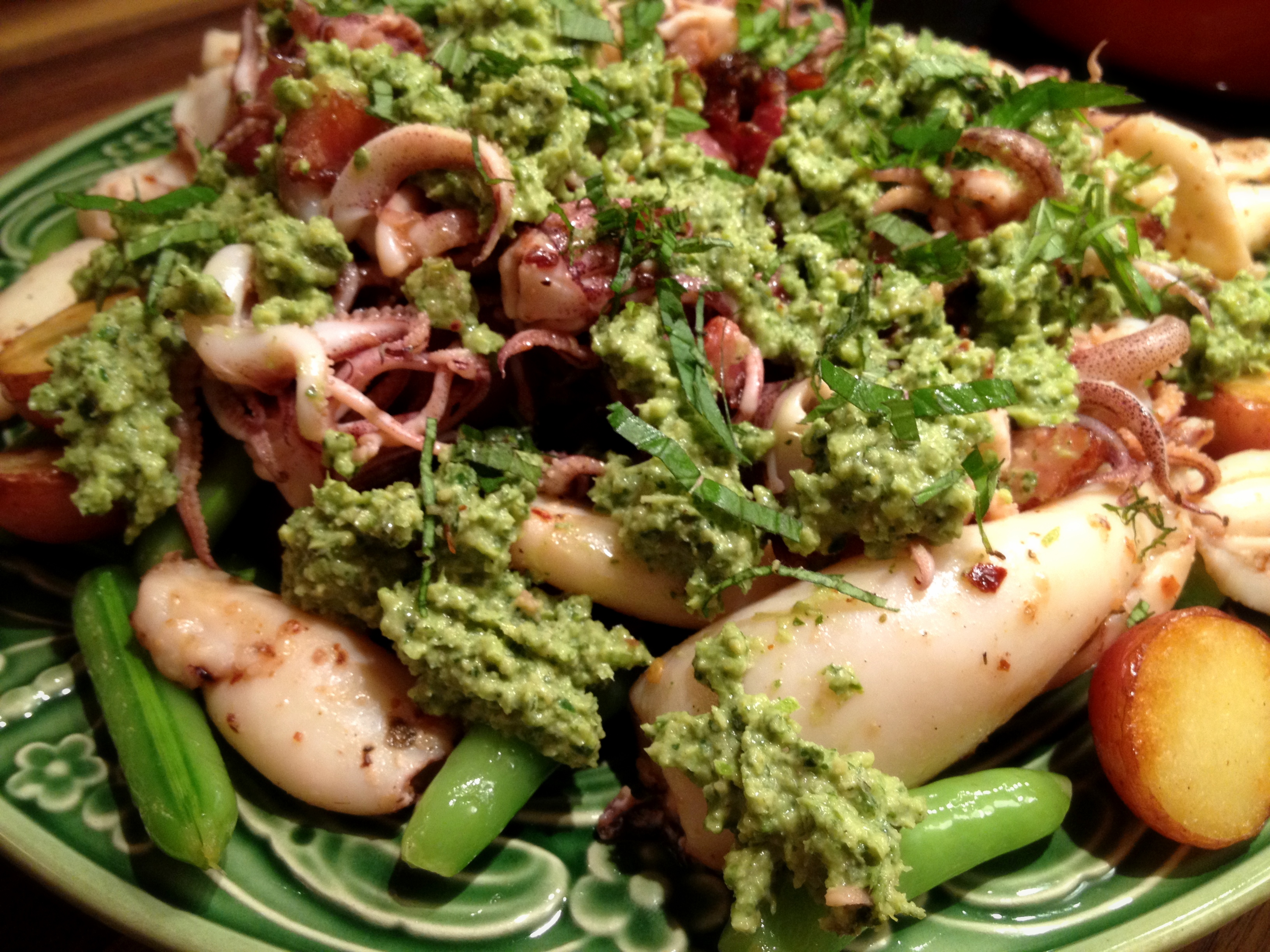
I’d texted Dana from the greenmarket to confirm that she eats squid. Her reply came just as I walked in the door: “I eat squid, but am not the hugest fan ever.” The pressure was on. I didn’t really have a plan, but had gotten it in my head that I wanted to make a single dish that married the scapes, squid, potatoes and sugar snap peas into a sort of warm composed salad.
A lot of people find the prospect of cooking squid intimidating, but it’s easy. The key is to cook it very quickly (grilled, fried, boiled or sautéed) or to cook it very slowly (in a traditional Italian red sauce or a fisherman’s stew perhaps). Anything in between yields the rubbery texture of late-night diner calamari.
Scapes and Squid
- 3 cloves pressed garlic
- 2 tablespoons olive oil
- 1 tablespoon red wine vinegar
- pinch each of dried oregano, Aleppo pepper and red pepper flakes
- smoked sea salt and fresh-ground black pepper
- 1.5 pounds cleaned squid
Combine all ingredients and let sit for at least one hour and up to six hours.
- 1 batch scape pesto (see above)
- 15-20 small red potatoes, cut in half
- 3 cups sugar snap peas, strings removed
- 3 ounces slab bacon (or other smoked fatty pork product)
- 1 preserved lemon (a regular lemon would also work), flesh removed and rind sliced into slivers
- 1 tablespoon butter
- 8-12 fresh mint leaves
While the squid marinates, slice the potatoes and parboil them in salted water until they are just fork tender. Removed the strings from the sugar snap peas and blanch them in the salted water for just a couple of minutes, taking care to cool them down quickly so that they stay crisp and bright green.
At this point, you can knock off and enjoy a glass or two of a nice crisp white wine or a rose until just before you’re ready to eat.
Cut the bacon into small pieces (you may recognize these as lardon) and render them in a cast iron skillet over medium heat.
Meanwhile, in a second pan, melt the butter with the preserved lemon rind over medium heat. When it has stopped foaming, add the potatoes, cut side down.
When the bacon is starting to crisp but is still meaty, push the pieces to the edge of the pan and add as many of the squid bodies as will fit in a single layer. Cook until the squid turns an opaque white on the bottom and then flip. When the other side turns white, pile them at the edge of the pan and add another layer, repeating the process until all of the squid is cooked.
When the potatoes have browned, add the sugar snap peas and stir until they are just heated through.
Spoon the potatoes and peas onto a platter and then add the bacon and squid as well as any juices left in the pan. Drizzle the whole thing with scape pesto and top with some thinly sliced mint leaves.
Dana, the squid skeptic, went back for thirds.
Baltimore Barbecue Brisket Bacchanal
Two years ago, dear friends from Brooklyn relocated to Baltimore. Mercifully, so did Beth and Don’s legendary Memorial Day Barbecue.
We arrived Friday evening in time to hit a block party celebrating Open Walls Baltimore, the (remarkably well-lit) PerVerse poetry reading at Cyclops, Joe Squared for some fine coal-fired pizza, and Mount Royal Tavern–which is everything you want in a local bar.
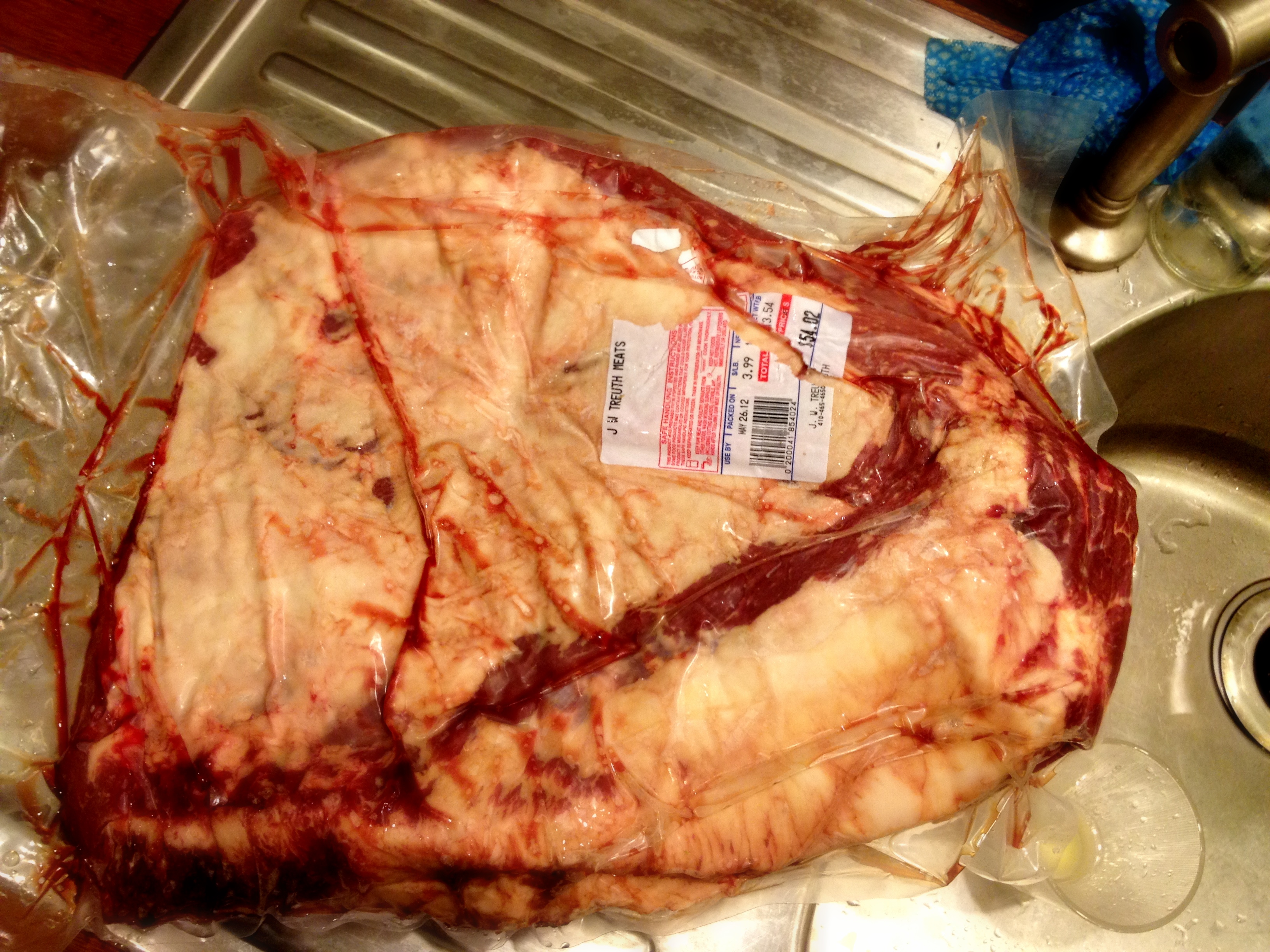
Round about midnight–after several beers and an undisclosed number of glasses of wine–it was time to prep the meat. I had it in my head that I wanted to do a whole, untrimmed brisket, but it turns out those aren’t so easy to come by on a day’s notice. Somehow, overnight Don had managed to source a 13-and-a-half pound cut with a nice fat cap and well marbled flesh. Better yet, he’d gotten it from a local beef packer and slaughterhouse, J.W. Treuth & Sons, at a very reasonable price.
At home I’d assembled a dry rub of salt (about half a cup), hot Spanish paprika (1 tablespoon), cayenne (1 tablespoon), cumin seed (1 tablespoon), sugar (1 tablespoon) and black and green peppercorns (probably a quarter cup in total). I toasted the cumin and peppercorns in a cast iron skillet until they started to make popping noises and then ran them through my pepper grinder. (Note to self: must purchase dedicated spice grinder.)
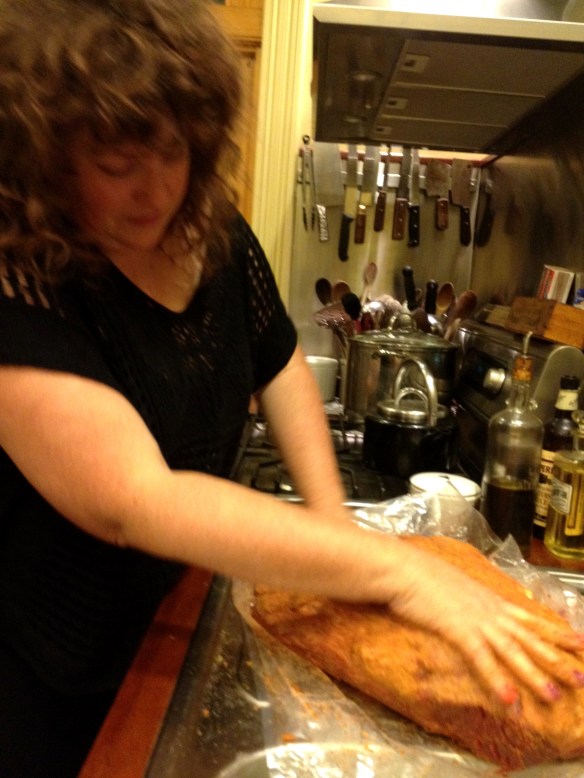
A dry rub contains more salt than seems reasonable and needs time to be absorbed by the meat. There’s really no pretty way to do this, so I removed my jewelry and got intimate with the brisket.
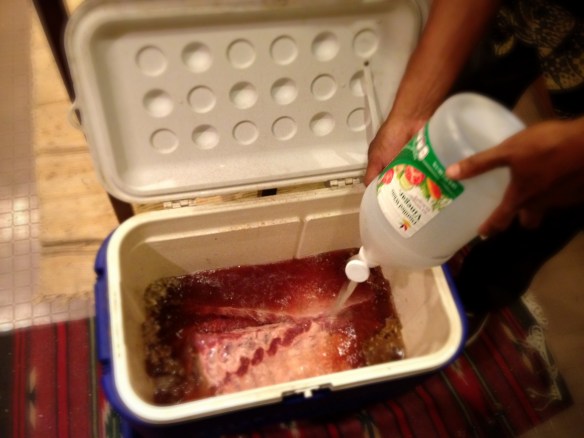
Don had a lot more prep work to do, so I stuck around for a bit carting cuts of meat up from the basement and rooting for spices. He’s famous for his ribs. I learned a couple of his secrets, but I’m pretty sure I’d get in trouble if I shared, so this picture will have to suffice.
Beth spent Saturday baking such wonders as red velvet cake, cherry pie and a tunnel of fudge. Don fired up the smoker with apple wood, fig wood, and some other woods I can’t recall. I spent the day eating crabs (at Cantler’s in Annapolis) and tracking down the perfect summer sandal (at Ma Petite Shoe in Hampden). Later than night in Beth and Don’s backyard we ate mussels marinara brought by a guest who grasped the nature of a potluck but didn’t quite grasp the date of the party.
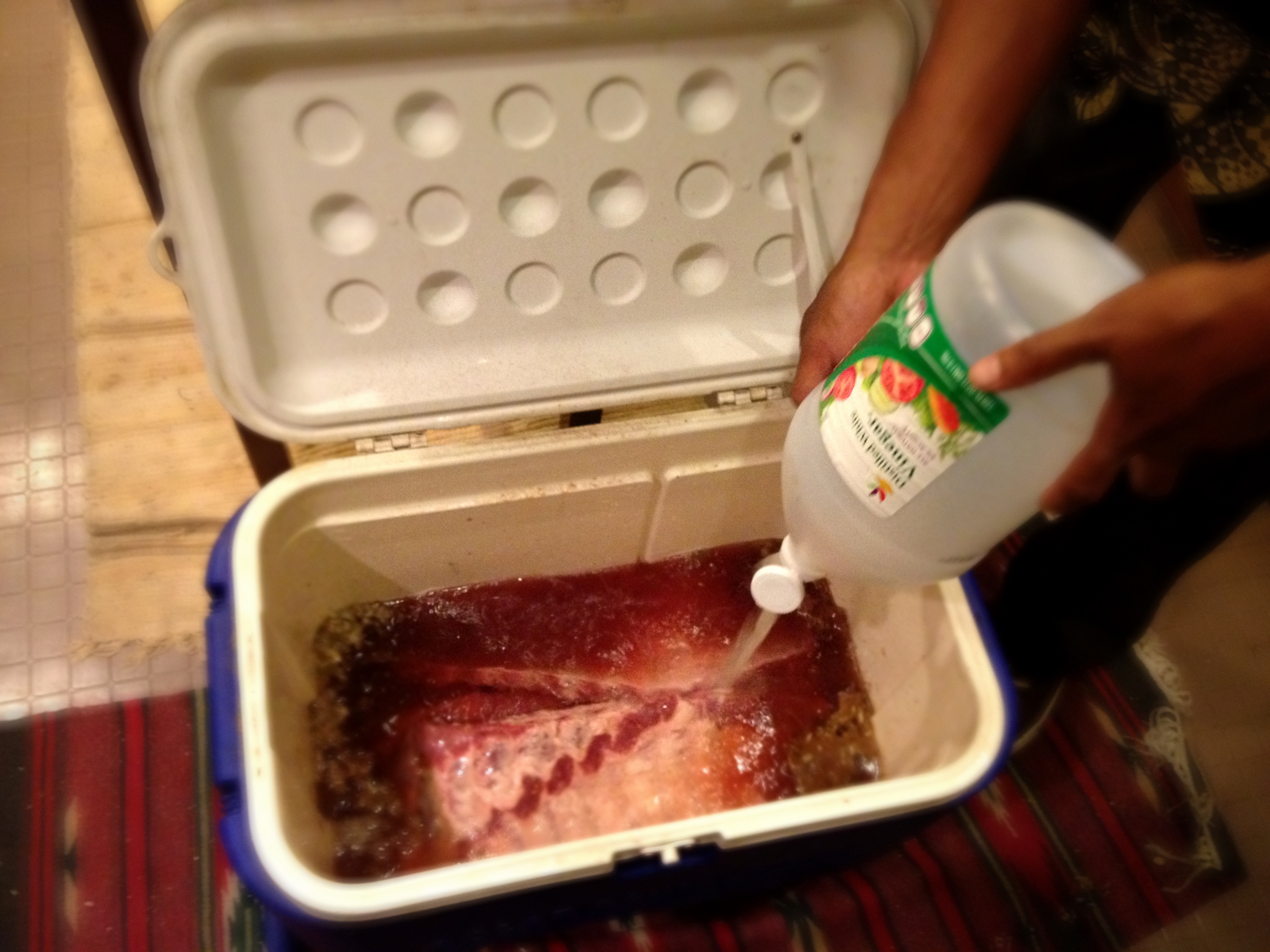
I’d made the mop sauce the night before leaving town. Having started the process at midnight, I was limited to items in my pantry and refrigerator. I managed to dig up four toasted dried whole New Mexico chiles, a red onion, a quarter cup of brown sugar, a whole bulb of elephant garlic, half a cup of molasses, a quarter cup of canola oil, a tablespoon of dried mustard powder, a couple of tablespoons of tomato paste, a quarter cup of tamari, half a cup of cider vinegar, most of a bottle of beer, a shot or so of tequila, some cumin, ground black and green peppercorns, miscellaneous hot sauce… You get the idea. I toasted the chiles in a cast iron pan and then pureed them in the small work bowl of my food processor along with the red onion, garlic and some of the liquid ingredients. I cooked this down in a pot, tasting and adding things as I went, until I was too tired to cook it any more. I think that the key here is that you want a very flavorful but balanced sauce that’s sweet, spicy, salty and tangy all at once.
The ribs and the brisket finished cooking on the grill while the smoker turned its attention to jerked chicken legs, pork shoulder and other meaty delights. I basted the brisket with a mop, periodically flipping the meat and adding layers of sauce to build up a nice caramelized crust on the meat. Flipping it was no joke.
The general rule of thumb is one hour per pound of meat, but it can take longer. Just be sure to keep the heat low so it doesn’t dry out. Our brisket, which had mysteriously shrunk to 12.5 or 13 pounds after some of the menfolk came home from a bar crawl the night before, probably spent 10 hours in the smoker and another three hours on the grill. At this point, I pulled it off the grill and began slicing–thin and against the grain to maximize the tenderness.
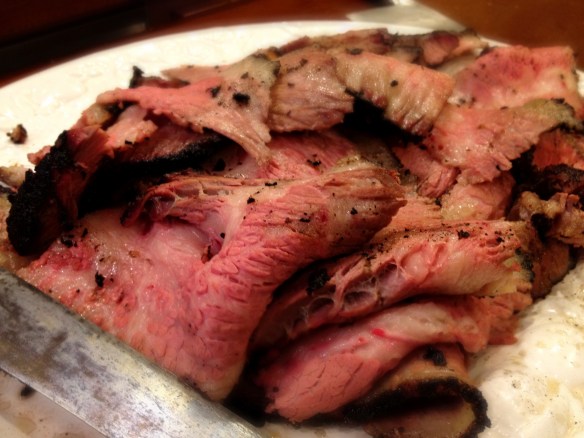
The brisket never actually made it to the buffet table. Folks appeared in the kitchen, plates in hand and devoured the slices as fast as I could cut them. At some point, the thicker end went back in the smoker and Don turned his attention to the ribs. He moved them to the lower rack of the grill and glazed them with his own homemade sauce. This time, as I carved the meat, folks didn’t bother with plates.
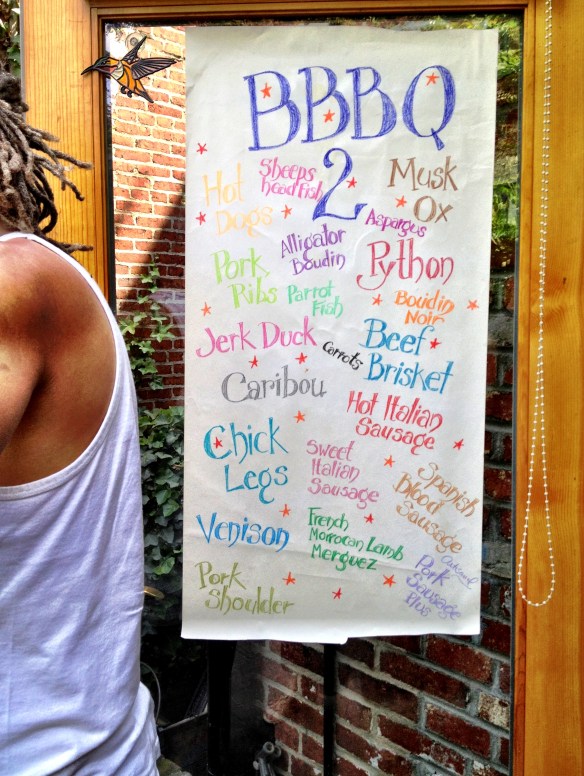
From here things get a little blurry. Kindly eaters swung by the grill bearing offerings of beer, wine and a lethal rum punch. We thanked them with bits of blood sausage, antelope, duck and venison. I hear there was python, but I must have been otherwise occupied at that point. In the words of one of the revelers (whose last name, and I am not making this up, is Bacchus):
For several hours there was a tribute to Don Cornelius in the kitchen with revelers lined up on either side dancing and sweating where in order to get to the patio and grill or back to the veggie and dessert spread in the dining room, you had to strut yourself on a Soul Train line!
And thus Brooklyn and Baltimore worked it off and worked it out on the dance floor…
Absinthe Soup
I’ve been battling a cold for the past couple of weeks. Tonight I made the difficult decision to skip a show to which I already had tickets. Instead, I came home and continued to work my way through the frozen soup collection I’ve been amassing.
On those winter days when it’s too cold to think about going out, I spend my time cooking up large batches of soup using whatever I have on hand. I eat it for as many meals as I can stand and freeze the rest. The plastic pint containers that you get when ordering takeout or buying olives are perfect for a single serving. The key here is to be diligent about labeling each container with the date and the contents.
Tonight’s freezer exploration turned up a particularly tasty soup that I made back in January. I had hosted a cocktail party at which I served bagna cauda, a dip of butter and/or olive oil with garlic and anchovies. I like to add some red pepper flakes and parsley. You serve it warm (hence the translation: “hot bath”) with raw winter vegetables and hunks of bread for dunking. The bagna cauda paired brilliantly with both the Prosecco and the Negronis.
The next morning found me with a headache, sticky counters, and a bunch of leftover fennel, endive and cauliflower. The vegetables were beginning to brown where I had cut them. Delicate spinach intended for a salad was also begging to be consumed.
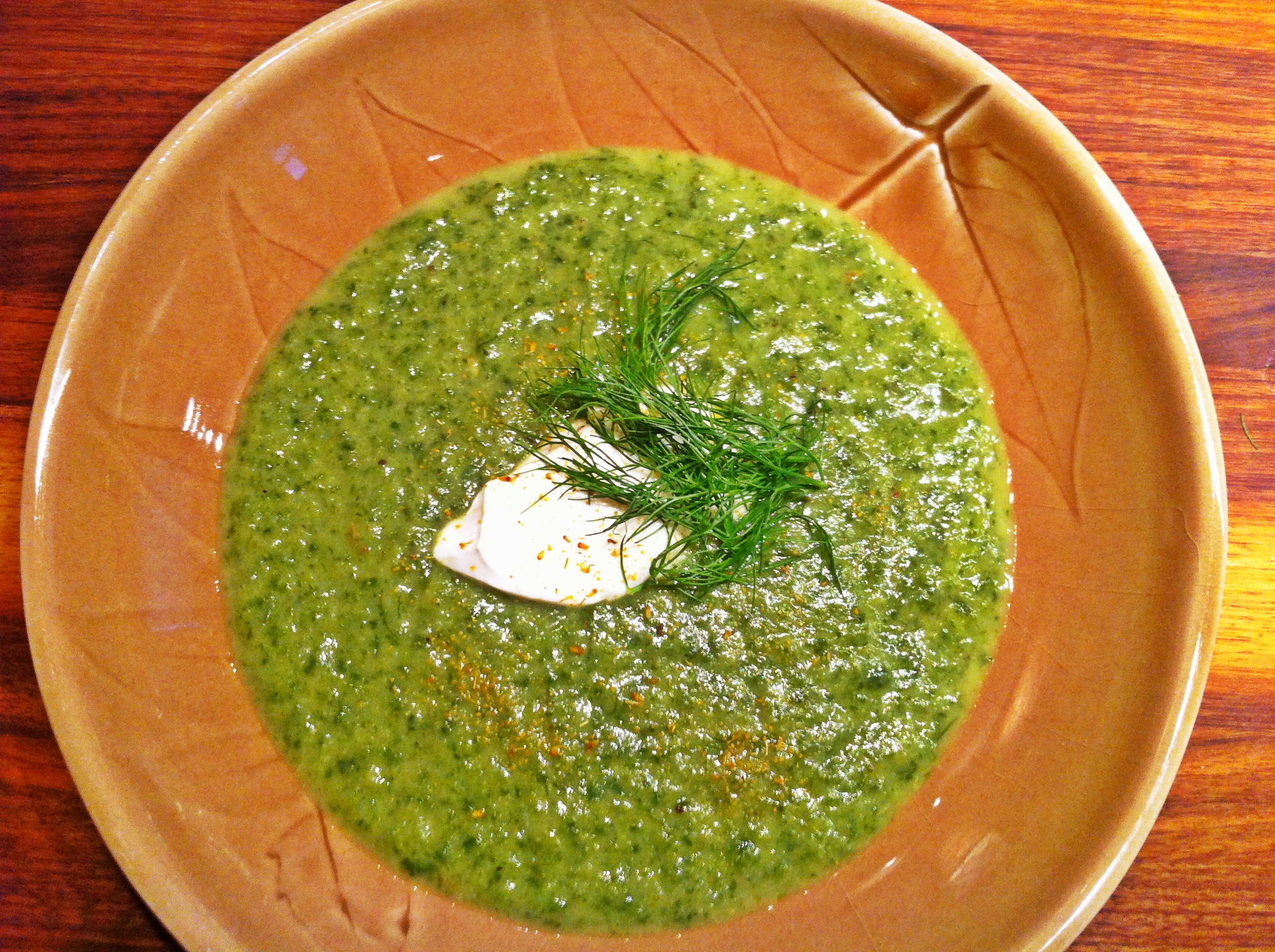
There are a few basic formulas for making soup. This one involves sweating the aromatics, adding the vegetables, gently simmering them in broth, and then pureeing the mixture. That’s it.
The absinthe was a last-minute addition that took the soup to a new level. Tonight it almost made me forget that I am missing Beth Ditto’s performance. Hopefully a cough syrup nightcap will finish the job.
Absinthe Soup
- 3 tbsp butter
- 2 tbsp olive oil
- 1 red onion, diced
- 1 fennel bulb, diced
- 4 cloves garlic, pressed
- 2 tsp fennel seed
- pinch cayenne
- pinch powdered ginger
- pinch nutmeg
- 2 cups chicken stock, 2 cups water
- ⅛ cup absinthe
- ½ head cauliflower
- 2 bunches spinach
- 1 head endive
- salt
- pepper
- sherry vinegar
- lemon juice
- garnish with plain yogurt, fennel fronds, fennel pollen
- Melt the butter with the olive oil over medium-low heat. Add the red onion and fennel and cook stirring frequently so that they do not brown.
- When the onion and fennel are soft and becoming translucent, add the garlic, fennel seed, cayenne, ginger and nutmeg. Cook stirring constantly for a minute or two.
- Add the chicken stock, water, endive and cauliflower and simmer gently until the cauliflower is soft. Add the spinach and absinthe and simmer for another 10 minutes – or maybe less. (You want the spinach to retain its bright green color.) Puree using an immersion blender or in batches in a food processor or traditional blender.
- Taste and adjust the seasoning as desired with salt, pepper, sherry vinegar and/or lemon juice. Ladle each serving into a bowl and garnish with plain yogurt, fennel pollen and the fennel fronds.
Gumbo in 10 (or So) Easy Steps
I made gumbo for the third time on Friday and was pleased to see that, once you have the basic concepts down, there are an endless number of ways to riff on this tasty one-pot dish. Pictured here is Friday’s creation, which featured bacon, smoked Louisiana sausage, Maine shrimp tails, okra and mustard greens (these first three ingredients being just a sampling of the proteins lurking in my cramped freezer). Some might consider the mustard greens to be heresy, but I thought that they made for some nice flavor and texture contrast.
What follows is a step-by-step documentation of my very first gumbo. By following these steps, you can make a delicious gumbo using whatever meats, seafood, stock and produce you have on hand. It’s a great way to clean out the freezer.
STEP 1 – Gather a bunch of meat and brown it in batches in a nice big heavy-bottomed pot. In this case, we have duck breast, andouille sausage, kielbasa and smoked hog jowl.
STEP 2 – While you’re browning the meat, dice your veggies. Celery, onion and green pepper (“the holy trinity” of Cajun cooking) are traditional. Carrot, red bell pepper and garlic are nice additions. You can also add jalapenos or other hot chile peppers, if you’re into that kind of thing.
STEP 3 – Transfer browned meat to an even bigger heavy-bottomed pot, add liquid and begin to simmer. An odd beer, some leftover red wine, clam juice and homemade stock from last Thanksgiving’s turkey carcass are just fine. (In the case of the shrimp gumbo pictured above, I used the shrimp shells along with some garlic, celery, carrot, a bay leave and whole black peppercorns to make a quick stock. You could also use a ham hock, which is a great thing to keep stashed in the freezer for soup and stew emergencies.)
STEP 4 – Now it’s time to make the roux. Add approximately as much flour as you have rendered fat from browning all of that meat and start whisking. If you’re low on fat, you can supplement with whatever hard fat you have on hand – butter, schmaltz, lard, vegetable shortening, etc. A cup of fat and a cup of flour will do you right for one large pot of gumbo.
STEP 5 – Keep whisking. I recommend NPR podcasts to keep you company.
STEP 6 – Now would be a good time to crack open a beer. But don’t stop whisking. The key is not to let it burn.
STEP 7 – When you can’t stand to whisk any more, you’ve got your roux. If you taste it, it will not be yummy. Do not be scared.
STEP 8 – Add your chopped vegetables into the roux and stir frequently until they start to soften. Toss in some herbs. Fresh or dried thyme, oregano and basil are all welcome. Cayenne, paprika and other dried chiles can also be added. Then dump it all, plus some bay leaves into the really big pot with the simmering meat.
STEP 9 – Let is simmer and simmer and simmer. At some point, you’ll want to pull any large hunks of meat out and shred them. Maybe turn the burner off, lid the pot and take a nice bike ride. While you’re out, pick up some really cheap french bread to serve with the finished product. It’s traditional.
STEP 10 – Fire the burner back up and keep simmering. Taste and adjust seasoning with salt, pepper, whatever hot sauces you have in the fridge, maybe a little more wine, some vinegar, etc. Make a batch of Sazeracs. Make another batch. Make some long-grain white rice. Add some okra, some chopped up oysters, some parsley and anything else your heart desires. Have some more Sazeracs. Just don’t get so drunk that you forget to take a picture of the finished product. Oops.
Fromage Fort
This one is so easy I feel a little guilty. I recently hosted a wine tasting at which I served a selection of cheeses.
OK, fine, I did more than taste the wine. It was all I could do to toss the remaining cheese hunks into a plastic container and shove that into the fridge before my face hit the pillow. Four weeks later, I unearthed the container and found a triple-cream Brie, some aged Gouda and a little nugget of Fourme d’Ambert that were beginning to assume one another’s identity.
I had a hazy memory of a French cheese dip that was made for just such a situation. A quick search led me to fromage fort. Traditionally, it’s made with white wine, garlic, fresh herbs and black pepper. I skinned the Brie and pinched off hunks that I dropped into the food processor along with the Fourme d’Ambert and the aforementioned wine and seasonings (thyme being the only fresh herb I had on hand). The Gouda was hard, so I grated it with a rasp—one of my all-time favorite kitchen tools. I ran the processor for a few minutes and sampled the results, which were a little boozy. I had some leftover Ricotta and a rapidly aging Romano in the fridge, so in they went to provide balance.
Now it was starting to taste good. Never one to leave well enough alone, I decided to see what I could do to improve upon the flavor and create a nice complement to tomorrow night’s Sazeracs and gumbo. Dried mustard, cayenne, smoked paprika and just a pinch of sugar created a well-balanced cheese dip that you could eat with a spoon. I did.