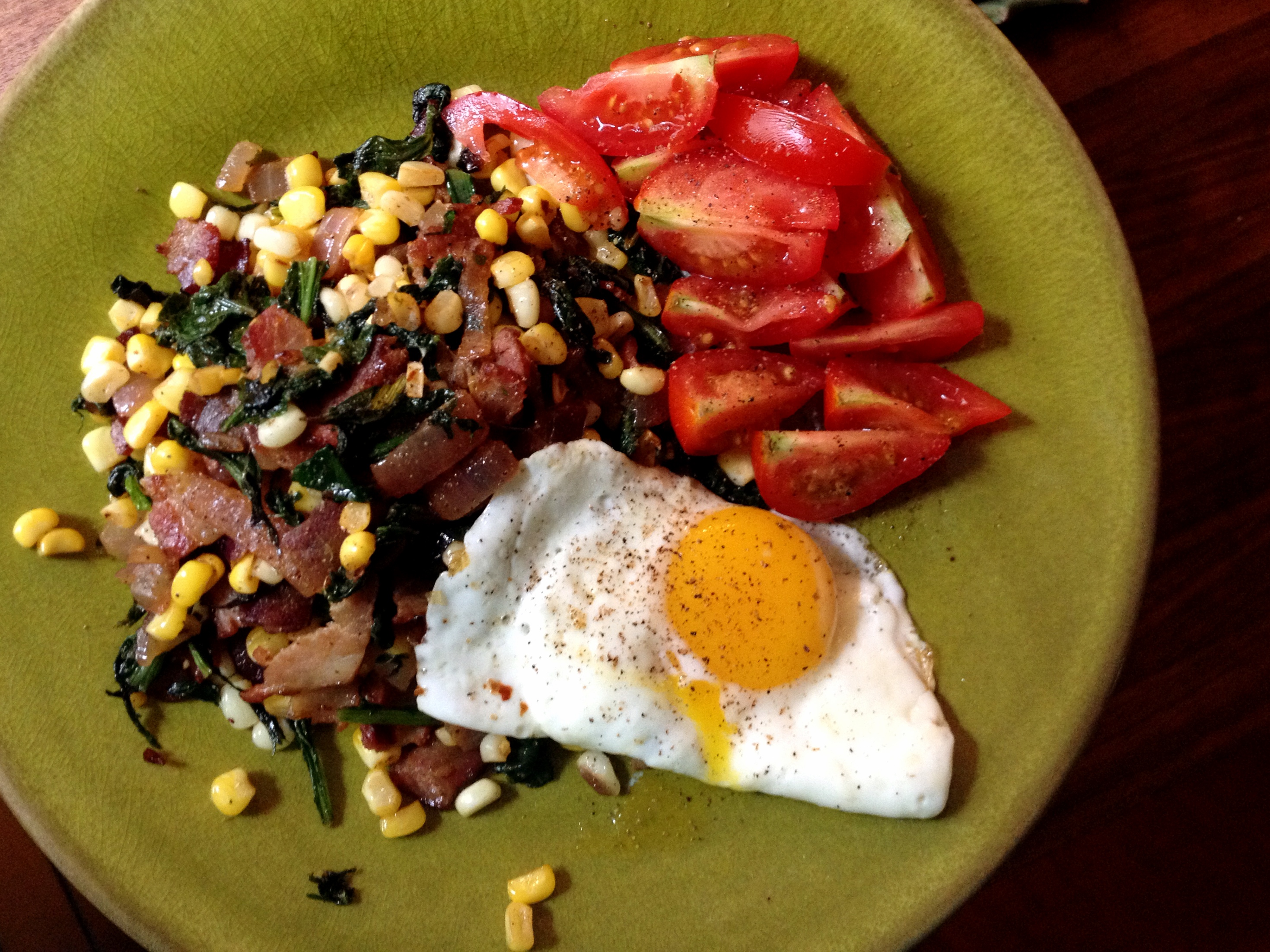
A succotash of bacon, red onion, mustard greens and corn topped with a fried egg may prove helpful when last night’s dinner consisted of margaritas, olives and Sauvignon Blanc.

A succotash of bacon, red onion, mustard greens and corn topped with a fried egg may prove helpful when last night’s dinner consisted of margaritas, olives and Sauvignon Blanc.
Between a broken ankle and the beginning of a new school year, I’m a bit behind on consuming my CSA vegetables. This weekend found me with a cooking date with my dear friend Leila and an abundance of green beans, tomatoes and potatoes. My first thought was some sort of Indian curry. But I seem to be out of rice.
Autumn has arrived in New York City. The sunlight is a distinct shade of gold and the air is crisp. My apartment, which is excessively hot in both summer and winter, has finally dropped below 76 degrees. (I know this because the coconut oil in my pantry has begun to crystallize.) After months of chopped salads and quick cooking on the stovetop, I found myself longing for a hot dish and the heady aroma that accompanies an oven bake.
Thus was born this potato, lamb, green bean, tomato and feta casserole.
Greek-Style Casserole

Since my first cardboard box of Lemonheads (slipped to me by my grandmother when my natural-foods-pushing parents weren’t looking), I’ve been hooked on sweet and sour. Give me a package of Fun Dip or some Haribo Gummi Grapefruit Slices over a piece of chocolate cake any day. And my dad’s deep love of peanut butter (all natural, stirring required, of course) introduced me to the notion of sweet and salty at an early age. It took me a little longer to find my way to spicy food but, once I did, it was with the zeal of a convert.
When I first discovered Thai food, it was a revelation. You mean I can have salty, sweet, sour and spicy all at once? In college, my stepdad’s brother Daniel took me to South Berkeley’s famed Thai Buddhist Temple brunch. Daniel being Daniel and me being a religious scholar, we somehow got to eat inside with the monks. This was my first introduction to Thai food cooked for Thai people–and it was HOT. I was seated somewhere in the middle of three long tables arranged in a horseshoe, flanked by serene men in saffron robes. I did my best to smile sweetly while tears and worse poured down my face. And still I loved it.
At the beginning I was satisfied with just about any Thai food but, over the years, I’ve become more discriminating. While I still love that unique flavor bomb (did I mention umami?), I find that many places dish up gloppy, sickly sweet sauce, overly starchy noodles, and way too much low-grade cooking oil for my stomach to properly process.
And so I save myself for those special Thai meals when the ingredients are fresh and each dish is like a symphony where you can pick out and appreciate the individual components but the whole is somehow greater.
In the meantime, I’ve figured out that I can make a reasonable facsimile of Thai food at home using whatever protein, vegetables and herbs I have on hand. The key is in the condiments. The shelves on my refrigerator door always contain fish sauce, soy sauce, Sriracha, rice wine vinegar and sesame oil–all of which will last pretty much forever. A few weeks back, I deployed these ingredients to whip up a Thai Beef Salad and Quick-Pickled Kohlrabi.
Yesterday was my first day off in two weeks. Sheer exhaustion and a badly sprained ankle compelled me to stay home. Luckily, I had plenty of CSA bounty with which to feed myself. For breakfast I had scrambled eggs and tomatoes lightly dressed with salt, pepper, balsamic vinegar, olive oil, and a little fresh basil. Lunch was the aforementioned Plum and Ricotta Salata Salad. By dinner time, I was ready to tackle the eggplant, green beans, onions, Thai red chilies and more of that basil.
This year, my CSA struck up a partnership with Lewis Waite Farm. One can order their pork and beef à la carte along with chicken and dairy products from neighboring farms. Overwhelmed by the choices, I opted for a monthly Carnivore Share. I’ve been trying to eat more meat and have made a commitment to focus on meat that is good for me and good for the planet. My freezer is starting to fill up as, even with dinner guests, four pounds is a lot of meat for me to go through in a month. But I imagine the stash will be quite welcome come winter.

I’m having fun toying with new cuts. Earlier this week, I cooked the lamb rib chops pictured above and ate them over an arugula and tomato salad. Last night, with my friend Louis on his way over, I was ready to tackle the eye round beef from my previous month’s share. While I was unfamiliar with eye round, I could tell by eyeballing it that this was a lean cut probably best suited for stewing or braising. But there was only half a pound of it, which didn’t seem worth a slow and low cook. I decided to try to tenderize it by slicing it thinly against the grain, cooking it quickly at high heat, and using a marinade with a good bit of acid. The resulting dish was so good that, sadly, there were no leftovers to pick at this morning.

Thai Beef with Eggplant

I served this with brown Jasmine rice and some green beans that I had sautéed with onion, garlic, ginger and the other half of the chili pepper. Off of the heat, these were dressed with a sauce made from peanut butter, sesame oil, Sriracha, and soy sauce. Fresh basil leaves went over the top.

This meal paired wonderfully with a Vinho Verde. Afterwards, we retired to the couch with a bottle of Prosecco, an ice pack, and a Barbara Stanwyck film. Louis was snoring within 30 minutes.
After a three and a half hour drive in bumper to bumper traffic followed by a rainy walk home laden with bags, I was in no mood to cook last Thursday. Apparently I was not the only one seeking the comforts of delivery. My chana masala and chicken tikka took well over an hour to arrive. On Saturday I ate the leftover chickpeas, with a liberal helping of goat milk yogurt, for breakfast. By 4:00 I was hungry again. Luckily, I still had a few hunks of chicken and some mango chutney left, along with plenty of fresh vegetables.
Leftover Chicken Tikka Salad
Combine 3 tablespoons of plain yogurt, 1 tablespoon of mango chutney, 1 tablespoon of apple cider vinegar, 1/2 tablespoon of olive oil, a pinch of salt, some black pepper, and 4 thinly sliced scallions. Let the dressing sit while you prep the salad. Wash and dry a small head of romaine and slice into ribbons. Peel and slice one very large cucumber. Slice your leftover chicken. Combine all of the ingredients along with any crispy onion bits left in the takeout container in a bowl, tossing to combine.

This hit the same pleasure center as a curried chicken salad sandwich. And the dressing held up well against what were arguably some rather toothsome lettuce leaves. All around a great use of leftovers.
 Saturday night was an unexpectedly festive one–so much so that I was still recovering by the time I met a friend for dinner on Monday. I found my comfort in some barbecued chicken. Hungry as I was, I still took home a quarter of what must have been a very hefty bird. The leg went to my new feline companion and the breast appeared the next night on a bed of romaine, cucumbers, tomatoes, scallions, and a homemade ranch dressing–which is a whole different thing from the gelatinous stuff served alongside lackluster crudité.
On Tuesday I returned from a deliriously fun and much-needed vacation to Montreal. That evening, I worked my CSA shift in a steamy warehouse. It is a testament to both the friendliness of my neighbors and the agricultural skills of the good folks at Windflower Farms that I do not begrudge my mosquito-bitten legs. I headed home around 8:30–itchy, dripping in sweat, and laden with fresh vegetables.
The rest of the week is a bit of a blur. I did my best to catch up at work, coming home late in the evenings to assemble a quick salad. The heat finally broke on Friday and I seized the opportunity for some actual cooking as well a joyride from my office in the Village to my home in Brooklyn courtesy of Citibike.
I’d invited a friend for dinner, assuming I could piece something together from the odds and ends in my fridge. I had red leaf lettuce, scapes, green onions, basil, and kohlrabi. I also needed to get a move on the meat socked away in my modestly-sized freezer before this month’s share arrived. I threw a block of ground beef into warm water to defrost, poured a glass of Riesling, and got to work on the kohlrabi, which looks like a cross between an alien spaceship and a deepwater sea creature.

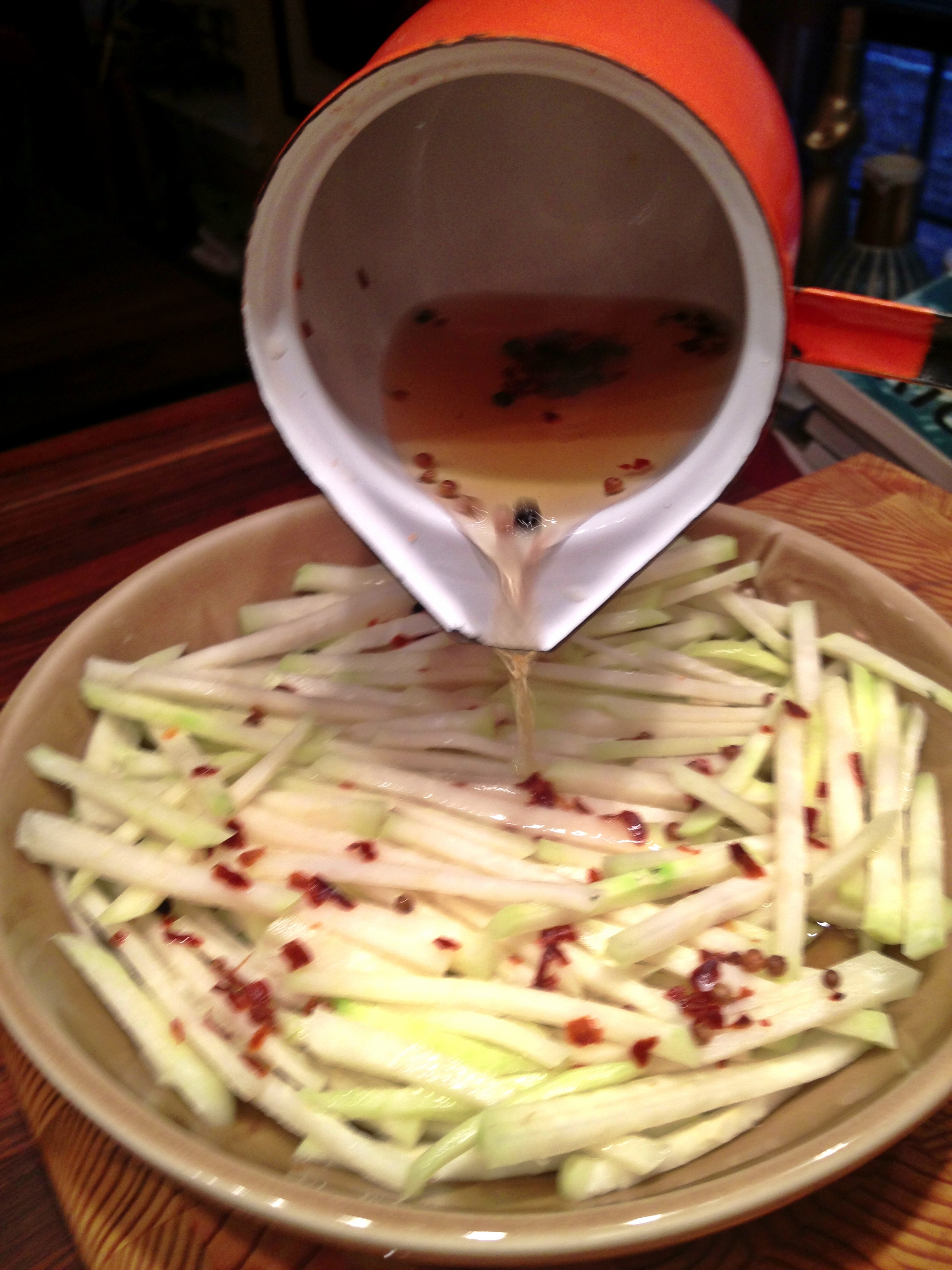
Quick Pickled Kohlrabi (or Carrots or Whatever)
Combine all but the kohlrabi in a very small saucepan and bring to a simmer over medium heat. While you’re waiting, peel the kohlrabi and cut into matchsticks. Pour the hot brine over the kohlrabi and let stand for an hour or so, stirring occasionally. If you have the time, toss it in the fridge to chill.
 At some point, I decided to make some rice. I brought 1/2 cup of brown Jasmine rice, just under a cup of water and a pinch of salt to a boil, tossed a lid on, turned the heat down, and let simmer until we were ready to eat. I also rinsed and dried a head of red leaf lettuce.
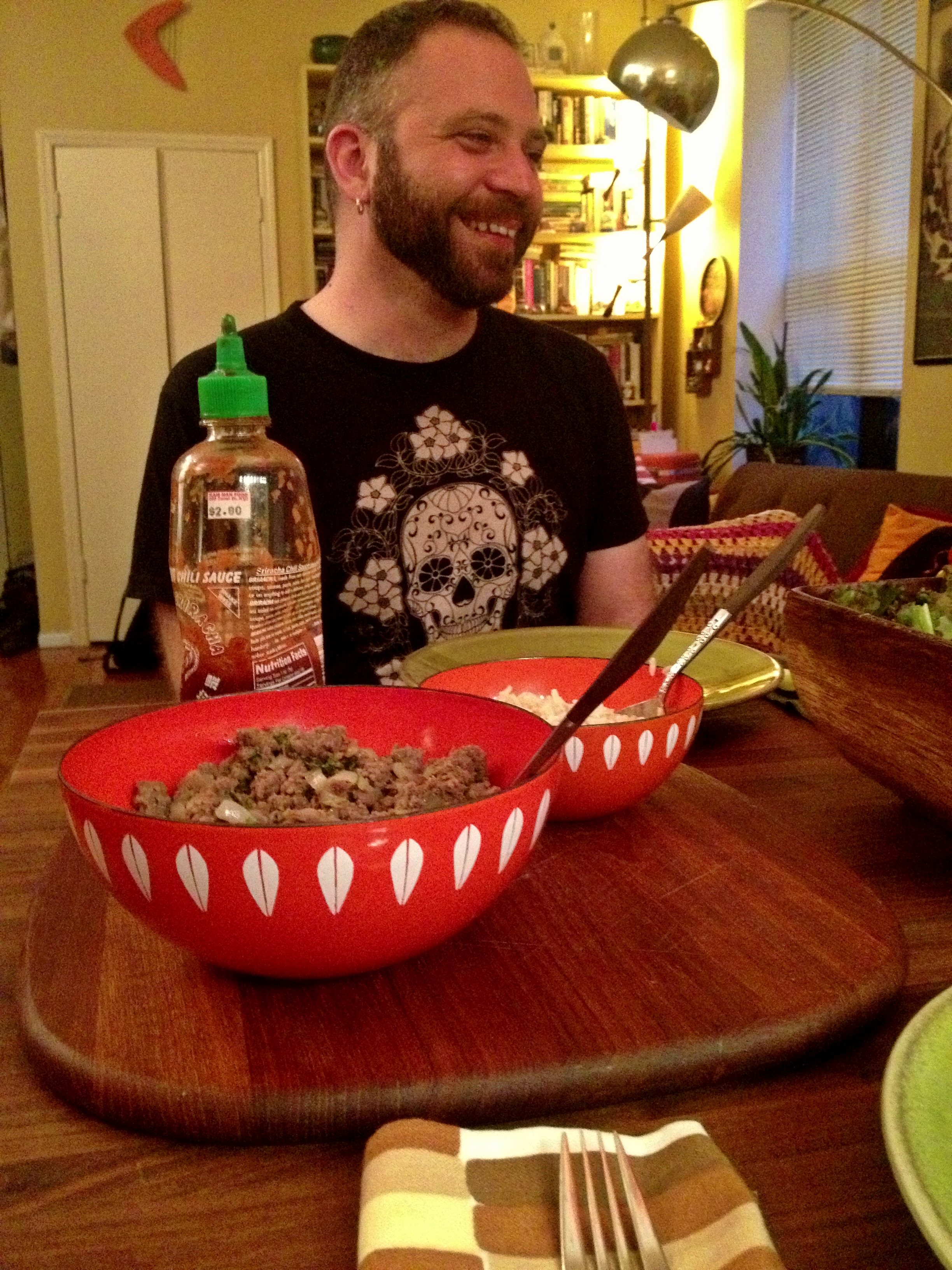
Justin arrived a little after 7:00, by which time I had polished off the wine. Justin busied himself making a batch of gin cocktails with sweet vermouth and the poaching liquid from my foray into homemade maraschino cherries. I got to work on my best approximation of Larb, a dish that I associate with Thai food, although the internet tells me that it is actually Laotian.
Thai Beef Salad

I had intended to serve the beef mixture in lettuce wraps, but the lettuce turned out to be more spikey than leafy, so we mounded it on our plates, adding the rice, beef, and additional Sriracha. This would have been even more delicious had I remembered the pickled kohlrabi (blame it on the gin), which ended up making a solo appearance as the second course.
From there, we whipped up a couple of Gibsons with radishes that I pickled during last autumn’s bumper crop and headed up to the roof for some fresh air. Back downstairs and having polished off the vermouth, we moved on to rye mixed with Campari and bitters–or something like that.

Ground lamb with garlic scapes and Ras el Hanout on a brioche bun topped with harissa-paprika mayo makes for a lovely Father’s Day cookout.
On Saturday I took a break from schoolwork to meet up with a friend for brunch (shakshuka for me, a tuna melt for my date) followed by manicures and pedicures (swimming pool blue and fire engine red for me, sunset orange for her).
Afterwards, we swung by the Fort Greene Park Greenmarket where I thought I might pick up something for dinner. I had a guest due at 8:00 and a mountain of reading to get through, so I was looking for a dish that could cook in the oven without much tending. On a whim, I bought a 4.5-pound whole Moulard duck from Hudson Valley Duck Farm.
I arrived home to find my neighbor Chris planting daffodils and pansies in the planters outside our apartment buildings. As we chatted, I set down my heavy tote bag and mentioned the duck inside. Chris, who is no slouch in the cooking department (he had made Momfuku’s Korean pork for a work potluck just the day before), wished me luck, noting that he had never cooked a whole duck. Come to think of it, neither had I.
Back in my apartment, none of the cookbooks included recipes for a whole duck. I flipped through some online recipes, each with more elaborate preparations than the last. It seemed that I should have started preparing my duck a couple of days ago. Then I remembered that the woman working the stand had encouraged me to check out Melissa Clark’s video on The New York Times website. Three and a half minutes later, I was good to go. Clark provides a simple, straightforward technique that you can riff on in an endless number of ways–the ideal recipe, in my book.
I rinsed the bird, hacked off the neck, made small incisions all over the skin (taking care not to nick the flesh), and rubbed it down with salt, pepper, cayenne powder, and some Chinese five-spice powder that I had on hand. Then I set it in the refrigerator uncovered and got down to my reading.
A few hours later, I removed the duck and let it come to room temperature while I preheated the oven. I stuffed the bird with large hunks of fresh ginger and garlic and half a lemon left over from a previous meal. At the last minute, I decided to drizzle the duck with a bit of soy sauce and honey.
Aside from some temperature adjustments and one flip, the duck took care of itself for the next couple of hours. As the heady scent filled my apartment, I realized that none of the wines I had in the house would hold up to the bold flavors, so I ran to the wine shop four blocks away. The shopkeeper could smell the duck and spices on me and, after some consideration, we settled on a Riesling and an Old Vine Zinfandel.
The duck rested draped lightly in tinfoil while I prepared rice and purple kale with leeks, soy sauce and rice wine vinegar.
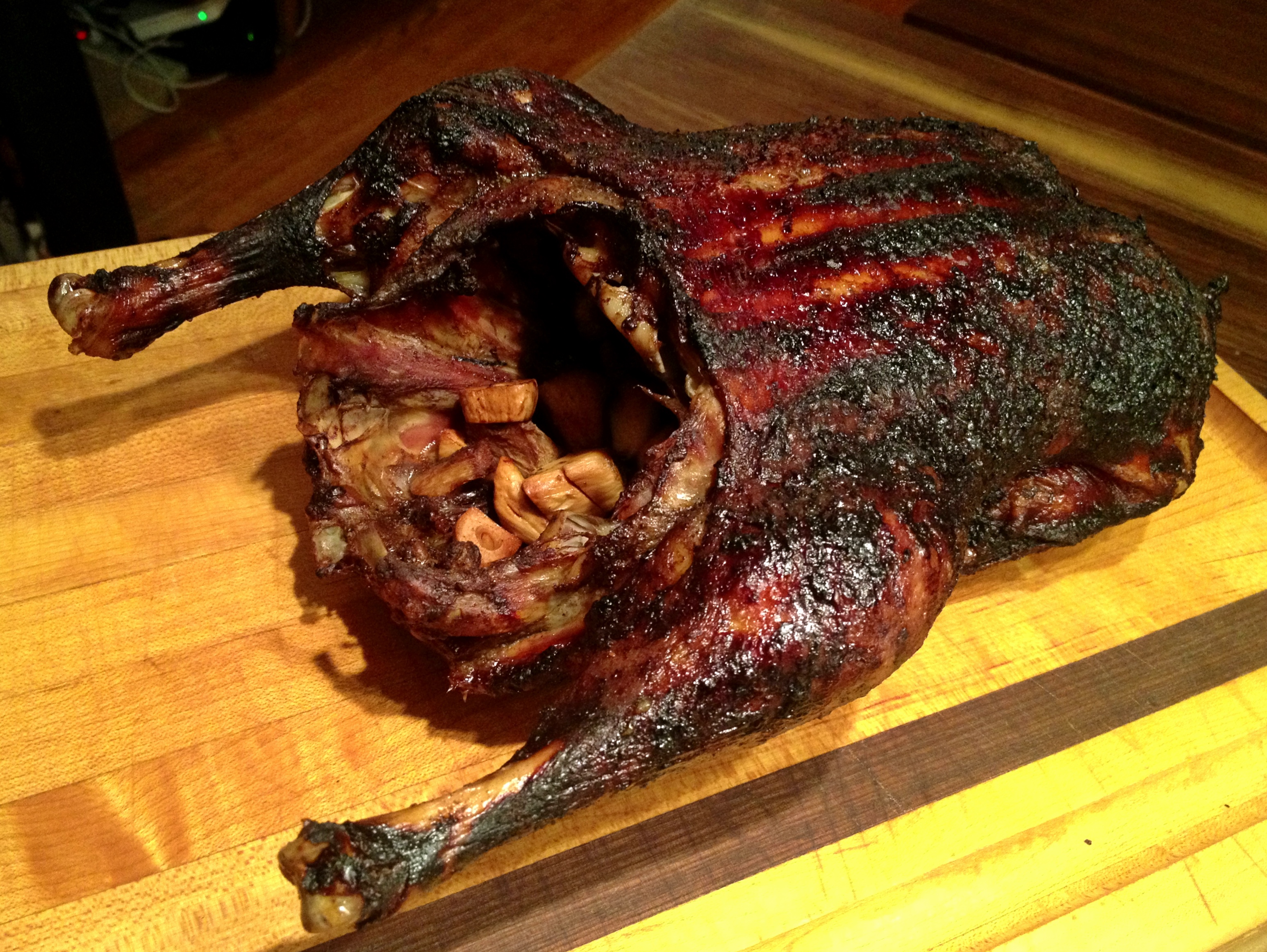
The duck was excellent–so much so that, by the time we had finished picking, there was nothing left but the carcass and half a breast.
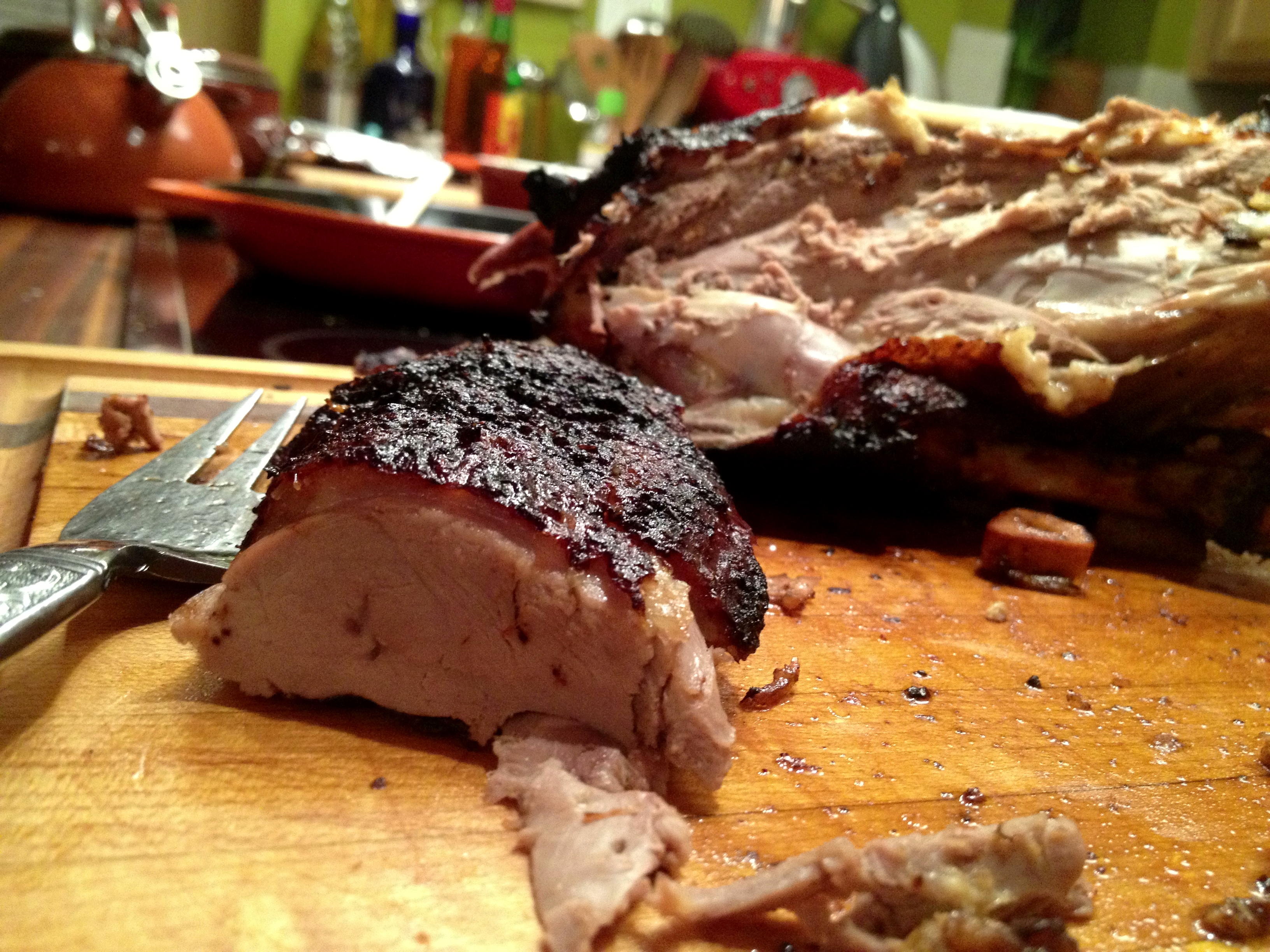
I awoke this morning feeling better than expected given how much wine we drank. I was determined to get as much as I could out of my duck. I was also determined to procrastinate on the day’s schoolwork. I made some coffee and got to work.
First up, I chopped the leftover meat and rendered it in a small skillet over medium heat before adding some finely sliced mustard greens. Once the greens had wilted, I added a bit of soy sauce and rice wine vinegar. Breakfast was served.

Following instructions I found online, I put some water in a small pan, added the excess fat and skin that I had trimmed from the duck prior to roasting, and brought it to a simmer over medium heat. An hour or so later, I poured the concoction through a fine mesh sieve and into a gravy separator which I stuck it in the fridge. Once the fat had congealed, I poured off the residual water and was left with some truly glorious looking duck fat. I imagine I’ll use it to pan fry some potatoes and as the foundation for a roux.

While my duck fat rendered, I preheated the oven to 400. I broke the duck carcass into as many pieces as I could manage (really must get a cleaver) and added it to a roasting pan along with the trimmings from last night’s leeks, a bunch of bedraggled scallions I found in the crisper, a few carrots, some celery, and some roughly chopped garlic. I drizzled this with a tablespoon or so of duck fat I had spooned out of the roasting pan last night and popped it in the oven for an hour.
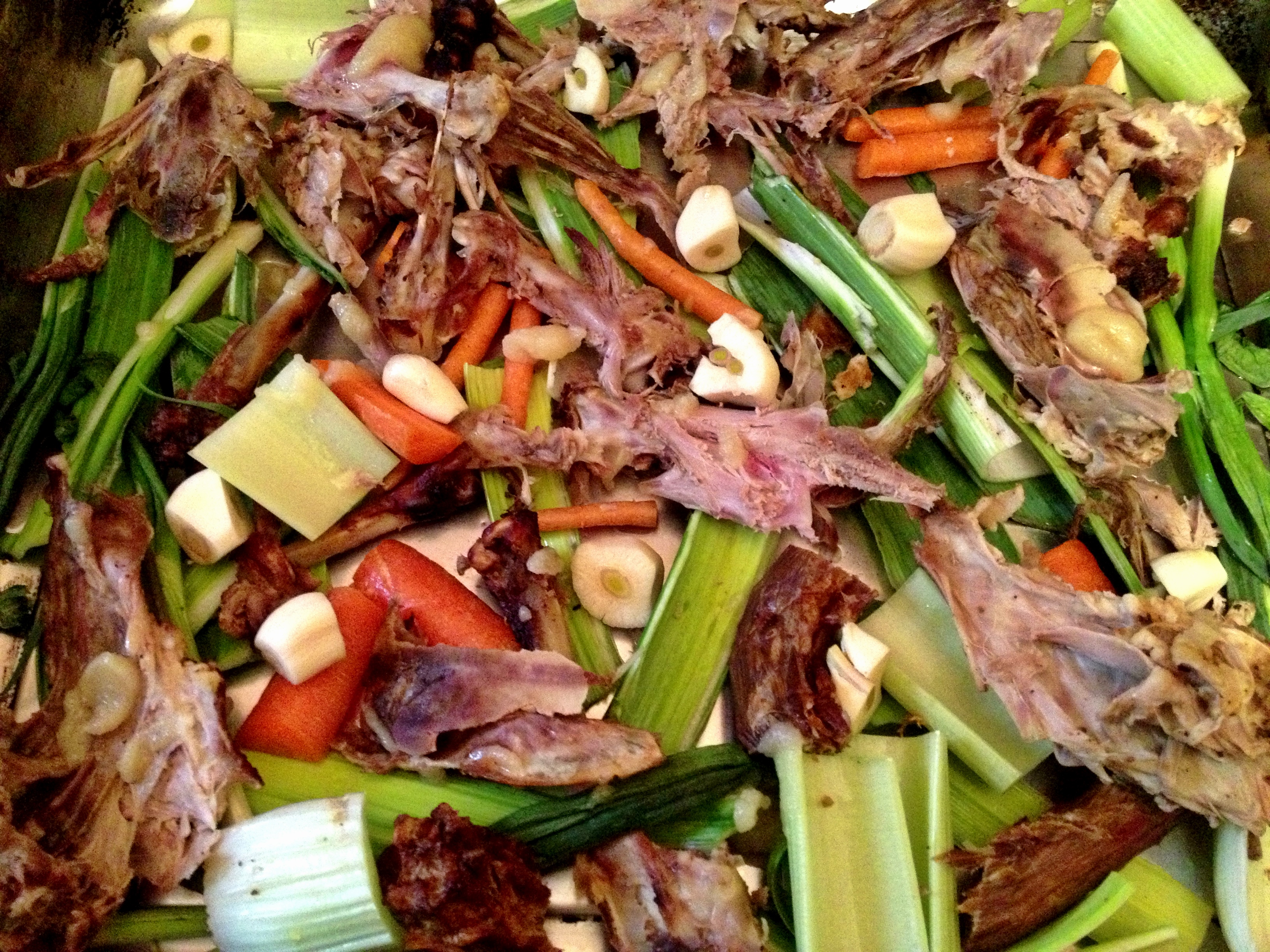
The roasted bones and vegetables then went into a medium-sized pot along with a bay leaf, several whole black peppercorns, a pinch of dried thyme, and enough water to cover. This simmered over medium-low heat while I continued studying.
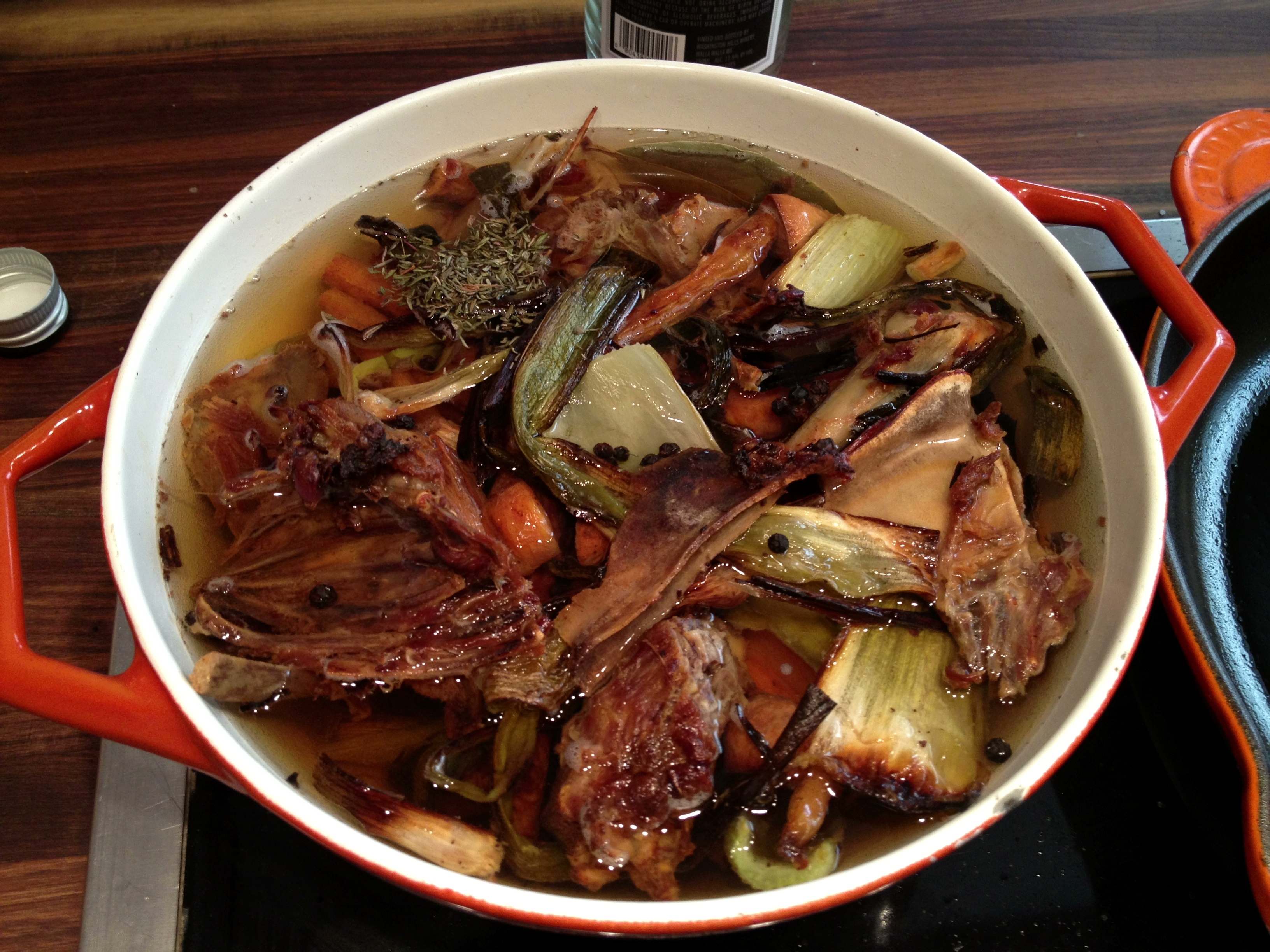
After a couple of hours, the liquid was a rich brown color and my apartment smelled unbelievable.

I strained the broth into a bowl and stuck it in the fridge. After an hour, I scraped off the fat that had accumulated on the surface and poured the stock through a fine mesh sieve into a container that I stuck in the freezer. I see some killer gumbo in my future.
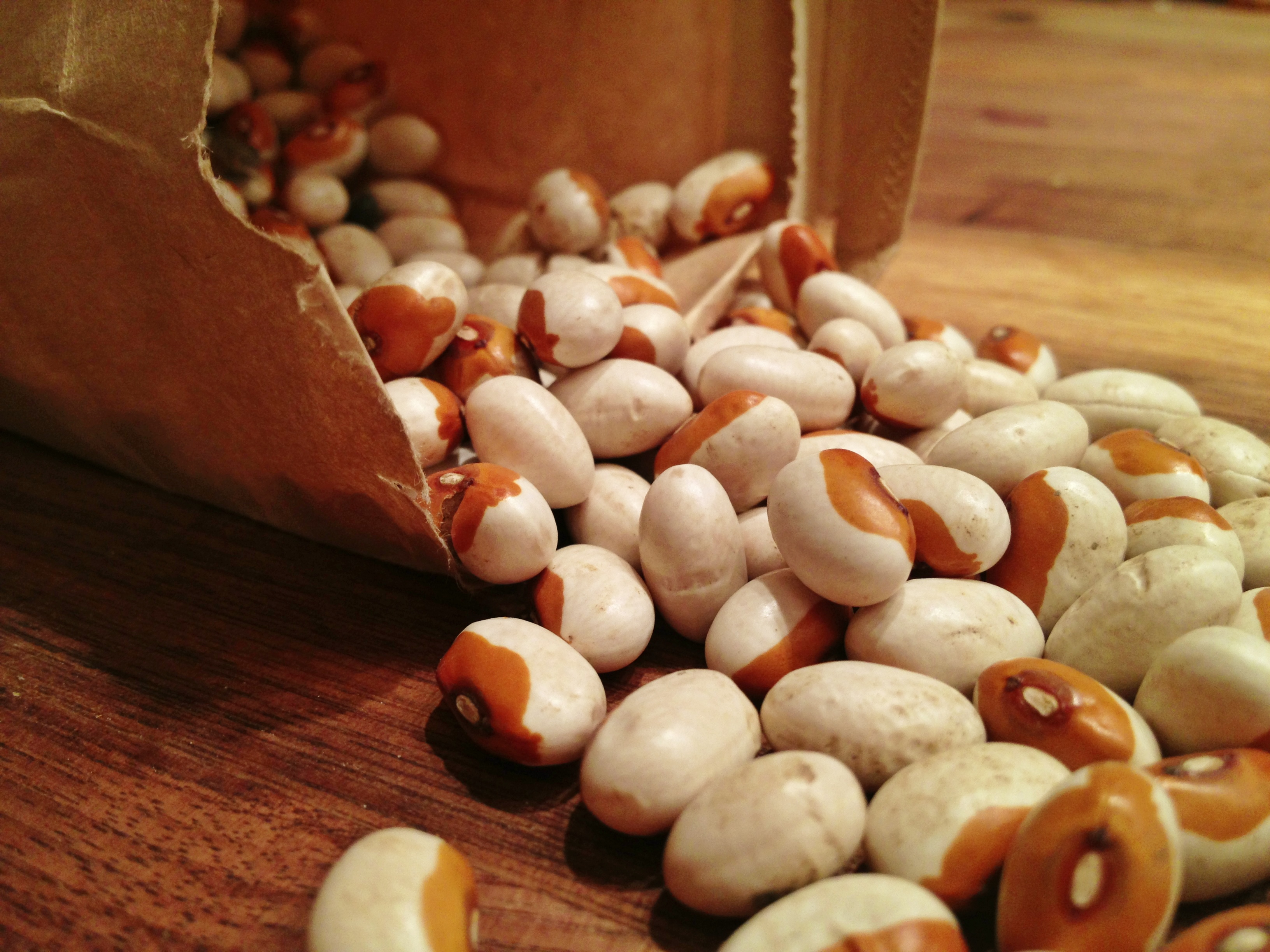
I flew home last Tuesday from an intense two-week study trip to New Orleans. OK, there may have been a little fun thrown in there. But, since then, it’s been all about work and school. I spent most of the weekend reading and writing, but I did manage to carve out some time to cook those beautiful yellow eye beans from Cayuga Pure Organics that I picked up last month.
Dried beans may seem intimidating, but they are infinitely better than canned and it’s honestly hard to screw them up. They’re also cheap and a great source of nutrition. Ideally, you soak them overnight, after which they should look something like the photo below. But the quick-soak method is just fine. Add the beans along with enough water to cover them to a pot, bring to a boil over high heat for a few minutes, and then let soak for a couple of hours. Whichever method you choose, be sure to drain them.

Yellow Eye Bean Stew
Before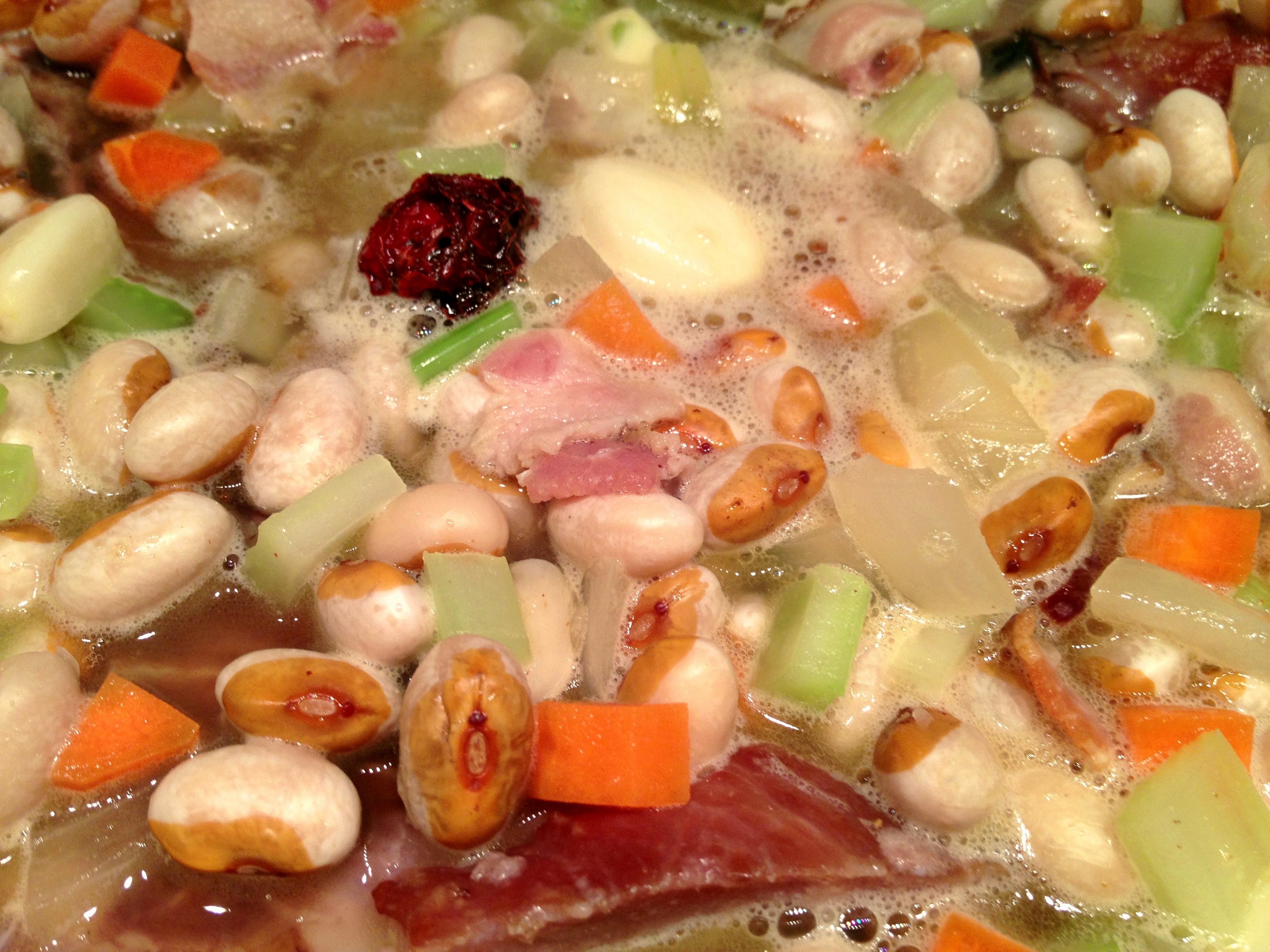
After
I love me some beans. And I love them even more when they’re served with greens. I cooked these up on Sunday night, took a nice helping over to my neighbors’ apartment, and have been eating the rest throughout the week along with some mustard greens that I had in the fridge.
Last night, I tossed the beans, raw mustard greens, and some cherry tomatoes with an apple cider and whole-grain mustard vinaigrette.

Tonight, I heated the beans up with some additional water, added the mustard greens, and simmered until they were lightly cooked. A few splashes of a vinegar-based hot sauce was the finishing touch.

There’s a new kid at the Grand Army Plaza Greenmarket. Founded in 2003, Cayuga Pure Organics‘ mission is to create a food system that works. Along the way, they are producing some beautiful dried beans and grains. On Saturday I bought some exceptionally pretty yellow-eyed peas, which I look forward to reporting on in a future post.
I also bought half a pound of freekeh, a grain I’d heard of but didn’t know much about. The Internet tells me that it’s actually green wheat that has been burned to remove the straw and chaff, giving it a smoky flavor. Like many whole grains, it’s high in protein and fiber and has a low glycemic index. My hunch that it would be toothsome and hold up to the lima beans I was planning to cook proved to be true.
Lima Beans with Ham and Freekeh

WARNING: This makes a lot of food and is very filling. I ate a decent portion, gave some to my neighbors (who hit me back with some tasty steamed mussels), and still have five portions waiting in the fridge–which is not such a bad thing given that I have a ton of reading to do this week, a big work event on Thursday, and a research paper due on Friday.
 the drunken fig