On Winter Storms and Chicken Stock

Winter storm Nemo passed over New York City last night, leaving us with somewhere around a foot of snow. Mayor Bloomberg encouraged everyone to stay home. But my brother-in-law was stranded in Los Angeles and my sister Hannah was going a bit nuts trapped inside with their teething one-year-old, Wally. So I donned my shearling-lined Bean boots (thanks, Mom!) and headed outside.

We had plans to have dinner delivered. But once I experienced the sharp little ice chunks pelting my face, I couldn’t imagine asking someone else to do so on a bike. Luckily, Brooklyn Victory Garden is halfway between our apartments. I scanned their well-curated selection of meats and immediately hit on roast chicken as the ideal meal for a blizzard. I also grabbed some Satur Farms wild arugula (so tasty) and a demi baguette. As she was ringing me up, the woman behind the counter asked if I had bought this chicken before, to which I replied no. “They’re great,” she said, “but you’ll want to remove the head and feet before roasting.” I thanked her for the advice and headed across the street for a lemon and some shallots.

By the time I got to my sister’s, the ice chips had given way to light, fluffy snow. Up on the 10th floor of her high rise, the flakes whirled in every direction, but mainly straight up–a remarkable effect that I could have watched for hours. But there was a baby to be entertained. We played bouncy. We built towers and knocked them down. We read books. We hammered balls into holes and sometimes just hammered people.

By 7:00, Hannah was nursing Wally to sleep and the chicken was in the oven. It was stuffed with shallot and lemon slices; coated in salt, pepper, and olive oil; and nestled in a bed of carrots and shallots. (I find it criminal not to allow some vegetables to cook in those delicious pan drippings.) I poured some wine and commenced to watch the snow. Around 8:00 we sat down to a dinner that included the roast chicken and carrots, arugula dressed with a shallot and balsamic vinaigrette, and the baguette, which I had crisped in the oven while the chicken rested. This was my first encounter with a Bo Bo chicken, but I can assure you it will not be my last. We sat at the table for quite some time picking at the bones, talking, and knocking back wine.

I had planned to depart before the worst of the storm, but the conversation (and, it is safe to assume, the wine) got the better of me. By the time I made it out to the street (chicken head, feet and bones tucked into my bag), Brooklyn was a winter wonderland and the streets were nearly deserted. It was breathtaking.

Image

Today I am content to sit at home watching old movies, catching up on a long-forgotten knitting project, and simmering chicken stock.

Image

It is a wonder to me that anyone ever throws chicken bones away, as homemade stock is seriously easy, makes the whole house smell glorious, and adds that extra little something to just about any savory dish. At the most basic level, you toss a chicken carcass or parts thereof into  a pot with just enough water to cover and simmer. But here are some tricks I’ve picked up over the years.

  1. If you don’t have enough bones yet, or are lacking the time for a proper slow cook, just toss the bones in a plastic bag in the freezer until you are ready.
  2. You can use raw or roasted chicken, or a combination of the two. Raw will yield a lighter, more refined stock while roasted will have a bolder, deeper flavor.
  3. Crack any bones that you can manage. (Note to self: must buy cleaver.) Stock is more about the bones than the meat. Cartilage and marrow are what give a good stock–and, ultimately, a good soup–that velvety mouth feel. Breaking the bones speeds this process. The best stock I ever made was, once it cooled, the consistency of Jell-o.
  4. Add some aromatics, vegetables, herbs and/or spices. Onions, garlic, carrots, celery, parsley, thyme, bay leaves, red pepper flakes, pepper, and allspice will give you a more complex flavor. You’re not limited to these ingredients, but they all provide a reasonably neutral base from which you can build. Fennel, parsnips, rosemary, and the like would be delicious, but may point your ultimate dish in a specific direction.
  5. Keep your stock at a low simmer. A full boil will emulsify the fat and yield cloudy stock.
  6. If scum appears at the top of the pot, skim it. This will also contribute to a clear stock.
  7. Cook your stock for as long as you can stand it and at least one hour. I had a roommate who would leave the pot on low overnight, which I found alarming from a safety perspective (though her stock was good). Four hours is great. Add water as needed to keep your ingredients submerged.
  8. If you’ve got limited storage space, let the stock cook down until it is concentrated.
  9. Don’t add a lot of salt. It is very easy to oversalt when you are cooking something down and you can always season at the end of the process and/or when making your final dish.
  10. Strain the stock through a fine mesh strainer, pressing hard on the solids to extract as much liquid as possible.
  11. Cool your stock, pop it in the fridge overnight, and then scrape off the layer of fat that forms on the top.
  12. Save the aforementioned fat in a container in the freezer and use it in place of or in addition to oil or butter for some extra flavor. I find that potatoes are particularly tasty. My grandma has fond memories of coming home from school to a piece of toast slathered in schmaltz, but I have yet to go there.
  13. If you’re not going to use the stock right away, pour it into ice cube trays, freeze them, and then drop them in a plastic baggie. You’d be amazed what a single cube of good quality chicken stock can do for a lackluster stir-fry or pasta sauce.

This technique works fine for turkey as well and has become my Black Friday ritual. But, as you can see, I ran into some problems when I tried to use Wally.

Image

Cassoulish

I awoke Thursday to yet another glorious morning in San Juan. It was sunny and the temperature was holding steady around 82. I was staying a couple of blocks from Ocean Park Beach, where I’d spent a lot of time dozing and gazing at the view.

Ocean Park Beach

Tragically, it was the last day of vacation. My flight arrived at JFK in the depths of winter. An 80-degree temperature drop in a little over four hours is no joke. I survived the taxi line and the ride home clad in yoga pants, a tank top, a cardigan, and a pair of flats that still had sand inside. I walked in the door of my apartment and immediately donned silk long underwear, which I have been sporting pretty much ever since.

I managed to make the trek up to the Upper West Side that night for the New York Abortion Access Fund‘s Celebrate Access Awards, but there was no way I was leaving my house on Friday. A hearty dish was in order, something that would necessitate leaving the oven on for an extended period of time. I had some French navy beans I’d picked up during a shopping spree at Kalustyan’s and a wide variety of root vegetables from my January CSA share. This plus whatever meat I had socked away in the freezer would surely warm me.

Cassoulet is a slow-cooked casserole originating from the South of France. As with many classic French dishes, cassoulet involves very specific ingredients and elaborate preparation. I have had it once or twice and it is tasty, for sure. But it’s hard to go wrong with beans, meat, and a slow braise. And so I present you with…

Cassoulish

  1. Pre-soak a pound of dried beans for at least six hours and then drain. The aforementioned navy beans were good, but I could see any kind of white bean working. Use black beans, kidney beans, or pintos and you’re veering into feijoada territory. This would not be a bad thing.
  2. Preheat your oven to 350.
  3. Render some smoked pork in a large dutch oven over medium heat. I used about four ounces of lean slab bacon cut into quarter-inch cubes.
  4. Add some well seasoned sausage and stir while it browns. I went with a few links of Spanish chorizo from Despaña, but Italian sausage, saucisson, kielbasa, or pretty much anything else would work.
  5. Pull our your porky bits and reserve. At this point, you could sear off some additional meat–duck, goose, lamb or whatever–in the fat left behind. But I didn’t have any of these and my dish came out A-OK.
  6. Add some onions and/or leeks and cook until they are wilted. I went with three medium onions, diced. Add some garlic (8 cloves thinly sliced in this case) and stir just until fragrant. 
  7. Scoot your aromatics to the edge and add a couple of tablespoons of tomato paste. Stir constantly being sure not to let it burn. 
  8. Add half a bottle or more of hearty red wine, your meat, and any stock that you have on hand. (I used some concentrated turkey stock from last Thanksgiving.) Bring to a simmer.
  9. Add your herbs and spices. I went with a bay leaf, about a tablespoon of chopped fresh rosemary, a good pinch of red pepper flakes, a tablespoon of hot smoked paprika, and a mix of five allspice berries and 30 assorted peppercorns, which I had ground with a mortar and pestle. Marjoram or thyme would be tasty too, I bet. Be sure to add some salt, although you can add more later.
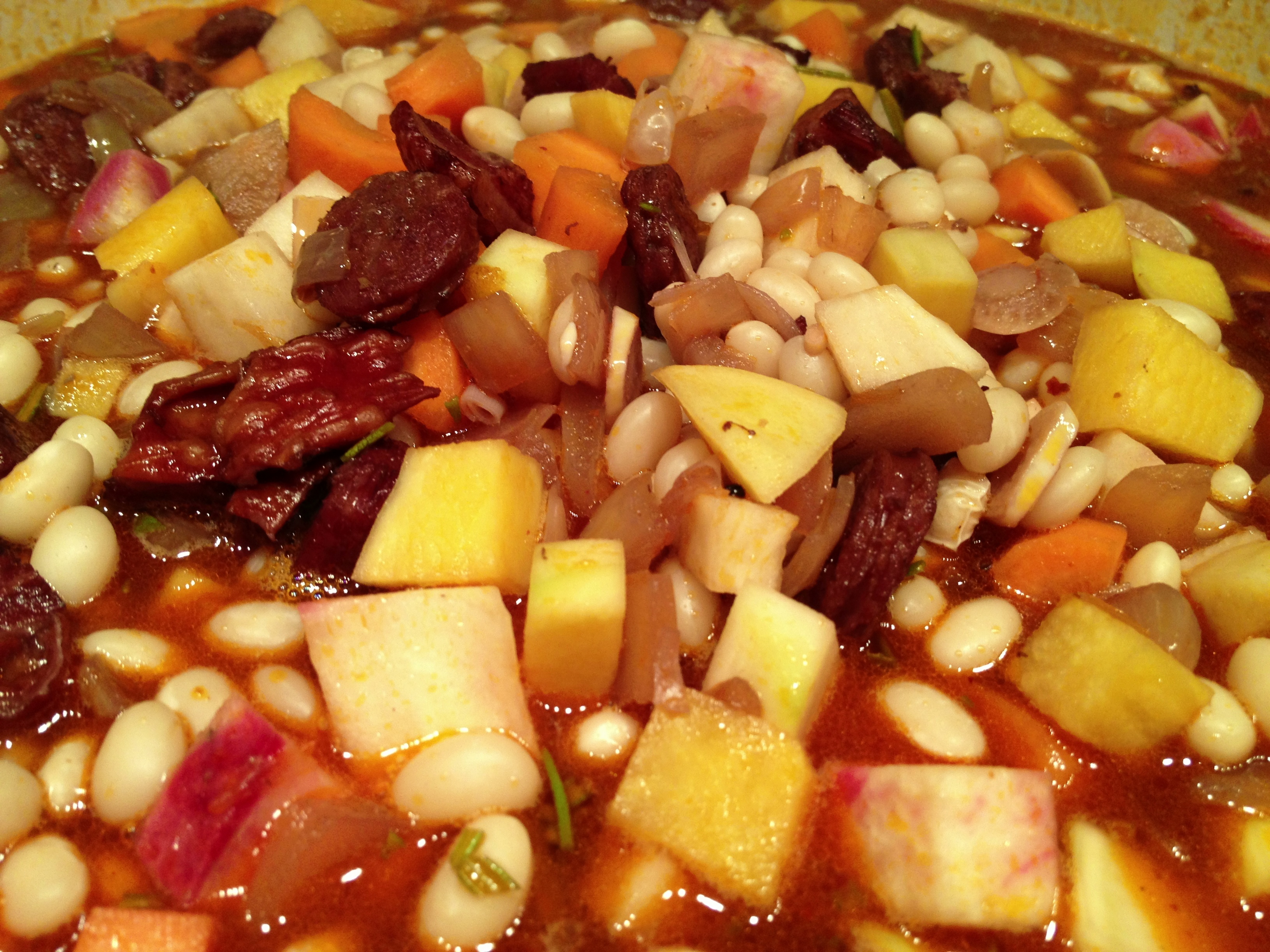
  10. Add a bunch of diced root vegetables. I used six carrots, four rutabagas, and one freakishly large radish. Top this off with enough water that the beans are just submerged and pop it in the oven with a lid. This is what it will look like, more or less.Pre-Baked
  11. Now go about your business.
  12. After three streaming episodes of 30 Rock and a couple of glasses of Tempranillo, take the lid off and top with one and a half stale pitas’ worth of breadcrumbs. Dot with some butter, pop it in the oven and watch another episode.
  13. At this point, you will have likely consumed the better part of a bottle of wine and could use a little food. Dish yourself a small portion, taste, and add more salt to your bowl and to the pot if needed. Stir in the crust that has formed, a quarter cup of red wine vinegar, and some additional water if it’s looking a little dry. Sprinkle the remaining half-pita’s worth of breadcrumbs over the top and pop it back in the oven, lowering the heat to 300.
  14. Stream a couple more episodes while you polish off the wine. Remove your meat and bean casserole from the oven and, regardless of what the Tempranillo is telling you to do, let it stand for at least ten minutes before serving yourself or anyone for whom you have affection.

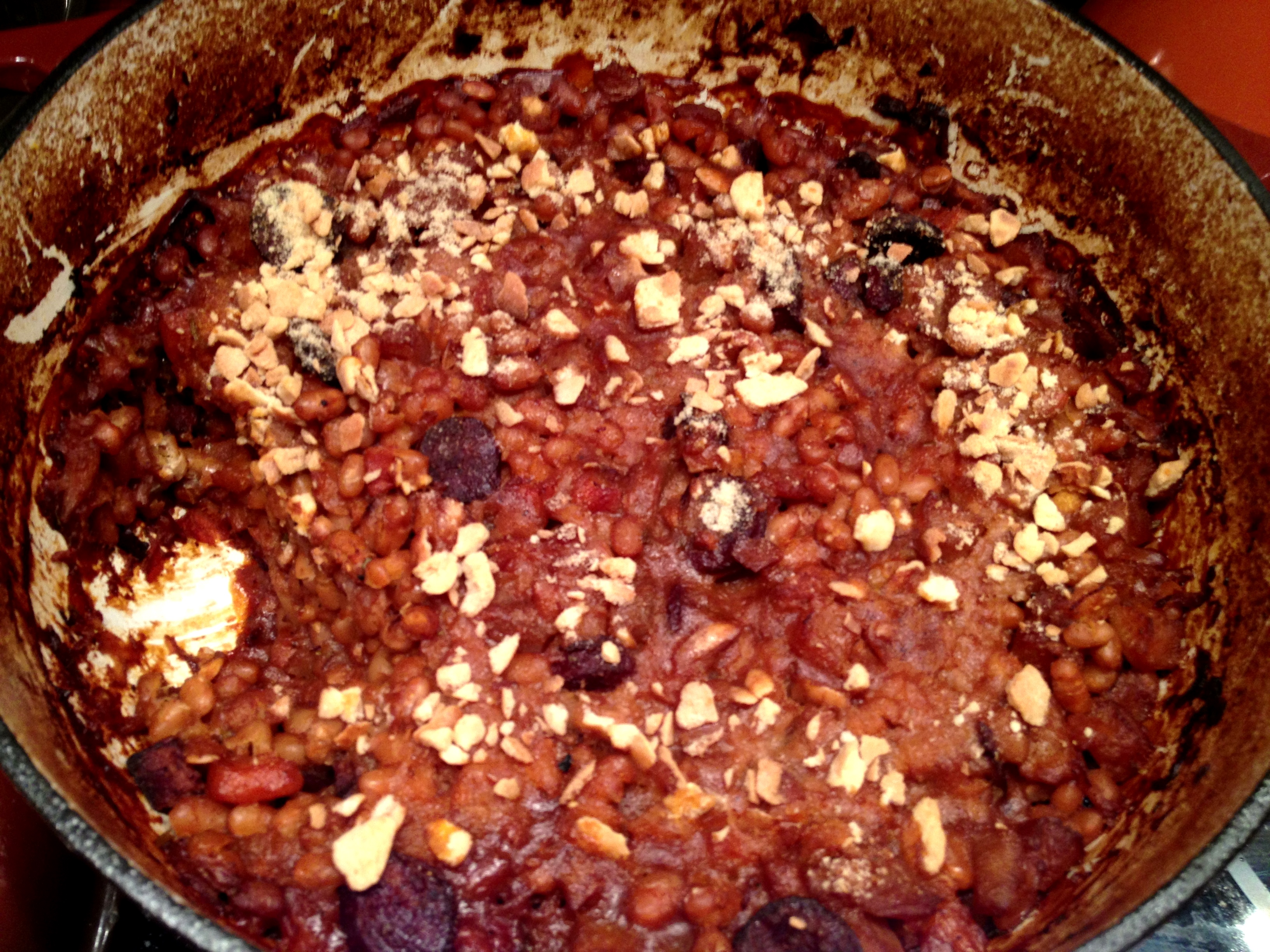
This make a lot of food, as evidenced by this photo of the Dutch oven minus my serving.

Baked

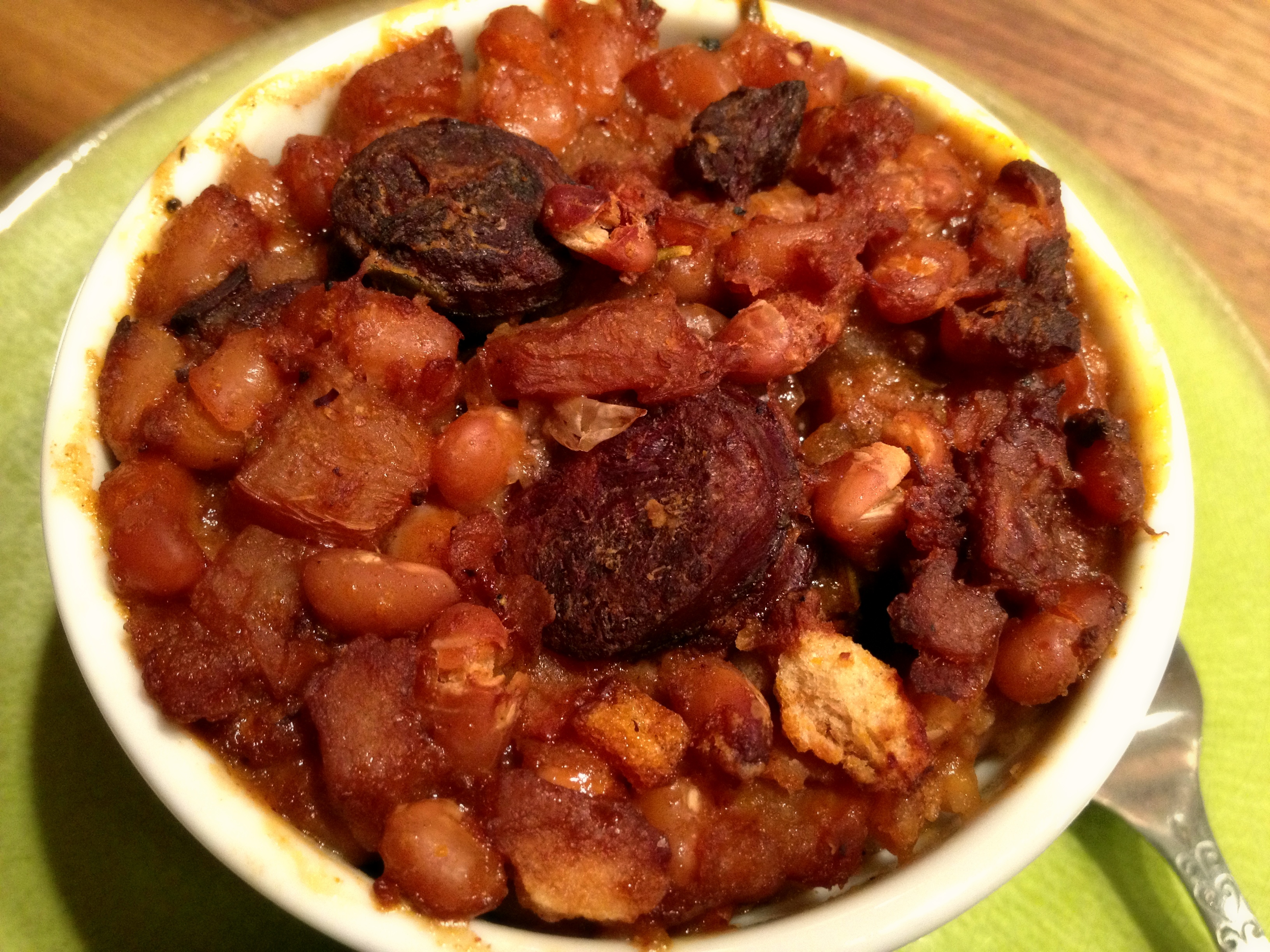
Fortunately, it reheats brilliantly in the oven. Just stuff some into an individual ramekin, top with some water and bake in the oven until your blog post is done–or until the smell overwhelms you and you decided that you’ve earned a break.Reheated

A Hoppin’ New Year

I put the finishing touches on my first grad school research paper a little after 1:00am on December 20th, sacked out for five hours, worked a full day, and then attended my final class. I arrived home around 9:00pm, stuffed some food into my mouth and some clothes into a suitcase, and hit the road for the twelve-hour drive to Gatlinburg, Tennessee. Needless to say, I was not in great shape by the time we arrived. I spent the first couple of days mentally and physically recovering.

When I came to, I found myself in a lovely house nestled in the Smoky Mountains, surrounded by good friends who’d driven in from Nashville and from Athens, Georgia. There were two wood-burning fireplaces, a pool table, a (kinda) hot tub, and plenty of booze. I was the first person up each morning and spent the earliest hours of my day under a blanket on the couch in front of a picture window. I alternated between indulging in a juicy novel and watching the mountains disappear and reappear though the mist.

Smokey View

On December 23rd, we hit Dollywood, Dolly Parton’s amusement park in Pigeon Forge. I don’t go in much for heroes, but Dolly certainly is one of mine and I have wanted to visit Dollywood ever since I learned of its existence.

We managed to hit all four of the excellent roller coasters, twice. My favorite was the Wild Eagle, a triumph of engineering in which you are hanging in a seat with nothing above or below. After a delightfully unnerving initial drop, the sensation is one of soaring. Our fear was replaced by a feeling of weightlessness that left us giddy.

Dollywood Coasters

The Chasing Rainbows Museum offered a staggering array of photos of Dolly with celebrities (Grace Jones being my personal favorite), a look back at her childhood and early years in Nashville, and an impressive collection of fan art.

Dolly's Attic

Downstairs were case upon case of clothing from Dolly’s movies and tours. My closet suddenly seems so drab.

Dolly's Wardrobe

We also got to check out Dolly’s tour bus and one of her (in)famous wigs.

Dolly's Wig

The quirky guy leading the tour got a shot of our whole group.

Dolly's Bus

Our day at Dollywood concluded with a Christmas-themed light parade led by a zealous woman with a banjo.

Dollywood Light Show

The next day was Christmas Eve, our last night in Gatlinburg. After taking stock of our food reserves, I headed out do some final grocery shopping. (Miraculously, the booze supply had held.) I knew that I wanted to use the dried black-eyed peas that our Nashville friends had brought, so I was thinking Tex-Mex as I walked into the local Food City. But one look at the freestanding cooler full of collard greens and I had a new plan. These greens were glorious–and huge; one bunch would be plenty to feed all six of us. A few aisles later, I stumbled on a shockingly large display of smoked hog jowl. This store and I were clearly on the same wavelength.

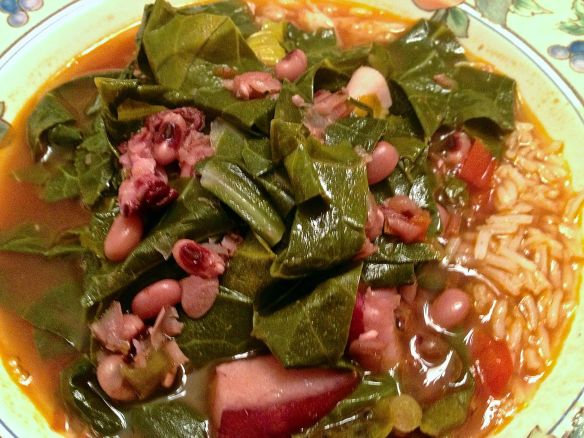
The nice young man who checked me out took one look at my cart and said, “You’re a little early, aren’t you?” For those that don’t know, collards and black-eyed peas are both traditional New Year’s foods in the Southern United States. The peas offer luck and the greens symbolize wealth. Black-eyed peas, which are generally served with rice in a dish called Hoppin’ John, came over with West African slaves. Collard greens, which were considered weeds by many plantation owners, were a mainstay of the slave diet. The hog jowl and other less desirable cuts would have been more readily accessible to the slaves. This combination of ingredients is cheap, easy to cook, and can simmer away untended.

My version is a bit fancified, to be sure, but its spirit is true–as its ability to heal after a night of over imbibing.

Hoppin' John Stew

New Year’s Day Stew

  • 1 pound dried black-eyed peas
  • 1 tablespoon olive oil
  • 3-4 ounces smoke hog jowl (slab bacon would also be fine), cut into 1/4″ cubes
  • 2 medium yellow onions, diced
  • 8 cloves of garlic, sliced
  • 1/2 bottle of cheap red wine
  • 16 ounces of chicken stock
  • 2 bunches of collard greens, large stems removed and cut into thick ribbons
  • 2 large tomatoes or 1 can whole tomatoes, chopped
  • 8 ounces apple cider vinegar
  • hot sauce, salt and pepper to taste
  1. If you’ve got it more together than I do, soak the beans in cold water overnight. If not, no worries. Just add them to a pot with enough water to cover them by a few inches, bring to a boil, simmer for a few minutes, and then let stand for an hour or more. Either way, be sure to drain the water.
  2. Add olive oil to a large heavy-bottomed pot over medium heat. Add your pork and let render, stirring occasionally. Cook the onions for a few minutes and then add the garlic. Continue cooking until onions are translucent, lowering heat if they start to brown.
  3. Add the soaked and drained beans, some leftover red wine, the chicken stock, tomatoes and a good pinch of salt. If the beans aren’t covered, you can round this out with some water. Let simmer until you sense hunger. One hour is probably enough, but two hours will be even better. Add 1/4 cup of apple cider vinegar, some hot sauce and lots of black pepper.
  4. Keep simmering while you put a pot of long-grained white rice on to boil. After 10 minutes or so, stir in the collards. (You may have to work in batches, letting each cook down a bit before you can cram the rest into the pot.)
  5. When your rice is just about done, taste the stew and adjust the seasoning with additional salt, pepper, cider vinegar, and hot sauce. (I went with plenty more of all of these.) You can let this simmer or even turn off the heat for a while if you’re not ready. I tend to like my collards a little more al dente than is traditional, but I leave that up to you. Serve the stew ladled over the rice in low bowls and get ready for a glorious new year.

Christmas Dinner

French Lentil and Fried Egg Perfection

I spent Thanksgiving with my family in South Florida. My 92-year-old grandparents finally relocated this past spring to be near my mom. It was a treat to spend the holiday with them after more than 25 years. While there were only six of us for Thanksgiving dinner, I ended up making a total of 11 dishes in order to satisfy various constituencies–including the aforementioned nonagenarians and a 16-year old vegan. And that doesn’t include dessert!

Image

Here’s my 92-year-old grandma keeping guard over her wing while the bird rests. I was particularly gratified that she liked the butternut squash and creamed kale gratin, which was a divergence from her usual fare.

Image

I got home to Brooklyn late last night. While I wasn’t thrilled to return to winter, I welcomed the opportunity to cater to my own tastes in my own kitchen. Best of all, I was able to cobble together the ingredients for this comforting dish without having to put on pants.

French Lentils

  1. Render 2 ounces of bacon in a medium-sized, heavy-bottomed pot over medium heat. (I highly recommend keeping some slab bacon in the freezer for such purposes.)
  2. Add some chopped onion. (I went with half of a large red onion that had been lingering in the fridge since before I left town.) Cook until onion is wilted and just starting to brown. (If your bacon is lean like mine and the bottom of the pan starts to get dark, add a half tablespoon of olive oil.)
  3. Add three small chopped carrots and saute until just beginning to soften. Then add four cups of water, a few cubes of frozen chicken stock (or some bouillon), and that last bit of red wine left over from your dinner party last weekend. Bring to a simmer and then add half a pound of French green lentils, a pinch of red pepper flakes and half a tablespoon of Herbes de Provence.
  4. Simmer until the lentils are soft and the broth has thickened a bit–roughly 45 minutes. Adjust seasoning with salt and pepper. Add three small carrots chopped into very small cubes and cook for a few more minutes. Stir in a tablespoon or so of red wine vinegar to provide a little balance.

This makes a great bed for just about any protein. I cooked the first half of these lentils for a dinner party a few months ago and served them with pan-roasted Scottish salmon to great effect. Tonight I went with a fried egg. The rich, oozy yolk was a perfect marriage with the earthy lentils.Image

Portable Moroccan Meze

Last Monday’s class included a discussion of Reflections on Fieldwork in Morocco, which chronicles Paul Rabinow’s experience conducting anthropological research in Morocco in the late 1960s. This particular course is from 6:45pm to 8:25pm–prime eating hours. At the beginning of the semester, we agreed to take turns bringing snacks to help us power through. I was up last week.

Some of my fellow students in the NYU Food Studies program are professional chefs. I’d be lying if I said that I didn’t feel a certain amount of pressure. Clearly, it needed to be Moroccan or, at least, Moroccan-ish. I’ve had success with a few variations on a tajine, but this seemed highly impractical given that I had to put in a full day at the office and would not be able to reheat anything. I also did not want to endanger my classmates’ notebooks and iPads.

I studied in Jerusalem for six months when I was an undergrad and have fond memories of meze–elaborate spreads of small dishes that are common throughout the Mediterranean and Middle East. Think hummus, olives, stuffed grape leaves, falafel and yogurt-based dips. Meze can be the precursor to a meal or, as is my preference, a meal unto itself.

Lamb and Date Kaftah

  • 1 pound ground lamb
  • 1/2 medium red onion, finely diced
  • 1/2 cup bulgur
  • 20 pitted, minced dates (currants or raisins would work too)
  • 1/2 cups toasted pine nuts
  • 1 bunch curly parsley, roughly chopped
  • 2 tablespoons minced fresh mint or 1 tablespoon dried
  • 1/2 tablespoon toasted coriander seeds, ground
  • 1/2 tablespoon toasted cumin seeds, ground
  • 1 tablespoon dried sumac (lemon zest could be substituted) 
  • 1 tablespoon Aleppo pepper and 1 teaspoon cayenne (or to taste)
  • 1/2 tablespoon turmeric
  • 2 whole allspice, ground
  • 1/2 teaspoon cinnamon
  • 1/2 teaspoon ground clove
  • 1 pinch nutmeg
  • salt and pepper to taste
  • canola oil
  1. Pour 2/3 cups boiling water over the bulgur in a small bowl and let sit while you prep your pine nuts, dates, onions, herbs and spices.
  2. Add everything except the canola oil to a medium work bowl and mix gently with you hands. Let this chill in the refrigerator for at least half an hour.
  3. Fill a large cast iron skillet with canola oil to approximately 1/4 inch and bring to medium-low heat. Working in batches, form the lamb mixture into small patties and add to the skillet. Cook until nicely browned on one side, flip and repeat. Drain on paper towels.These would make great sliders. Formed into balls and served with toothpicks, they would be a delightful hors d’oeuvres for a cocktail party. A couple of months ago, I made a similar version and served them hot over a Moroccan-seasoned ratatouille.In this case, I packed the kaftah in additional layers of paper towels and stashed them in the refrigerator along with a roasted eggplant dip and a labeneh-lemon dip. Another classmate brought a spicy carrot salad, mint tea, dates and almond cookies. We served it all with white and whole wheat pitas. It was a delightful feast.

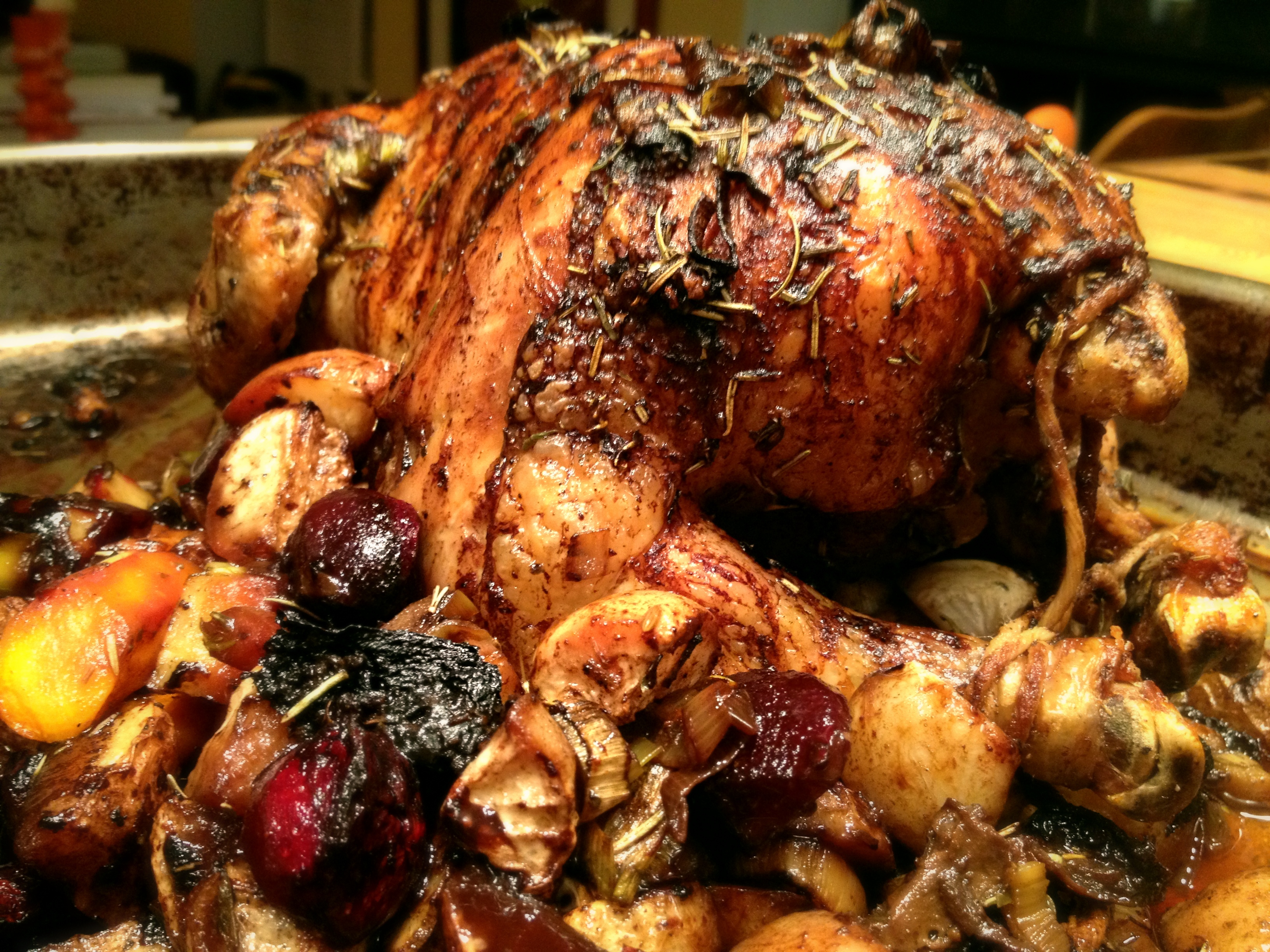
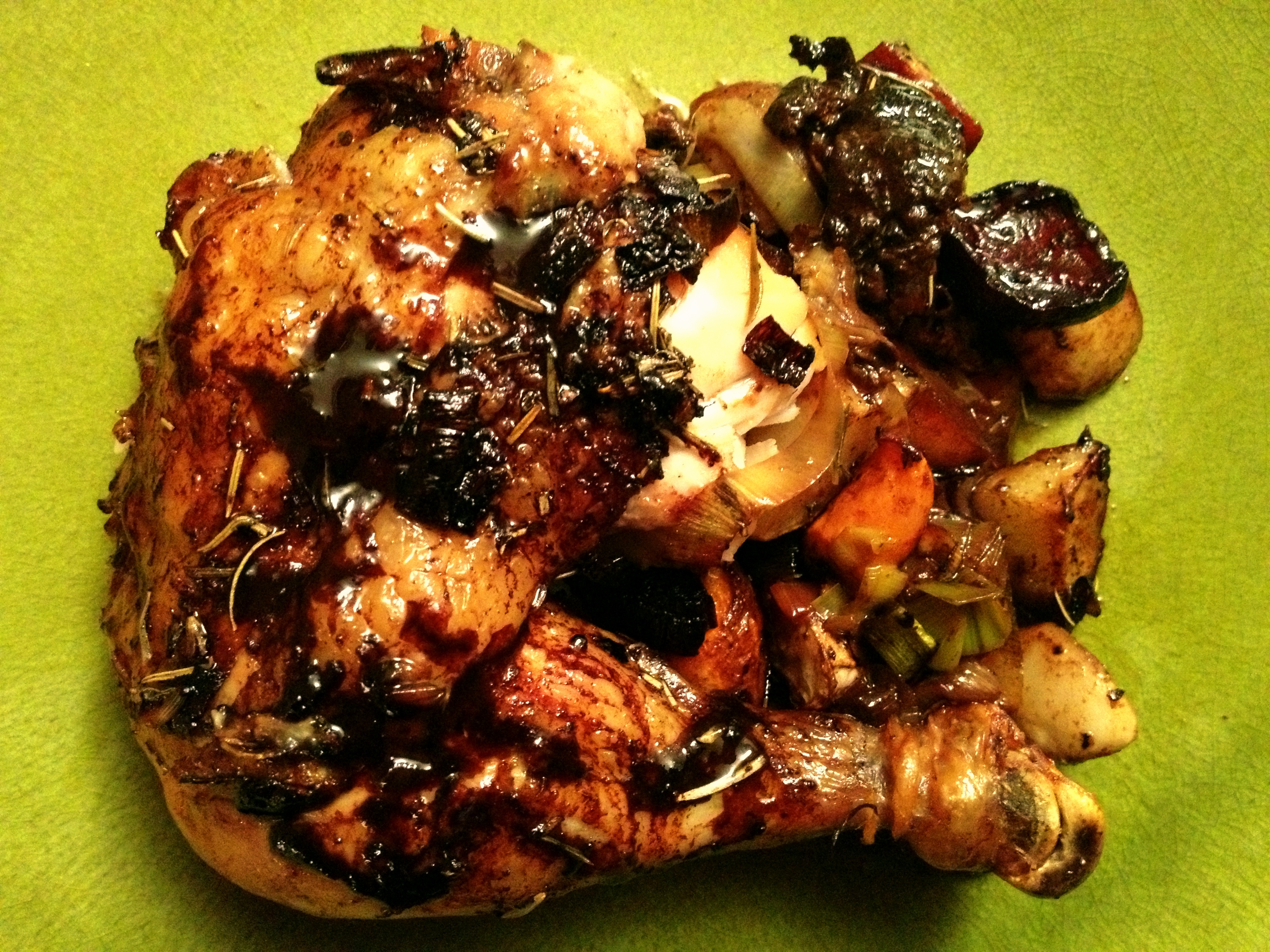
Provencal Roast Chicken

I adopted Jezebel around 1999. She was so small that I quite reasonably assumed she was a kitten. But the vet put her at about three years old. Jezebel remains a delightful companion, despite her recent propensity for late night yowling. (The internet suggests that dementia is likely.) As you can see, whatever’s happening in her brain, she’s managed to hold onto her good looks.

As tiny as she was when she found me, Jezebel is now down under five pounds, so I tend to feed her whatever she wants. She and I only made our way through a small bit of this truly scrumptious Provencal-style roast chicken tonight, but I am confident that it will be just as good throughout the week.

While I once confined myself to white meat off the bone (a holdover from my vegetarian upbringing and subsequent squeamishness), I love roasting a whole chicken. The smell permeates the house. It’s economical. It leaves you with bones to make stock. And a whole chicken can be communal–even when it’s just you and your cat.

Roast Chicken with Porcini, Leeks and Root Vegetables

  • One whole chicken (5-7 pounds), rinsed and patted dry
  • 1.5 ounces dried porcini mushrooms
  • 1 lemon
  • kosher salt
  • black pepper
  • 1 1/2 tablespoons Herbes de Provence (lavender, savory, fennel, thyme and rosemary or some combination thereof)
  • 1-2 tablespoons olive oil
  • 2 large leeks, white and light green portions sliced and rinsed thoroughly
  • 4 cups of chopped root vegetables (turnips, carrots, parsnips, beets, potatoes, etc.)
  1. Preheat the oven to 375 degrees. Bring a cup of water to a boil and pour over the dried porcini.
  2. Slice the ends off of the lemon, score the sides and stuff it inside the bird. Combine a tablespoon of kosher salt, a good amount of freshly-ground pepper and a tablespoon of the Herbes de Provence in a small dish. Rub this all over the bird, being sure to get under the skin to massage it into the breast meat. If you’ve got some kitchen twine and you can find a way to access it while your hands are covered in raw chicken, truss the legs. If not, whatever.
  3. Set the bird in a roasting pan breast-side down, drizzle some olive oil over the top and pop it in the oven. After 30 minutes or so, flip the bird over and baste with the pan juices. If the bird hasn’t released much fat, you can use a little more olive oil. You might also sprinkle the top with additional salt, pepper and herbs if you like.
  4. After another 30 minutes, slide the bird to the side and add your leeks and root vegetables. (I went with turnips, carrots, beets and potatoes because that’s what I had on hand.) Stir these with the pan juices and then add 1/2 tablespoon of the Herbes de Provence, salt, pepper and the porcini along with their liquid. Mound the vegetables in the center, flip your chicken so that it is once again breast-side down and place it on top of the vegetables.
  5. Continue cooking, basting the bird with the juices approximately every fifteen minutes and stirring the vegetables if needed. It should take roughly 20 minutes total cooking time per pound, but start checking your chicken whenever you get anxious or when the aroma starts to make you dizzy. I recommend ignoring whatever guidelines your thermometer may suggest and, instead, aim for getting the deepest part of the thigh up around 165 degrees. Be sure to let it rest for about five minutes out of the oven. If you’re worried about the bird getting cold, tent it very loosely–lest you steam that beautiful, crisp skin–with foil.

Were I serving this to a crowd, I would have placed the chicken on a platter, mounded the vegetables around it, and carved at the table. Instead, I hacked off of a leg and got to work.

Happy New Year from the Heartland

I spent Rosh Hashanah visiting good friends, Juliet and Phil, who lured me with the promise of an 18-pound kosher turkey and a smoker in which to cook it.

I arrived Friday evening and immediately began assessing the vegetables that had collected in the crisper. There were pattypan squash, corn and bell peppers in abundance. There were fresh herbs in the garden. I wanted a menu that spoke to traditional Rosh Hashanah foods (apples and honey) but also reflected the place (Madison, Wisconsin) and the season (that glorious moment in between summer and fall).

That night Phil stayed home with their son Doobie, who is almost two. Juliet and I strolled over to Lombardino’s for some Brandy Old Fashioneds (when in Rome) and classic Italian American food prepared well using local ingredients.

Saturday morning we headed to the Dane County Farmers’ Market, which is one of the best I’ve had the chance to visit. The stalls are arranged in a square around the state capitol. The Madisonians rotate counterclockwise in an orderly fashion—and are polite enough to not say anything when a New Yorker who’s forgotten something fails to do so. The quality and variety of the produce is pretty astonishing. And oh, the cheese curds!

We bought onions, edamame and poblano peppers to round out a succotash. We snacked on oatmeal rhubarb bars and beef jerky. We bought onions, shallots, leeks and apple cider. I had a vision of a bitter green salad with roasted squash and hazelnuts that would speak to the changing season. There were no delicata squash among the array on display at the squash stand, but the overall-clad man behind the table dug through buckets to procure three lovely specimens. The woman with the exotic greens had sold through her dandelion, but had some chicory that tasted right.

Afterwards, we hit an African drumming class at the Madison Children’s Museum. Doobie got down on the bongos while I tried out the reading nests. Juliet and Doobie headed home with our farmers’ market haul in the undercarriage of the stroller and I headed to the University of Wisconsin campus to collect a friend, Elliot, who was arriving on a bus from Chicago. We indulged in a Madison tradition, beer and bratwurst on the Memorial Union Terrace, which looks out over Lake Mendota before making our way back along the Lakeshore Path, admiring the sailboats bobbing in the water. One of the many charming things about Juliet and Phil’s home is that you know you’re almost there when you spot the octopus.

Later that afternoon, the five of us swung by the grocery store for a few last-minute ingredients. Doobie helped himself to some organic raspberries as we wandered aisles that were a bit overwhelming to an urbanite like myself. Case in point: there was an entire aisle devoted to frozen pizza.

That night a babysitter allowed the four of us to go out for decidedly not frozen pizza at Greenbush Bar. Located in the basement of an old Italian social hall, it is just as charming as it sounds.

Sunday morning was devoted to toasting hazelnuts, roasting squash (with olive oil, salt and pepper) and getting the turkey started in the smoker. We didn’t have one of those handy fire-starting chimneys, so Juliet and I conjured our inner girl scout and eventually achieved a nice smolder. We layered chunks of soaked apple wood on top of the lump charcoal, filled the drip pan with apple cider and set the bird (which I had rubbed inside and out with salt, pepper, allspice, sage and bay leaves the night before) to smoking. I was guessing that this would take anywhere from six to ten hours. I left Juliet, who had challah to make and a child to put down for a nap, with instructions for stoking the coals and refilling the drip pan.

Madison has a bunch of old rail lines that were converted into bike paths, allowing for minimal interaction with cars. Elliot and I followed one of these commuter paths down to the capitol where we had a lovely brunch at Graze, a locally focused gastropub in a light, airy space that’s definitely worth a visit. Four hours later, the smell of smoked turkey wafted down the block as we approached the house. It looked and smelled amazing. I added whatever wood chunks were left and drizzled a little grapeseed oil on top to ensure crisp, brown skin.

The rest of the menu came together pretty quickly.

While the turkey rested, I ladled most of the fat from the pan drippings off and poured the smoky, meaty apple cider that was left into a saucepan. I added some diced onions and salt and left it to simmer while I worked on the other dishes. Before serving, I hit this with an immersion blender, allowing the onions to provide the gravy with some body rather than risk gumming it up with a roux (and because I was already using every burner on the stove).

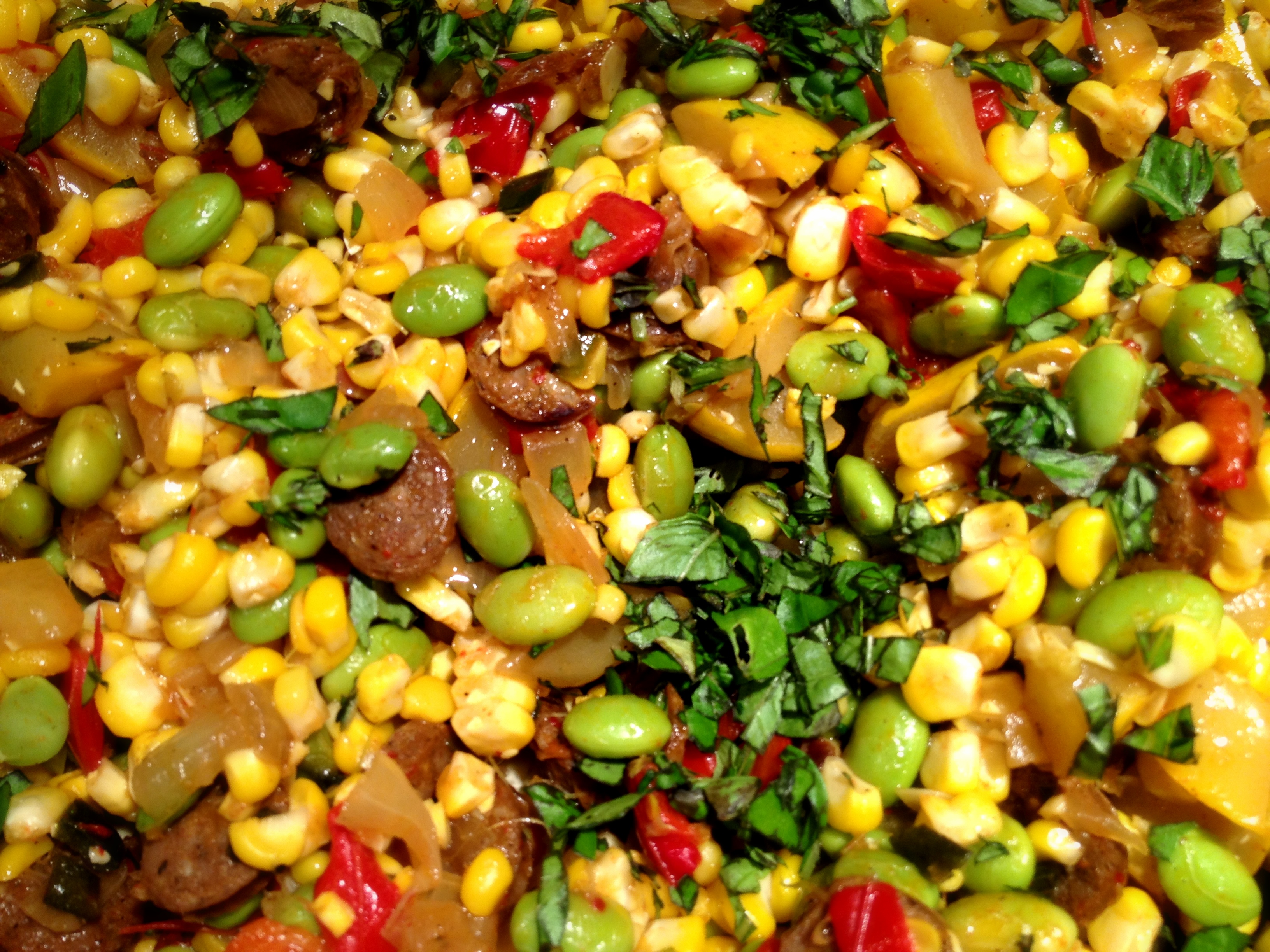
For the succotash, I browned some kosher Andouille sausage (yes, that exists—and it’s surprisingly good) in a little olive oil in cast iron skillet. I added onions, poblano pepper and red bell pepper. In time, I added the pattypan squash, some shelled edamame and fresh corn cut from the cob. Salt, pepper and basil went in just before serving.

Juliet carved the turkey, which we spread onto cookie sheets with some of the pan drippings and kept warm in a low oven until guests arrived.

I made a wild rice pilaf by sautéing leeks in olive oil, adding crushed red pepper and thyme. I toasted the wild rice in this mixture for a few minutes until each grain was coated and then added turkey stock. After 45 minutes or so of simmering, I pulled the rice off of the heat and added dried cranberries and crushed toasted hazelnuts.

I made a honey lemon dressing for the chicory, toasted hazelnut and roasted delicata squash salad by combining lemon juice, honey, shallots, olive oil, pepper and a little mayonnaise using an immersion blender. (Had this not been a kosher meal, I might have gone with buttermilk instead of mayonnaise.)

Guests began arriving at 6:15. By 6:30, we were an even dozen. Once the sun had set, Phil led us in blessings over the wine, over Juliet’s beautiful raisin-dotted challah, and over the apples and honey. Then we began eating. Things get a little blurry after that. There’s a mysterious alchemy to wine, a bounteous meal and interesting people. At these moments, I feel as though time has stopped and the only thing that exists is our table. It is a moment of pure joy.

Here’s to a sweet 5773!

Beach House Chicken Salad

Greetings from Rehoboth Beach, Delaware.

After a morning round of sunning, swimming and snoozing under the umbrella, I headed back to the house to see what I could dig up for lunch.  We’re at the tail end of a weeklong beach trip and have collectively agreed not to purchase any new groceries and instead focus on consuming what we have amassed.

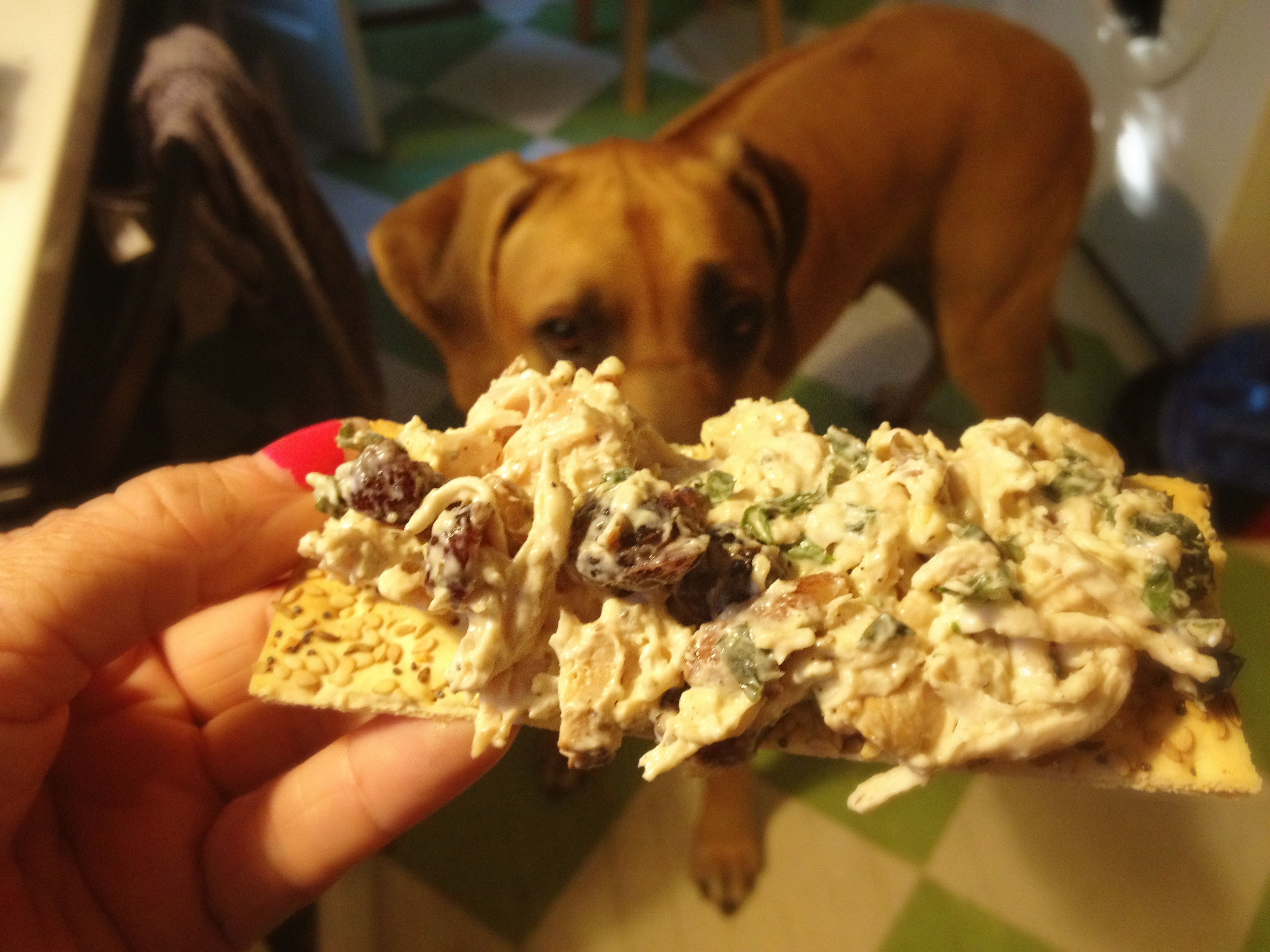
Beach House Chicken Salad

  1. You know that marinated chicken that you grilled but couldn’t finish because you were also serving kale salad and grilled okra, corn, and the leftover mushroom and green bean risotto stuffed into some zucchini and eggplant that were begging to get used?  Well grab yourself a nice glass of ice water and start picking that chicken.  Two large split breasts should be plenty.  (Someone might want the leftover drumsticks later tonight.)  Remove the skin, bones and any less desirable bits.  Tear the rest into small pieces.  
  2. Now open the fridge and assess the condiment stash left by previous renters.  Half a cup of mayonnaise and a quarter cup of Dijon mustard will do just fine.
  3. Check the crisper and see what farmers market bounty you’ve failed to consume.  While mojitos were a great idea, somehow you never got around to using that mint.  And, despite having been liberal with the grilled skirt steak and homemade pizzas of nights past, you’ve still got an awful lot of basil.  Mince your herbs while pondering whether or not to take a shower.  Convince yourself that the fine film of sand will protect you from UV rays.
  4. Get another glass of water (it’s hot out there) and assess the pantry items that are spilling across the washer and dryer.  Something crunchy and something sweet would be great.  Grab a handful of roasted almonds, stick them in a plastic baggie and crush them with an empty wine bottle.  (Plenty of those on hand).  No raisins but, lo and behold, there are dried cranberries which are EVEN BETTER.
  5. Mix it all around, taste and season as you see fit.  A little balsamic and some fresh-ground black pepper can work wonders.

Your housemates will sing your praises as they roll in from the beach.  They will enjoy it on top of the leftover kale salad, as a sandwich on some slightly stale French bread, rolled up in a tortilla with some fresh tomato and, yes, straight from the bowl.  You will enjoy it on a cracker after your second trip to the beach, still in your bathing suit, standing at the kitchen counter, Campari and soda in hand, while the house dog, Obie, gazes on longingly.

Living Room Picnic

Last night I was supposed to meet friends in Prospect Park for a screening of The Muppet Movie. Mother Nature had other plans. I’d been prepping for a picnic, but a blanket over the coffee table would have to suffice. On the menu: a Pressed Picnic Sandwich, Quick-Pickled Kale and Beets, Potato Chips (lifted from Thursday’s Prospect Park Alliance fundraiser) and a boatload of rosé.

Pressed Picnic Sandwich

This isn’t so much a recipe as a concept. The idea here is to layer a bunch of tasty ingredients in a logical order and then to press the sandwich with a weight.

I started with a round, day-old olive loaf from BKLYN Larder, but imagine you could use any rustic loaf with a nice crust. I sliced the loaf in half horizontally and scooped out most of the soft stuff with my hand, leaving about 1/2 inch all the way around. I then slathered the inside, top and bottom with a homemade tapenade (oil-cured black olives, anchovies, basil, garlic scapes, almonds, balsamic vinegar, Dijon mustard, capers, and whatever else was lurking in my fridge.). You could use prepared tapenade or pesto or even some herbed mayonnaise. The key is that you need a layer with some fat in it to prevent the bread from getting soggy.

I then added a layer of browned onions followed by strips of grilled summer squash. (I like to do this in a hot cast iron pan and then sprinkle the vegetables with smoked sea salt to give them the depth that comes from outdoor grilling). Next up was an Italian cow’s milk cheese. I’m blanking on the name, but it was creamy and a little tart, which provided a nice counterpoint to the sweetness of the veggies. Then layers of hot sopresatta, prosciutto and peppadew peppers.

I wrapped the sandwich in a couple of layers of aluminum foil and placed a cast iron grill pan over the top. Periodically, I would flip the sandwich and apply pressure to the pan until the sandwich looked like a UFO. I would guess that you want this to sit for at least an hour. (Had we been successful in dining outdoors, I would have stuck the sandwich in the bottom of the picnic basket, allowing the weight of the other items to do the pressing.)

As you can see, it sliced beautifully.

Quick-Pickled Kale and Beets

  • ½ cup apple cider vinegar
  • 3 Tbsp sugar
  • 3 garlic cloves
  • 2-3 Tbsp combined of whole pickling spices (such as coriander, fennel, allspice, cloves, cumin, fennel, peppercorns, cinnamon stick, bay leaf, mustard seed, etc.)
  • 1 pinch red pepper flakes
  • 1 thinly sliced red onion
  • 4 large beets
  • Small bunch kale including stems, roughly chopped

Combine all but the last two ingredients along with ½ cup of water in a small saucepan, bring to a boil, reduce heat to low and let simmer for 20-30 minutes to give the spices a change to release their flavor into the brine. In a separate pot, add the beets, cover with water, bring to a boil and cook until they give when pierced with a fork (approximately 30 minutes). Pull the beets out and add the kale, starting with the stem pieces. Let this boil for a few minutes and then drain. When beets have cooled, peel and slice them. Combine beets, kale and brine in a jar or plastic container and let sit for at least one hour, making sure to stir if the brine doesn’t fully cover the vegetables.

The living room picnic continued with a trip to the wine shop for reinforcements, a Barbie styling session and fresh nectarines and rum over salted caramel ice cream. Regrettably, it did not conclude with any efforts to clean up.

Nothing Bacon Can’t Cure

Last night, I headed over to the boathouse for the Prospect Park Alliance Junior Committee’s Summer Soiree. I throw a lot of fundraisers for work, so it is truly a treat to be a guest.

Image

No dinner and a few hours of open bar later, I found myself getting cozy with a bare air mattress in my friends’ living room. (They offered sheets, but that would have necessitated me getting up.) This morning I walked the hot and humid mile home in pajama pants, my dress bulging out of my gift bag.

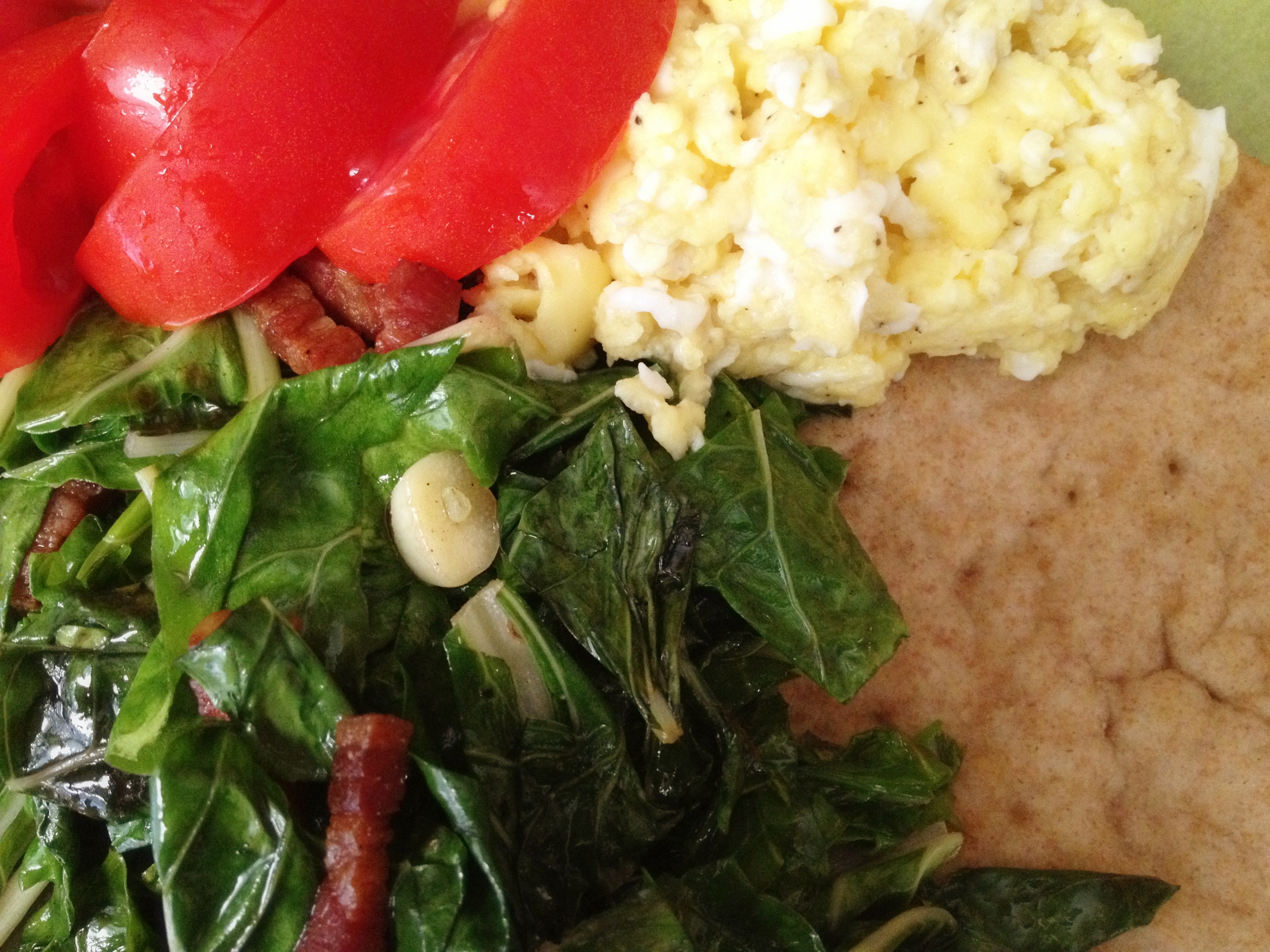
I knew I had some nice slab bacon and CSA veggies at home, so I swung by the grocery store for eggs. I sliced about half an ounce of bacon into lardon and rendered these in a cast iron skillet over medium heat. I added a few big chunks of garlic and toasted these in the bacon fat. I coarsely chopped a bunch of chard and sautéed it in the pan before adding salt and pepper. I slid the wilted greens to the side and toasted half of a whole wheat flatbread right in the skillet. I made some scrambled eggs in another pot and threw it all together, adding half of a very ripe tomato.

This plus a latte and I was good to go.

Image